Beyond Browser Lockdowns: Stopping GenAI Interview Fraud
Legacy browser lockdowns can't catch invisible AI overlays. See how Mockwin secures interviews with 360° dual-camera proctoring, speech pattern AI & human-in-the-loop review.
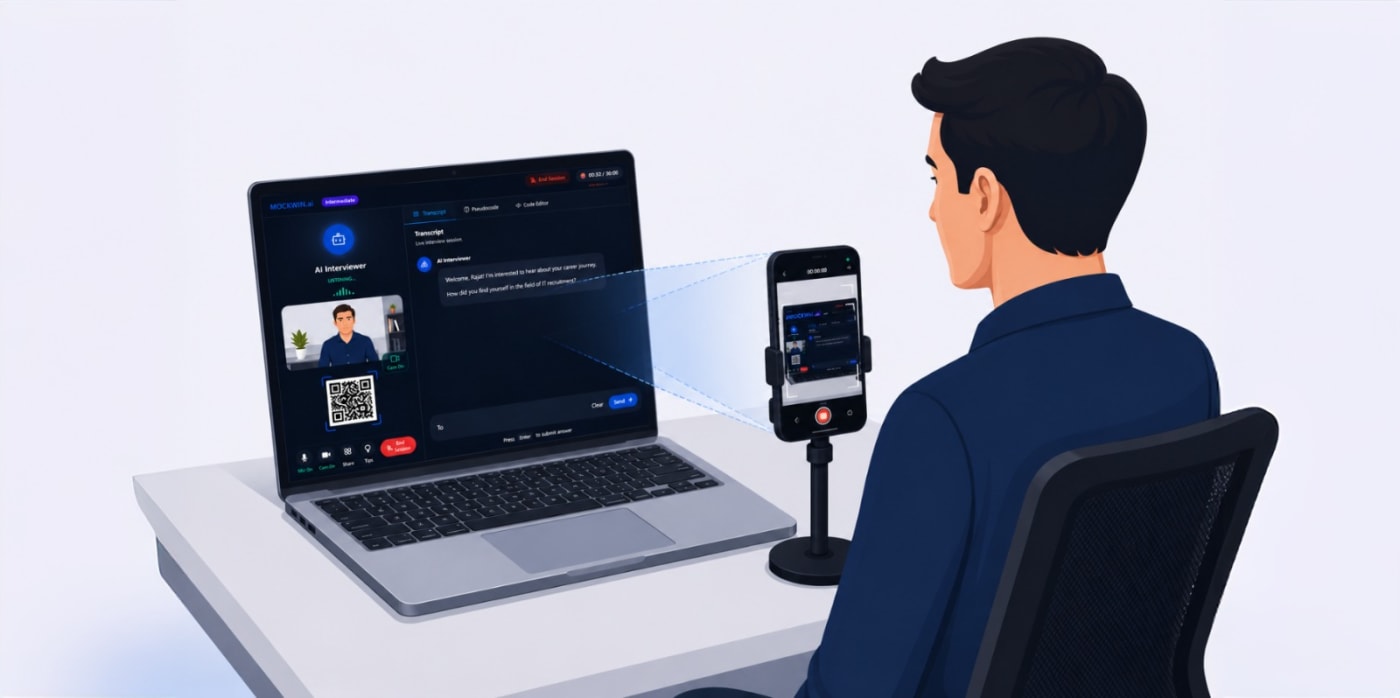
How Mockwin Secures the Modern Interview Against GenAI Fraud
Quick Summary
Browser lockdowns and tab-tracking were built for yesterday's cheating. Today's candidates use invisible, OS-level GenAI overlays that read interview questions off the screen and never trigger a single alert. Mockwin.ai closes that gap with 360° dual-camera proctoring, language style pattern analysis, and a privacy-first, human-in-the-loop review workflow securing hiring pipelines without turning every interview into a surveillance exercise.
On This Page
The landscape of talent acquisition has gone through a seismic shift. A few years ago, candidate fraud meant a padded resume or a rehearsed answer to a common behavioral question. Today, hiring teams are up against a technologically armed applicant pool that treats the interview itself as a system to be reverse-engineered.
Enterprises running technical hiring pipelines at scale are the ones feeling it first, but the problem is no longer confined to engineering roles. We've entered the era of real-time generative AI, deepfake proxy interviews, and cheating vectors specifically engineered to be invisible to the tools recruiters already trust.
The "Invisible" Crisis in Hiring
Recent analysis of live technical interview pipelines paints a stark picture of how normalized AI-assisted cheating has become. This isn't a fringe problem limited to a handful of bad actors it's now a structural feature of remote hiring.
What's changed isn't just the volume of cheating it's the mechanism. Candidates are no longer Googling answers in a second tab. They're running dedicated, purpose-built assistants that operate silently underneath the interview window itself, a shift we unpack in our interview feedback and evaluation resources.
Why Traditional Proctoring Is Dead
Early remote proctoring relied on relatively simple mechanics: lock down the browser, track the mouse, and flag the candidate the moment they switch tabs to search Google. That model assumed the cheating tool needed to live inside the browser. It doesn't anymore.
Invisible Overlays
A new wave of dedicated cheating assistants operate silently at the operating system level. Using low-level graphics hooks and real-time optical character recognition, these tools read interview questions directly off the screen, query a large language model, and project a transparent, scrolling script of answers over the candidate's active window.
Zero Focus-Loss
Because the candidate never loses active window focus, legacy applicant tracking systems and standard proctoring platforms register zero violations. The candidate simply reads the script, presenting a flawless but entirely fabricated illusion of technical expertise.
Deepfake Bait-and-Switch
The explosion of deepfake proxy interviews where the face and voice on screen belong to someone other than the applicant means identity itself can no longer be assumed from a webcam feed alone.
Laptop Farm Operations
Coordinated setups where a single operator manages multiple candidate identities across devices push fraud further upstream, well beyond what a single-camera, browser-locked interview can ever catch.
Building a digital wall around a web browser is no longer enough. Any defense that only watches the tab a candidate is looking at is, by design, blind to a threat that never touches that tab.
The Compliance and Candidate Experience Dilemma
Compounding the technological failure of legacy systems is the human cost. Traditional algorithmic proctoring frequently relies on rigid baselines of "normal" behavior. A neurodivergent candidate who fidgets, or a parent taking an interview with ambient background noise, can get flagged as suspicious by a system that was never trained to tell the difference between anxiety and dishonesty.
This creates a stressful environment of surveillance anxiety that alienates strong candidates before they've even had a fair shot a real cost explored further in our guide to candidate engagement. It also raises compliance red flags under regulation that increasingly treats automated hiring decisions as high-risk by default.
⚠️ The Regulatory Backdrop
A sweeping EU-wide AI regulation framework now classifies most AI systems used in recruitment and candidate evaluation as high-risk, triggering mandatory human oversight, bias documentation, and transparency obligations. In the United States, a growing patchwork of city and state rules including a well-known local law governing automated employment decision tools requires bias audits and clear disclosure whenever an automated tool substantially influences a hiring decision. Black-box, fully automated rejections are becoming a genuine legal liability, not just a candidate-experience problem.
For enterprise teams managing hiring at volume whether that's mass hiring, campus hiring, or distributed remote interviewing this dilemma is unavoidable: detect fraud aggressively enough to protect hiring quality, without building a system so invasive or so biased that it drives away exactly the talent you're trying to hire.
Enter Mockwin.ai: Securing the Modern Interview
At Mockwin.ai, we start from a simple premise: fighting modern GenAI with browser-locking tools is like bringing a knife to a laser fight. Securing the modern talent pipeline means stepping outside the browser entirely and analyzing the holistic interview environment. Here's how our AI-powered interview platform neutralizes the GenAI threat while protecting the candidate experience.
See the physical screen, not just the shared window
The most effective way to defeat an invisible screen overlay is to look at the physical screen itself. Candidates scan a QR code with their smartphone, turning it into a secondary, secure proctoring camera placed on their desk. This provides a wide-angle view of the laptop screen, keyboard, and hands, so any hidden overlay, split-screen setup, or secondary device becomes immediately visible. Co-opting the candidate's phone as the camera also removes the primary tool used for covert cheating in the first place a core part of our approach to candidate authentication and proctoring.
Listen for the teleprompter cadence
When a candidate is reading a transparent, AI-generated script, they don't sound like someone thinking through a complex problem they sound like a news anchor reading a teleprompter. Mockwin's AI models a candidate's natural speech baseline during the opening minutes of the interview, then continuously monitors for mechanical pacing, unnatural reading rhythms, and sudden vocabulary shifts: the definitive fingerprints of a hidden script. This is the same behavioral engine behind our adaptive AI mock interviewer.
Keep a human in the loop, always
Mockwin operates entirely in the browser, without invasive kernel-level downloads. Our AI acts as an analytical engine, evaluating multimodal signals to flag timestamped anomalies nothing more. Those flags are reviewed by your hiring team before any decision is made. This human-in-the-loop workflow mitigates algorithmic bias, reduces false positives, and keeps hiring decisions defensible under evolving global regulation.
✅ Built for Enterprise Hiring Operations
Whether you're running structured technical loops, high-volume campus drives, or an outsourced RPO hiring engagement, Mockwin plugs into your existing hiring operations platform without adding friction for genuine candidates.
| Threat Vector | Legacy Browser Lockdown | Mockwin.ai Approach |
|---|---|---|
| Invisible OS-level LLM overlay | No visibility tool never touches the browser | Caught via dual-camera view of the physical screen |
| Reading a scripted answer aloud | Not monitored | Flagged via language style pattern analysis |
| Deepfake or proxy candidate | Single webcam, easy to spoof | Secondary device view adds an authentication layer |
| Neurodivergent or nervous behavior | Often auto-flagged as suspicious | Reviewed by a human before any decision is made |
| Regulatory transparency | Black-box scoring | Human-in-the-loop, auditable flags |
The same integrity layer extends across our role-specific interview practice, resume-based interview practice, and Challenge Mode experiences, so the same standard of integrity applies whether a candidate is preparing on their own or sitting a live enterprise round via our real-time AI interview engine or Chrome extension.
Frequently Asked Questions
Does dual-camera proctoring require candidates to install anything?
No. Candidates scan a QR code with their phone's existing camera to link it as a secondary view. There's no app install and no kernel-level software on either device.
Can language style pattern analysis produce false positives?
Any behavioral signal can. That's why Mockwin treats every flag as a starting point for human review rather than an automatic rejection, which is core to how we approach AI interview assistance generally.
How does this help with EU AI Act or NYC-style compliance?
By keeping a human in the loop and logging timestamped, explainable flags instead of fully automated rejections, Mockwin's workflow is designed to align with the transparency and human-oversight expectations found in emerging automated-hiring regulation.
Is this only useful for technical hiring?
Technical roles see the highest cheating rates, but the same invisible-overlay and proxy-interview risks apply across sales, support, and other high-volume remote hiring functions.
Conclusion: Stop Interviewing the AI
You cannot build an impenetrable digital fortress against generative AI using last decade's tools. It's time to move beyond security theater. By combining 360° environmental visibility with advanced behavioral telemetry, Mockwin.ai lets enterprise hiring teams confidently identify genuine talent, protect their engineering culture, and hire with integrity intact.
Learn more about the philosophy behind our approach on why teams choose Mockwin, or explore Mockwin for Enterprise and pricing to see how it fits your hiring stack.
Stop Interviewing the AI. Start Interviewing the Candidate.
See how 360° proctoring, behavioral analysis, and human-reviewed flags work together to secure your hiring pipeline against GenAI fraud.