Interview Preparation: The Complete Guide to Cracking Any Job Interview
Interview preparation is not about memorizing answers, it's about mastering structured thinking, delivering quantified impact, and performing with clarity under pressure in any interview environment.

Why Candidates Fail: Moving From Passive Reading to Active Simulation
Effective interview preparation is a strategic process of aligning your skills with a company’s needs, structuring answers using proven behavioral frameworks, and practicing under realistic pressure to ensure peak performance.
Most candidates fail not because they lack ability but because they lack a system.
Modern hiring has evolved. To get hired today, you must navigate:
- AI Screeners: Automated systems analyzing your keywords and pacing.
- Behavioral Scoring: Structured evaluations of your soft skills.
- Technical Drill-Downs: Rounds designed to test the depth of your knowledge.
- “Bar Raiser” Stress Testing: High-pressure questions to test resilience.
To succeed, you must move from passive reading to active simulation. This guide covers the complete ecosystem of interview success from decoding job descriptions to mastering the STAR method and preparing for AI-driven interviews.
Interview preparation is the structured process of researching a role, aligning your experience with employer expectations, practicing behavioral and technical responses, and simulating real interview conditions to maximize performance.
TL;DR / At-a-Glance Summary
Definition:
Interview preparation is researching the role, structuring STAR answers, and practicing under realistic conditions.
The Goal: Demonstrate clear thinking, quantified impact, and adaptability.
The Challenge: Modern hiring includes AI screeners and deep-dive “Bar Raiser” questioning.
The Solution: AI mock interview tools improve structure, pacing, and confidence through measurable feedback.
What Is Interview Preparation?
Interview preparation is the strategic alignment of your experience with a company’s expectations, reinforced through structured practice and real-world simulation.
It is not memorization. It is Cognitive Readiness the ability to adapt your stories to unexpected questions in real time. True preparation stands on three pillars:
- Research: Understanding business pain points, not just reading the “About Us” page.
- Structure: Using frameworks like the STAR method to prevent rambling.
- Simulation: Practicing under realistic conditions to mimic actual interview pressure.
Why Most Candidates Fail (The Passive Trap)
Most candidates approach interview preparation passively. They read blog posts, memorize sample answers, and practice casually. This creates an illusion of readiness.
The top 1% of candidates treat interviews like a skill that must be trained. They simulate interviews repeatedly, track metrics like Words Per Minute (WPM), and refine their delivery.

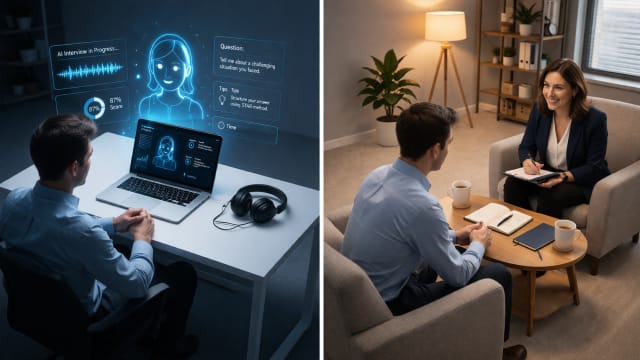
The Difference Between Traditional Prep and AI-Enhanced Simulation :
| Feature | Traditional Prep | AI-Enhanced Simulation |
|---|---|---|
| Practice Method | Mirror / friend | AI mock interview with real-time feedback |
| Feedback | “You sounded good” | “You missed the Result in STAR” |
| Metrics | None | WPM, filler words, structure score |
| Environment | Low stress | Bar Raiser persona (high stress) |
| Outcome | False confidence | Performance readiness |
The goal is not comfort. The goal is readiness.
Interview Preparation for Freshers vs Experienced Candidates
Interview preparation varies significantly between freshers and experienced professionals because expectations differ. While freshers are evaluated on potential, clarity, and learning ability, experienced candidates are assessed on impact, leadership, and execution depth.
For Freshers
For freshers, interview preparation should focus on demonstrating potential, structured thinking, and strong communication rather than extensive work experience. Since professional exposure may be limited, clearly explaining academic projects, internships, and learning outcomes becomes critical. Recruiters assess how logically you think, how confidently you communicate, and how effectively you structure your responses.
Key focus areas include:
- Focus on projects: Highlight academic projects, internships, certifications, or practical assignments that demonstrate applied skills.
- Academic examples: Use coursework or real project scenarios to showcase problem-solving ability and initiative.
- Communication clarity: Speak clearly, avoid filler words, and explain concepts in a simple and structured manner.
- Structured answers: Use frameworks like the STAR method to ensure responses are logical, concise, and complete.
For Experienced Candidates
For experienced professionals, interview preparation must go beyond listing responsibilities and focus on measurable results and strategic contribution. Employers expect clear evidence of business impact, leadership capability, and the ability to handle complex decision-making under pressure. Evaluation shifts from knowledge alone to ownership, influence, and depth.
Key focus areas include:
- Quantified impact: Highlight measurable outcomes such as revenue growth, cost savings, performance improvements, or efficiency gains.
- Leadership examples: Demonstrate ownership, team coordination, mentoring, or initiative in driving projects forward.
- Stakeholder management: Show experience in cross-functional collaboration, client communication, or conflict resolution.
- Deep technical drill-down: Be prepared to defend architectural choices, technical trade-offs, and problem-solving approaches with clarity and depth.
Phase 1: Strategic Research & The Context Engine
Strategic interview preparation begins with carefully decoding the Job Description (JD). You cannot prepare for every specific question, but you can identify recurring themes and priority competencies.
The JD Decoder Framework
Look for signals in the job description to predict the interview questions:
- Mentions Python + API Design → Expect technical architecture questions.
- Mentions Stakeholder Management → Expect conflict resolution behavioral questions.
- Mentions Optimization / Performance → Expect measurable impact discussions.
- Mentions Leadership / Ownership → Expect deep behavioral probing.
The Pre-Interview Checklist
Before any interview, ensure you:
- Read the company’s last 3 press releases.
- Identify cultural values (e.g., Do they value Speed vs. Precision?).
- Align your stories to those values.
- Ensure your LinkedIn profile matches your resume to avoid credibility gaps.
Stop guessing what you’ll be asked. Upload your job description to Mockwin and simulate the exact interview scenario before the real round.
Phase 2: Mastering Behavioral Interview Questions (The STAR Method)
Behavioral interview questions are based on the principle that past behavior predicts future performance. Interviewers will ask you to describe a time you failed, managed conflict, or solved a problem.
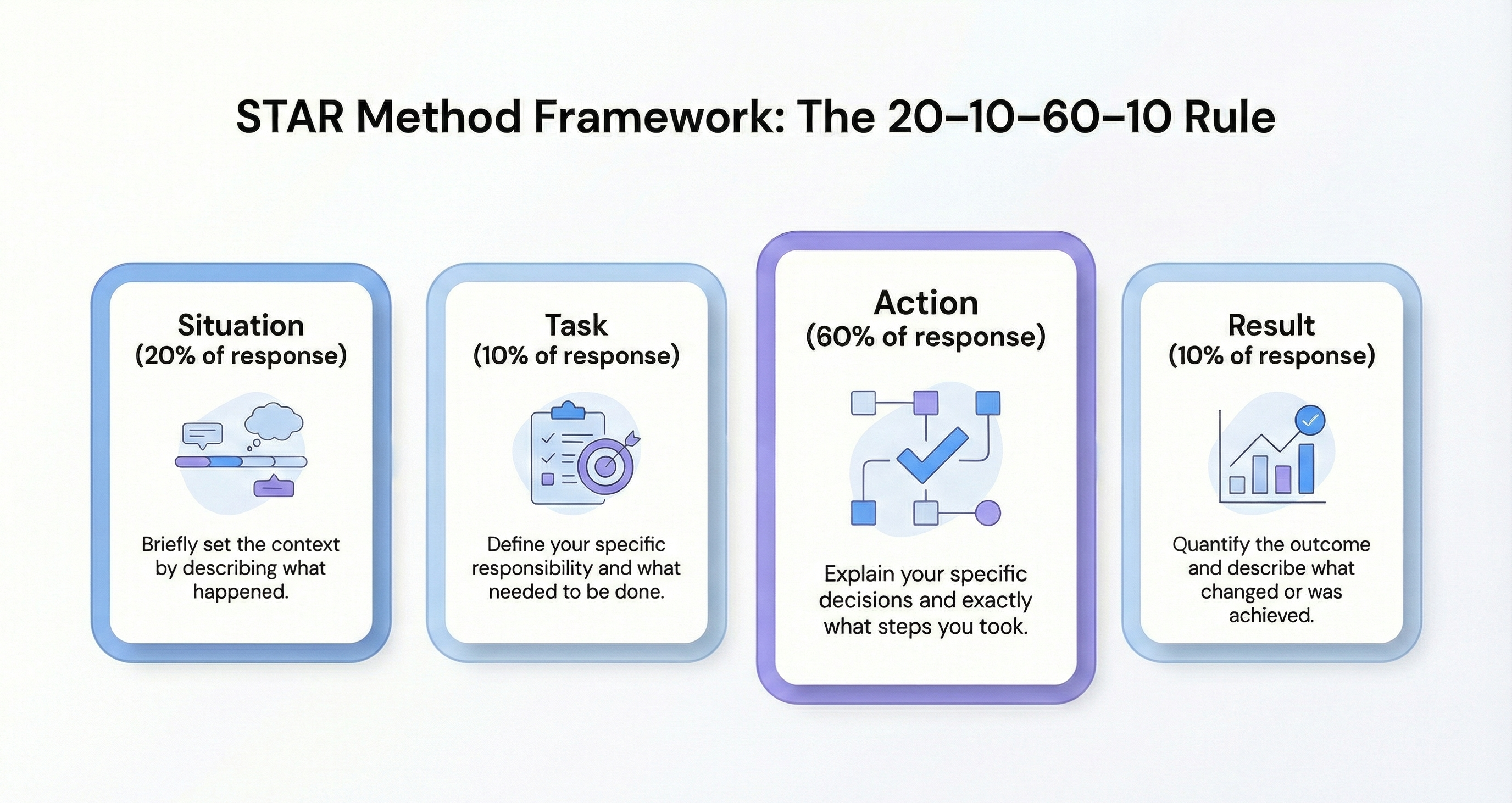
To answer these effectively, you must use the STAR Method (Situation, Task, Action, Result). It ensures clarity, completeness, and persuasive storytelling.
The Winning Formula: 20-10-60-10
To avoid rambling, allocate your time as follows:
- Situation (20%): Set context briefly.
Example: “Our database latency increased to 400ms during peak traffic.” - Task (10%): Define your responsibility.
Example: “I was responsible for improving performance without downtime.” - Action (60%): The most important section. Use “I,” not “We.”
Example: “I implemented read replicas and optimized SQL indexing strategy.” - Result (10%): Quantify the impact.
Example: “Latency reduced to 85ms, preventing revenue loss and improving UX.”
Mockwin’s STAR Detection Engine can analyze your spoken answers in real-time to flag if you miss the “Result” section before you walk into the real interview.
Phase 3: Technical Interview Preparation
Technical interview prep is not just about knowing the theory; it's about demonstrating structured problem-solving under time constraints. Interviewers evaluate how clearly you think and communicate.
How to Prepare:
- Master the fundamentals.
- Practice timed problems.
- Explain your thought process clearly (Think Aloud).
- Prepare for follow-up drill-down questions.
The "Bar Raiser" Standard
A “Bar Raiser” interviewer is tasked with stress-testing the depth of your knowledge. If you say you know a technology, they will drill down until you say "I don't know."
- You: “I used React.”
- Follow-up 1: “Why React over Vue?”
- Follow-up 2: “How does Virtual DOM optimize that state change?”
- Follow-up 3: “What breaks at scale?”
If you cannot defend your logic deeply, you are not fully prepared. Simulation builds depth.

How to Beat AI Video Screeners
Many first-round interviews are now conducted using AI-based screening systems before a human interviewer becomes involved. These AI systems evaluate more than just the content of your answers they may analyze whether you are using relevant keywords from the job description, assess your speaking pace to detect nervousness or hesitation, track filler words that reduce clarity, monitor eye contact through video analysis, and measure the overall structure and coherence of your responses. This means candidates must prepare not only what they say, but how they say it.
Performance Benchmarks
- Ideal pace: 130-150 Words Per Minute
- Avoid excessive filler words
- Maintain camera eye contact
- Keep answers between 90-120 seconds
AI mock interview simulation allows candidates to refine delivery before real screening.
Never use AI to generate answers live. Use it to practice beforehand.
How AI Interview Algorithms Score Candidates
AI interview algorithms evaluate candidates using multiple layers of automated analysis designed to replicate structured hiring criteria. These systems go beyond simple keyword matching and assess how clearly, confidently, and logically a candidate communicates their responses.
Key evaluation components include:
- NLP keyword detection: Natural Language Processing (NLP) scans your responses for relevant skills, tools, and terminology mentioned in the job description. Candidates who use accurate, role-specific language are more likely to receive higher relevance scores.
- Sentiment scoring: AI models analyze tone and emotional consistency to detect confidence, hesitation, or uncertainty. Balanced and professional sentiment tends to score better than overly negative or overly exaggerated responses.
- Structured response scoring: Algorithms evaluate whether answers follow logical patterns such as the STAR method. Structured responses with clear context, action steps, and measurable results typically rank higher than vague or rambling answers.
- Confidence metrics: Some systems assess delivery indicators such as speaking pace, filler words, pause frequency, and vocal stability. Consistent pacing and minimal filler language signal preparedness and clarity.
Understanding these scoring layers allows candidates to prepare strategically rather than guessing what the system evaluates.
Common Interview Mistakes to Avoid
Interview mistakes are behavioral errors that subtly undermine a candidate’s perceived authority and credibility during the conversation. These mistakes often include rambling answers, lack of structure, overusing filler words, avoiding eye contact, speaking negatively about past employers, or failing to clearly articulate personal contributions. Even when technical knowledge is strong, such behavioral missteps can weaken the overall impression and signal a lack of preparation or confidence to the interviewer.
| Mistake | Why It Hurts | The Fix |
|---|---|---|
| The “We” Trap | Hides your contribution | Use “I” statements |
| Rambling | Loses attention | Keep answers under 2 minutes |
| Fake Weakness | Sounds inauthentic | Share real weakness + improvement |
| No Questions | Signals disinterest | Ask strategic performance questions |
Preparation eliminates preventable errors.
Top 10 Interview Questions and How to Answer Them
- Tell me about yourself
- Why should we hire you?
- Describe a failure
- What is your biggest strength?
- Where do you see yourself in 5 years?
- Explain a technical challenge
- Why are you leaving your job?
- Describe a conflict
- What motivates you?
- Do you have questions for us?
AI Mock Interview vs Traditional Practice
Why are AI tools becoming the standard for interview prep? Traditional mock interviews (with friends or mirrors) rely on subjective opinions. AI simulation offers data.
Limitations of Traditional Practice:
- Lacks structured metrics (Did I speak too fast?).
- Lacks "interrupt tolerance" training.
- No drill-down logic to test depth.
Benefits of AI Mock Interview Platforms:
- Real-time scoring on clarity and structure.
- STAR method detection to ensure complete answers.
- Communication metrics (WPM, filler words).
- Persona-based simulation (e.g., High-pressure "Bar Raiser" modes).
By introducing objective measurement, AI mock interview platforms transform interview preparation from guesswork into measurable progress.

7-Day Interview Preparation Plan
- Day 1: JD analysis
- Day 2: Behavioral story drafting
- Day 3: STAR refinement
- Day 4: Technical practice
- Day 5: AI mock simulation
- Day 6: Drill-down simulation
- Day 7: Full mock interview + feedback
Conclusion
Interview preparation is not about memorizing scripts. It is about structured thinking, quantified storytelling, and real-time adaptability.
Companies hire candidates who stay clear under pressure. Training the way interviews are actually evaluated through realistic simulation and AI-driven feedback significantly improves your selection probability.
Mockwin.ai helps you practice under real interview conditions, refine your STAR responses, and prepare for AI screeners and drill-down rounds.
Stop rehearsing in comfort. Start preparing in reality.
Platforms like Mockwin help candidates simulate structured evaluation environments with real-time feedback, aligning preparation with how companies actually assess talent.
FAQs
How long should interview preparation take?
Ideally, you should spend 5-7 days on structured preparation. This includes research, refining your behavioral stories, and 2-3 days of mock interview simulation.
How long should “Tell Me About Yourself” be?
Keep it between 30-60 seconds. Structure it as: Past (Experience) → Present (Current Role) → Future (Why you are a fit for this role).
How can I practice interview questions alone?
Use an AI mock interview simulator. These tools provide the real-time feedback and performance metrics you can't get from a mirror or a recording.
What are the best behavioral interview questions to prepare for?
Focus on the "Big 5" themes: Leadership, Failure, Conflict Resolution, Teamwork, and Problem-Solving.
How do I prepare for a technical interview?
Focus on fundamentals rather than memorizing syntax. Practice explaining your thought process out loud and prepare for deep-dive questions on your specific tech stack.