How AI Analyzes Your Interview Answers
A comprehensive guide on the technology behind AI interviews, covering NLP, communication scoring, and how to use AI-powered feedback to improve your performance.

How AI Analyzes Your Interview Answers: The Ultimate Guide to Landing Your Dream Job
In today’s competitive job market, your first "handshake" might not be with a human, but with an algorithm. Top enterprises like Google, Microsoft, and Apple are increasingly using AI to replace or augment traditional interview formats. Understanding how these systems work is no longer optional it is a strategic necessity.
Did you know? AI-powered recruitment can cut screening time by up to 75%, allowing companies to identify top talent faster and more objectively than ever before.
1. What Does It Mean to Analyze an AI Interview?
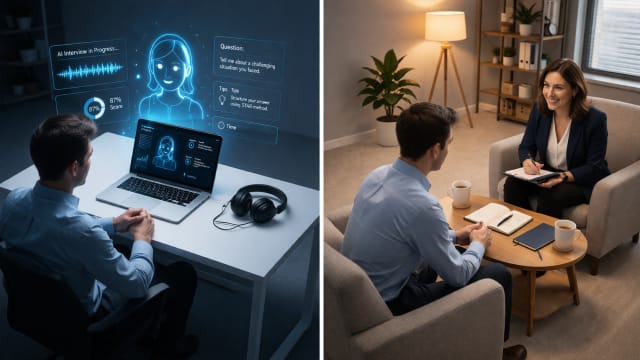
AI interview analysis uses technologies like Natural Language Processing (NLP) and Machine Learning to evaluate candidates systematically. Instead of relying on a recruiter's "gut feeling," these systems look at hundreds of data points across your voice, facial expressions, and vocabulary. Whether it is a real-time chatbot or a one-way video recording, the AI is looking for patterns that signify a "high-performing" candidate.

2. How AI Analyzes Your Response Content and Quality
The substance of your answer is the most critical factor. AI systems don't just "hear" you; they evaluate the logical flow and organization of your points. The algorithm checks for relevance to the job description and whether you are providing "depth of reasoning" rather than generic, surface-level answers.
To ensure you are meeting these high standards, using a tool like AI Interview Performance Analysis can provide a complete breakdown of your answer quality across multiple practice sessions.
3. Decoding the STAR Method in AI Interview Analysis
AI favors structured responses. One of the most effective ways to score high is using the STAR method (Situation, Task, Action, Result).
- Situation/Task: The AI looks for the context and specific challenge you faced.
- Action: It identifies your specific steps and personal contribution.
- Result: It prioritizes data-driven outcomes, such as "increased sales by 20%".
Mockwin specifically offers STAR Method Interview Feedback, highlighting exactly where your structure might be "rambling" and how to refine it for maximum impact.
4. How AI Analyzes Your Communication and Verbal Cues
It’s not just what you say, but how you say it. AI evaluates Voice Clarity including your articulation, speech rhythm, and pace. Speaking too fast can signal anxiety, while too many pauses might suggest a lack of preparation. Modern analysis also flags filler words like "um" and "uh".
5. The Role of Body Language in AI Interview Feedback
In video-based interviews, AI utilizes computer vision to monitor your head posture, eye contact, and facial expressions:
| Metric | What the AI Looks For |
|---|---|
| Eye Contact | Looking directly at the camera to simulate professional engagement. |
| Micro-expressions | Detecting small facial changes that reveal confidence or stress. |
| Posture | Sitting up straight to signal authority and focus. |
6. How AI Analyzes Technical Interview Skill Depth
For technical roles, AI auto-evaluates coding quality, logic flow, and edge case handling. It measures your depth of knowledge by identifying industry-specific terminology. Mockwin’s Technical Interview Skill Assessment allows you to see a percentage-based score on your performance, ensuring you are ready for role-specific requirements.

7. Measuring Your Interview Confidence with AI
AI systems recognize emotional intelligence and resilience by analyzing tone and response time. If you find yourself losing your train of thought, practicing with Challenge Mode helps you identify "hesitation gaps," building the mental agility needed to handle curveball questions.
8. Interview Skill Gap Analysis: Mapping Responses to Job Roles
One of the most powerful features of AI is comparing responses against role-specific requirements. It identifies "missing skills" in your answers. Mockwin’s Skill Gap Analysis provides a targeted improvement roadmap, helping you raise your Job-Market Readiness Score.
9. Resume-Based Interview Feedback: Ensuring Consistency
AI often cross-checks your verbal answers against your uploaded resume. It looks for consistency in your claimed impact. Using Mockwin’s Resume-Based Practice, you can get a sharp AI-powered review that turns vague claims like "managed servers" into data-driven results like "reduced server downtime by 40%."
10. Final Readiness Assessment: Know Before You Go
The ultimate goal of AI analysis is to provide a Final Green Light. By combining data from your practice mocks, you can get a Comprehensive Readiness Score. Instead of guessing, go into your real interview knowing exactly where you stand.
Ready to Ace Your Interview?
Get instant, data-driven feedback on your performance today.
Get Feedback Now with MockwinFrequently Asked Questions
Does AI decide who gets hired?
No. In most enterprise settings, AI organizes information so human recruiters can review it more efficiently and fairly.
Can AI understand different accents?
Modern AI systems focus on intent and terminology. Engineers are constantly working to reduce bias related to cultural differences.
How do I score higher in an AI interview?
Focus on clarity, use the STAR method, look at the camera, and eliminate filler words.
Is practicing with AI actually helpful?
Yes. Research shows companies using AI-driven tools have seen a 40% improvement in candidate quality.
What if the AI flags me for being nervous?
AI signals like hesitation are usually designed to prompt a human review, not to automatically disqualify you.