SAP Hiring & Interview Integrity: Why Speed Isn't Enough
SAP hiring runs fast on AI screening, but can you trust the interview itself? See why testing candidates under pressure and verifying they're genuine both matter.
The Missing Layer in SAP Hiring: Why Interview Integrity Matters as Much as Interview Speed
TL;DR
SAP hiring has gotten faster AI screening and remote interviews have seen to that. What it hasn't necessarily gotten is more trustworthy. Static resumes can't show how a candidate thinks under pressure, and even a polished interview score can be coached, scripted, or faked. Solving SAP hiring today means solving both problems at once: testing candidates rigorously, and verifying that the person answering is who they say they are, doing their own thinking, in real time.
On this page
AI has made SAP hiring faster. Screening that used to take a recruiter days now happens in minutes. Interviews that used to require flying a candidate to a regional office now happen over video, on the candidate's own schedule, from anywhere in the world. By almost every operational measure, SAP recruitment has gotten more efficient.
But faster isn't the same as more trustworthy. And that gap is where a harder question starts to surface: can you actually trust the interview itself? Not the resume, not the recruiter's gut feeling the interview. The thing hiring managers still treat as the closest they get to "seeing" a candidate think.
For most roles, that question is uncomfortable but manageable. For SAP roles, it's existential. A mis-hired consultant doesn't just cost a bad quarter they can stall a business-critical S/4HANA migration, misconfigure a process that touches finance or supply chain, or quietly widen a skills gap that was already too wide to begin with.
The Current State of SAP Hiring
Remote interviews and AI-driven screening have let SAP hiring teams cover far more ground than a purely manual process ever could. That's genuinely useful in a market where finding the right person is the hard part, not scheduling the call.
And the market is hard. SAP roles sit on business-critical systems ERP, finance, supply chain, HR where a configuration mistake doesn't stay contained to one team. At the same time, demand keeps climbing while qualified supply doesn't keep up.
Layer cost pressure on top of that. Every hiring round carries real spend sourcing, recruiter time, technical assessments, interview panels. A resume-only or lightly-screened process might move fast, but it tells you almost nothing about how a candidate reasons through an incident, handles a scope disagreement, or reacts when a stakeholder pushes back mid-project. Speed without depth just gets you to a bad decision faster.
Two Problems, Not One
Most conversations about "fixing" SAP hiring focus on a single lever usually speed, or coverage. But there are actually two separate problems sitting underneath the surface, and solving only one leaves the other quietly undermining every hire you make.
Problem A: The resume tells you almost nothing
A static resume or a resume-based screen can confirm someone has worked on S/4HANA before. It can't show you how they think under pressure, how they handle ambiguity, or whether they'd hold their ground on a risky implementation decision.
Problem B: A good score doesn't mean a genuine one
A strong interview transcript can be the product of real skill or of AI-generated answers, a coached stand-in, or a scripted response memorized in advance. On paper, both look identical.
These aren't two separate fires to put out one at a time. They're two sides of the same coin: you need confidence the process finds the right signal, and confidence that signal is real. A brilliant assessment framework built on top of an unverified interview is still built on sand.
That single data point should reframe how any hiring team thinks about interview scores. A 9-out-of-10 rating isn't useful information if you can't also answer: was that actually the candidate, thinking in real time?
What "Testing Under Pressure" Looks Like
Solving Problem A means moving past scripted, one-shot questions and building an interview that behaves the way a real SAP project does unpredictable, layered, and unforgiving of shallow answers.
Adaptive drill-down questioning
Instead of moving to the next scripted question after a vague answer, an adaptive AI interviewer pushes deeper up to three levels down the same way a skeptical technical lead would when a candidate's explanation doesn't quite hold up.
Persona calibration
A junior support-desk candidate and a senior SAP architect shouldn't face the same tone. Dialing the interviewer's persona from a friendly HR-style conversation up to a demanding "Bar Raiser" mode mirrored in challenge mode matches interview pressure to the actual stakes of the role.
Custom, branded knowledge bases
Generic SAP questions miss what actually matters to your organization. Interviews built against your own standards S/4HANA migration approach, Clean Core principles, SAP BTP conventions surface whether a candidate can operate inside your environment, not a textbook one, and can be tailored across role-specific interview tracks.
What "Verifying the Interview Is Genuine" Looks Like (360° Proctoring)
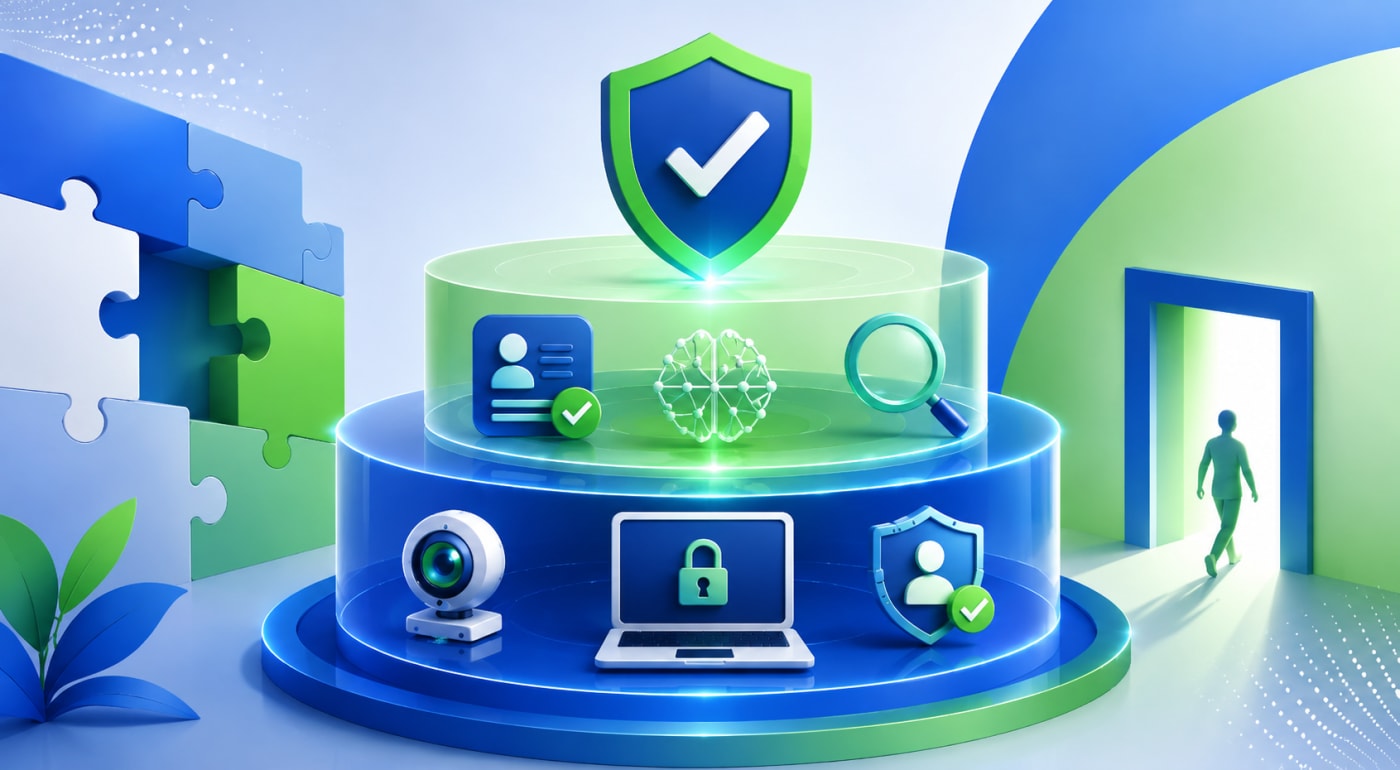
Solving Problem B means treating the interview itself as something that needs to be verified, not just scored. That's the job of continuous, 360° candidate authentication and proctoring not a single identity check at login, but ongoing verification for the full length of the interview.
That last point matters more than it might seem. Human reviewers watching a recorded interview are not reliably good at spotting synthetic or coached behavior on their own independent research on deepfake detection has found accuracy barely better than a coin flip when people try to judge authenticity by eye alone. Integrity checks can't be a "does this feel off?" judgment call. They need to be systematic, and they need to run for the whole interview, not just the first thirty seconds.
⚠️ Why this isn't optional anymore
A meaningful share of hiring teams report having unknowingly brought on a fraudulent candidate, and detection tooling still isn't standard practice across the industry. For SAP roles where access to core business systems is part of the job on day one that gap is a direct operational risk, not just a hiring inconvenience.
From Raw Signals to Decisions
Testing under pressure and verifying authenticity both generate a lot of raw signal. On their own, none of it is useful to a hiring manager who needs to make a decision by Friday. The last mile is turning that signal into something a human can act on with confidence.
| Signal | What it captures |
|---|---|
| STAR-framework detection | Flags whether an answer is actually structured (Situation, Task, Action, Result) or just sounds confident. |
| Communication analytics | Pace, filler-word frequency, and vocal stability across the session patterns a transcript alone won't show. |
| Technical skill-gap analysis | Maps responses directly against job-description keywords to show where a candidate is strong and where they're guessing. |
| Leaderboards & badges | Standardized labels Recommended, High Potential, Mismatch so panels compare candidates on the same scale. |
| Full audit trail | Recordings, timestamped logs, and shareable report cards that hold up if a hiring decision is ever questioned later. |
This is the layer that turns proctoring data and interview depth into something usable: structured feedback a hiring panel can actually read, backed by evaluation software built to standardize decisions across dozens or hundreds of SAP candidates at once all sitting on top of a single hiring operations platform instead of scattered spreadsheets and recorded calls nobody has time to re-watch.
Why This Matters Specifically for SAP Roles
None of this is abstract for SAP hiring. The cost of getting a hire wrong on a business-critical implementation isn't a bad quarter for one team it's rework across finance, supply chain, and every process that touches the system. And with the ongoing SAP talent shortage, teams are already under pressure to move fast, which is exactly the condition under which shortcuts around verification start to look tempting.
📊 The stakes, in one line
A single fraudulent or badly-vetted hire in a role with system access can carry direct financial exposure well beyond typical bad-hire costs research on hiring fraud puts the fallout from a single serious incident in the hundreds of thousands, before legal and remediation costs are even counted.
That's why the more useful industry question isn't "can AI conduct SAP interviews?" that's largely solved, and has been for a while through platforms built for AI-powered interviewing at scale. The sharper question, especially for high-volume and RPO-driven SAP hiring programs, is: can you verify the interview is genuine? That's the layer that decides whether everything upstream the adaptive questioning, the persona calibration, the scoring is actually measuring the candidate in front of you, or a well-rehearsed performance.
FAQs
Does continuous proctoring slow down the candidate experience?
No verification runs in the background throughout the interview rather than as a separate step, so it doesn't add extra time for the candidate or the hiring team.
Is 360° proctoring only useful for detecting fraud?
Detection is one output, but the bigger value is confidence: hiring managers can trust the report card in front of them without needing to re-watch every recording themselves.
How is this different from a standard video interview tool?
Standard video tools record the interview. An integrity-first approach verifies identity continuously, adapts question difficulty in real time, and turns the result into a structured, auditable decision not just a video file.
Can this be customized for different SAP modules or seniority levels?
Yes knowledge bases and persona intensity (from HR-style to Bar Raiser mode) can be calibrated per role, module, and seniority level rather than using one generic interview for every SAP opening.
Closing Thoughts
The strongest hiring decisions don't rest on a fast process or a high score alone. They rest on confidence that the evaluation in front of you actually reflects the real candidate how they think, how they hold up under pressure, and whether the person on screen is who they say they are. For SAP hiring specifically, where the cost of getting it wrong is measured in stalled implementations and system risk, that confidence isn't a nice-to-have. It's the layer that was missing.
As remote hiring keeps growing, it's worth asking honestly: how is your team protecting interview integrity today and would your current process catch it if it wasn't there at all?
Hire SAP Talent You Can Actually Trust
Adaptive interviews that test real thinking, backed by 360° proctoring that verifies every answer is genuine.