Cost Per Hire in 2026: How the Direct Invitation System Cuts Recruitment Costs
Cost per hire (CPH) is the total internal and external cost of filling a role divided by the total number of hires made-and in 2026, it is rising sharply despite a cooler labor market.
Introduction
The macroeconomic landscape of 2026 has introduced a profound paradox within talent acquisition. While overall hiring demand has softened and application volumes per role have surged, the financial cost required to acquire human capital keeps climbing. Traditional economic models dictate that an increased supply of candidates should drive down acquisition costs. In 2026, however, aggressive monetization strategies by incumbent job boards, programmatic ad inflation, and the complexity of specialized roles have severed that historical correlation.
The deeper issue is that most enterprise organizations undercount their true CPH by roughly 30% to 40%. Opaque surface-level calculations frequently omit interview panel hours, scheduling latency, and internal coordination overhead. Visible hard costs-such as job board invoices, background checks, and third-party vendor fees-represent merely 30% to 40% of the financial picture. The remaining 60% to 70% constitutes hidden recruitment inefficiencies and hiring funnel leakage. This structural drain includes recruiter bandwidth lost to manual coordination, candidates dropping out mid-funnel, severe cost-of-vacancy penalties, and the catastrophic organizational expense of a mis-hire.
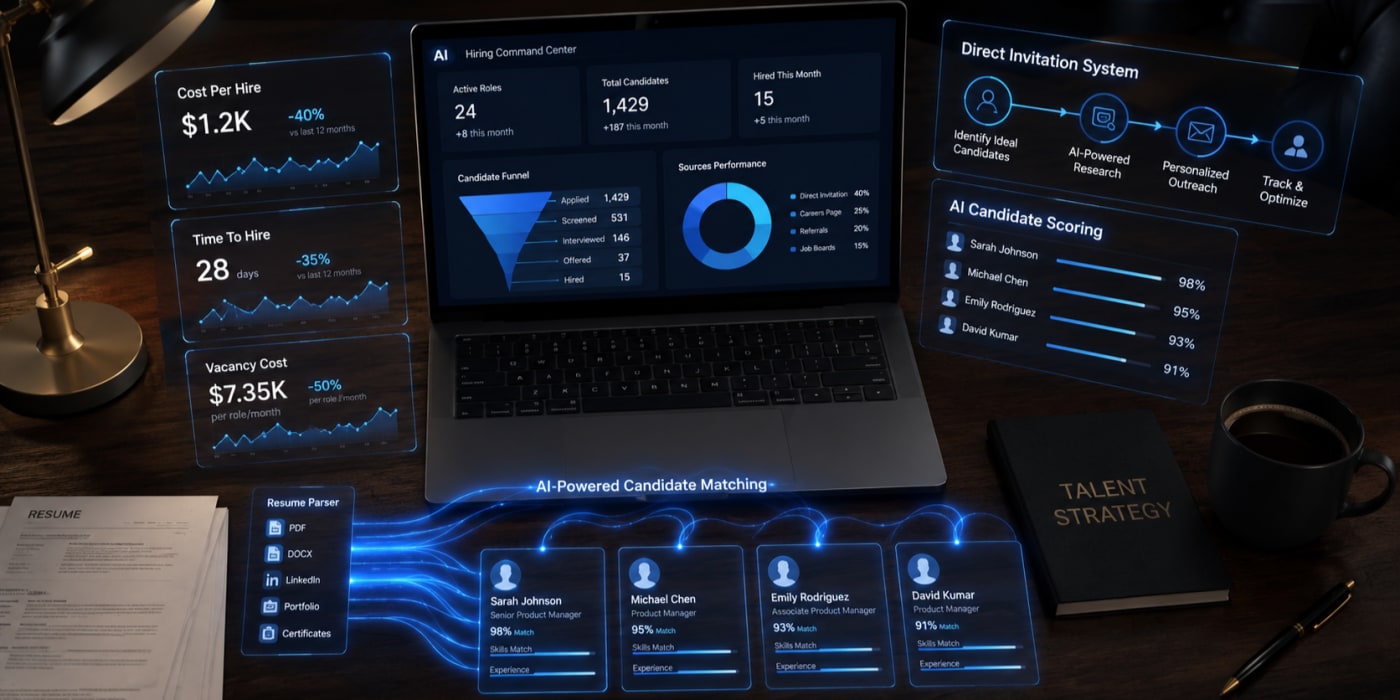
To combat this margin compression, forward-thinking talent acquisition teams, Managed Service Providers (MSPs), and Global Capability Centers (GCCs) are abandoning passive workflows. Instead, they are implementing a Direct Invitation System (DIS)-an active, AI-driven routing framework that bypasses manual administrative bottlenecks and funnels pre-identified candidates straight into structured, objective, asynchronous screening.
At-a-Glance Summary
- The 2026 Paradox: Market demand has cooled, yet recruitment costs have surged due to shifting job-board ad pricing and specialized role complexity.
- The Hard Benchmarks: US non-executive CPH has reached $5,475, executive CPH has climbed to $35,879, and traditional skilled roles take an average of 52 days to fill.
- The Controllable Drain: Third-party agency fees (15–25% of first-year salary) and the Cost of Vacancy (~$500/day) represent the largest addressable financial leaks.
- The Direct Invitation Mechanism: By proactively inviting targeted talent into automated, async screens, organizations eliminate external staffing dependency, reduce recruiter coordination tasks, and compress time-to-hire from weeks to days.
- Quantifiable Bottom-Line Impact: Removing a manual interview bottleneck saves an average of $440 per hire in panel labor, enabling high-volume programs to yield measurable ROI within the first quarter.
What Is Cost Per Hire?
As standardized by the ANSI/SHRM guidelines (SHRM-06001.2012), cost per hire measures the mean cost of putting one person into one seat up to their first day of work. It isolates capital efficiency before post-hire salary and training costs are absorbed.
- External Costs: Contingency/retained agency commissions, RPO fees, job board postings, programmatic advertising spend, background verification (BGV) checks, and candidate assessment licenses.
- Internal Costs: Fully loaded recruiter salaries prorated by time, coordinator administrative hours, internal employee referral bonuses, and the estimated monetary value of hiring-manager and interview-panel time.
- Tooling Allocations: Prorated Applicant Tracking System (ATS), Candidate Relationship Management (CRM), and sourcing-tool infrastructure subscriptions.
Because a single blended average obscures critical operational realities, CPH should always be segmented by seniority level, industry vertical, and sourcing channel.
Why Is Cost Per Hire Rising in 2026?
According to the SHRM 2025 Benchmarking Survey, the baseline US non-executive average CPH reached $5,475, while executive hires surged to $35,879-representing a 113% inflation spike for executive acquisition since 2017.
│
▼
[Direct Invitation System: Magic Link] ──> [Pre-vetted Pipeline] ──> [Automated Scorecards]
This escalation is not driven by a scarcity of applicants, but by programmatic recruitment marketing costs. Across recent cycles, median cost-per-click (CPC) pricing spiked over 27% to roughly $1.00, and cost-per-application (CPA) rose to a median of $16.87, causing recruitment ad spend to rise sharply even in a softer employment market.
Concurrently, regional and functional variations heavily tilt the scales. While India’s baseline CPH remains lower (commonly averaging ₹25,000 to ₹50,000, drawing heavy GCC investment), localized talent wars in high-growth hubs like Bengaluru demand an 18% to 25% cost and salary premium for specialized engineering and machine learning talent.
The Core Cost Drivers in Modern Recruitment
Understanding where the financial leakage occurs is the first step toward neutralizing it. Traditional channels accumulate systematic waste across six distinct layers:
| Cost Driver | Typical Economic Magnitude | Strategic Impact & Root Cause |
|---|---|---|
| Agency & Staffing Fees | 15% to 25% contingency fee; 25% to 33%+ retained search | The single largest controllable external cost line item per placement. |
| Recruiter & Coordinator Labor | 60% of recruiter time spent on manual administrative tasks | High requisition loads result in "calendar Tetris" and repetitive phone screening. |
| Screening Inefficiency | 1 hire out of every 180 cold applicants; 68% of candidates fail basic requirements | Manual resume reviews buckle under candidate volume and AI-generated resume spam. |
| Candidate No-Shows & Ghosting | 61% post-interview candidate ghosting; 40% vendor drop-off rates | Opaque application funnels and scheduling friction trigger candidate drop-off. |
| Cost of Vacancy (COV) | Roughly $500 per day for standard roles; $1,100+ per day for high-leverage positions | Open roles drain revenue, delay product shipping timelines, and drive team burnout. |
| Cost of a Bad Hire | 30% to 50% of first-year salary for entry roles; $15,000+ basic minimum overhead | Accelerated, panic-driven hiring compromises evaluation rigor and forces a costly replacement cycle. |
Deconstructing Time-to-Hire and Vacancy Costs
Time-to-hire acts as a compounding multiplier for recruitment costs. The global median time-to-fill an open role sits between 44 and 45 days, while highly skilled or technical requisitions stretch to an average of 52 days.
To quantify the financial impact of an open seat, organizations utilize the standardized Cost of Vacancy formula:
The Role Impact Multiplier reflects the economic value an individual generates beyond their salary:
- Low Impact (1.5x): Standard administrative or support roles.
- Medium Impact (2.0x - 2.5x): Core software engineers, mid-level operations professionals, or accountants.
- High Impact (3.0x - 5.0x): Revenue-generating sales executives, specialized technical architects, or executive leadership.
For a system engineer commanding an annual base salary of $120,000 at a 2.0 impact multiplier, the organization loses approximately $1,004 per day. Shaving just 15 days off a 45-day vacancy saves more than $15,000 in recovered organizational output-frequently dwarfing the direct software licensing costs of the recruitment technology stack itself.
Many enterprises address vacancy-related losses through a dedicated Hiring Operations Platform that automates screening and workflow orchestration.
What Is a Direct Invitation System?
A Direct Invitation System (DIS) completely reimagines the top and middle of the recruitment funnel. While traditional Applicant Tracking Systems act as passive data repositories that record inbound applicants, a DIS functions as an active, agentic routing engine.
Instead of purchasing untargeted job board traffic and sifting through resume noise, recruiters invite pre-identified, pipelined, or referred talent directly into an automated, asynchronous evaluation layer. Candidates complete standardized, structured assessments on their own time. The system forensically evaluates their capabilities and ranks them objectively on a real-time Candidate Leaderboard.
[MockWin 5-Day Sprint] ──> 24/7 AI Interview + Automated Rank (Day 1) ──> Verified Shortlist ──> Final Round ──> Offer
By transitioning from a manual, linear screening model to an automated, parallel assessment flow, companies compress the traditional 45-day hiring cycle into a tight 5-day sprint.
Learn how modern Candidate Engagement Platforms help organizations automate outreach, screening, and candidate progression.
Mechanism-to-Cost Mapping: How MockWin Protects Margins
A Direct Invitation System does not cut costs through generic optimization; it targets specific line items within your CPH formula through clear architectural mechanisms:
- Bypassing Agency Dependency: By embedding targeted Magic Links across your passive candidate pools, networks, and internal talent databases, you transition away from third-party contingency search, avoiding $9,000 to $24,000 placement fees per mid-level role.
- Reclaiming Recruiter & Panel Labor: Asynchronous Voice-Based Screening evaluates thousands of candidates simultaneously, removing the need for preliminary live phone screens and calendar coordination.
- Eliminating Funnel Drop-offs: Integrated Invite Funnel Tracking turns opaque pipelines into clear, data-rich flows. To mitigate candidate ghosting, Automated Multi-Channel Follow-ups deploy tailored reminders across SMS, email, and WhatsApp, handling rescheduling automatically if a conflict arises.
- Neutralizing Evaluation Bias & Fatigue: Candidates are mapped objectively against job descriptions via the Candidate Leaderboard, ensuring consistent evaluation standards regardless of applicant volume.
- Countering Generative AI Cheating: As candidates utilize advanced real-time interview helpers, MockWin incorporates 360° Fraud Detection. By utilizing computer vision, gaze consistency tracking, tab monitoring, and audio latency analysis, the system flags proxy users and guarantees assessment integrity, achieving up to 95% verification accuracy based on internal MockWin deployment benchmarks.
The Hard ROI: Quantifying the Financial Model
The primary source of financial return stems from resolving the interview panel bottleneck. In a traditional technical hiring setup, senior engineers or architects typically conduct approximately 10 live, first-round interviews to secure a single qualified placement.
By positioning an AI-driven async assessment as the first-round validator, only the final 2 to 3 quality-verified candidates reach the human panel.
10 Interviews x 1 Hour x $55/Hour = $550 per hire
MockWin Optimized Panel Labor:
2 Final Interviews x 1 Hour x $55/Hour = $110 per hire
Direct Labor Savings:
$550 - $110 = $440 saved per resource onboarded
For an enterprise, MSP, or GCC onboarding 500 professionals per year, this single structural shift yields substantial compounding returns:
- Direct Panel Labor Savings: $440 × 500 hires = $220,000
- Program Management Optimization: Reducing manual coordination allows 9 out of 10 administrative Program Managers to be redeployed to strategic talent initiatives, saving $315,000 in departmental overhead.
- Total Annual Hard Savings: $535,000 scaled across the recruitment program.
Backed by internal MockWin client data showing an 86% reduction in time-to-shortlist (from 14 days down to 48 hours), MockWin implementations demonstrate an average 4.8X ROI that is measurable within the very first quarter of deployment.
Segment Impact: MSPs, Staffing, GCCs, and Enterprise HR
The operational value of an integrated Direct Invitation System shifts based on organizational architecture:
- Managed Service Providers (MSPs): Helps teams consistently hit strict client agreements, achieving up to 98% SLA adherence and boosting fill rates by 35%, according to MockWin deployment benchmarks. Learn more about MSP integrations.
- Staffing & Recruitment Agencies: Reclaims delivery speed by screening 5x more candidates per day, resulting in a 60% faster time-to-present to end clients, based on internal data. See how Staffing Agencies use DIS.
- Global Capability Centers (GCCs): Runs scalable, 24x7 cross-time-zone screening, utilizing multilingual capabilities to seamlessly process massive regional application volumes. Find out about GCC scaling.
- Enterprise HR Tech Layers: Integrates directly into existing Workday, Greenhouse, SAP SuccessFactors, or SmartRecruiters stacks via a secure, RESTful API in under two hours, creating a unified system of intelligence. Connect with HR Tech Partners.
Implementation Framework for Talent Leaders
To systematically reduce your CPH without compromising candidate quality, execute this quarterly operational playbook:
- Deconstruct Your True Baseline CPH: Utilize the ANSI/SHRM formula. Segment your inputs by role family and sourcing channel, ensuring you factor in the fully loaded cost of interview panel hours.
- Calculate Localized Cost of Vacancy: Map out your average time-to-fill and apply role impact multipliers to clearly communicate the financial penalty of open seats to executive leadership.
- Conduct an Agency Dependency Audit: Identify repeatable, high-volume, or mid-level specialized roles where third-party spend is high, and earmark them for direct-invitation pilots.
- Deploy Asynchronous Screening and Fraud Layers: Replace initial live phone screens with automated, authenticated evaluations to immediately reclaim internal recruiter bandwidth.
- Activate Tracked, Multi-Channel Follow-ups: Address candidate ghosting at the mid-funnel stage by utilizing automated SMS and WhatsApp check-ins.
- Centralize Shortlists onto a Leaderboard: Rank talent strictly based on evidence and verified competency, shielding your process from resume inflation and unstructured interview bias.
- Review and Calibrate Quarterly: Evaluate your 90-day candidate retention metrics. If external agency spend exceeds the loaded cost of your internal sourcing stack paired with a DIS platform, adjust your channel mix accordingly.
Conclusion
In the competitive talent ecosystem of 2026, managing cost per hire is no longer a simple budgeting task; it is a core operational priority. Relying on manual resume screening, unstructured evaluation loops, and fragmented scheduling coordination is a financially unsustainable approach when job board costs and vacancy penalties continue to climb.
A Direct Invitation System fundamentally restructures recruitment economics. By matching clear technological mechanisms to specific financial leaks, it effectively eliminates agency dependency, frees up internal recruiter capacity, and minimizes vacancy drift. Implementing an AI-accelerated, human-governed candidate pipeline allows organizations to reduce overhead, protect assessment integrity, and secure top-tier talent ahead of the competition.
Optimize Your Recruitment Economics
Explore how MockWin scales your screening capabilities and compresses your hiring timelines through our tailored solutions:
- ⚡ Candidate Engagement Platform
- ⚙️ Hiring Operations Platform
- 📊 Candidate Evaluation Software
- 🤖 AI-Powered Interviews
- 🌍 Remote Interviewing Solutions
Frequently Asked Questions
What defines cost per hire in 2026?
Cost per hire represents the mean all-in cost required to fill a single role up to day one. It includes all external vendor invoices (agencies, ad spend, test platforms) added to internal operational costs (recruiter salaries, panel interview hours) divided by total hires.
Why are recruitment costs scaling upward if the labor market has cooled?
Recruitment-marketing platforms and job boards adjusted their monetization structures, increasing programmatic ad pricing and cost-per-application baselines. Employers are paying a premium simply to maintain visibility, even though application volumes have surged.
What is the single largest controllable cost in talent acquisition?
For most traditional organizations, external contingency staffing fees (typically running between 15% and 25% of a candidate's first-year base salary) represent the largest addressable expense.
How does a Direct Invitation System lower overall CPH?
It directly targets specific cost lines. It uses direct invites to scale internal sourcing and lower agency reliance, cuts recruiter coordination hours through automated asynchronous screening, prevents candidate drop-offs with tracked follow-ups, and reduces cost-of-vacancy penalties by speeding up shortlisting.
Does deploying AI assessments mean replacing human recruiters?
No. The most effective model in 2026 pairs AI-accelerated pipeline automation with human ownership of the final hiring and relationship decisions, especially for senior or culture-critical positions.
What is the core difference between time-to-hire and the Cost of Vacancy?
Time-to-hire measures the temporal duration required to transition a role from opened to filled. The Cost of Vacancy measures the unrecorded financial loss in organizational productivity and revenue for every day that position sits open.