The $67.4 Billion Hallucination Tax: Why Enterprise Hiring Needs Grounded AI
Discover why unconstrained AI creates costly evaluation errors and how Grounded AI Architecture helps improve hiring accuracy, compliance, and recruiter confidence.
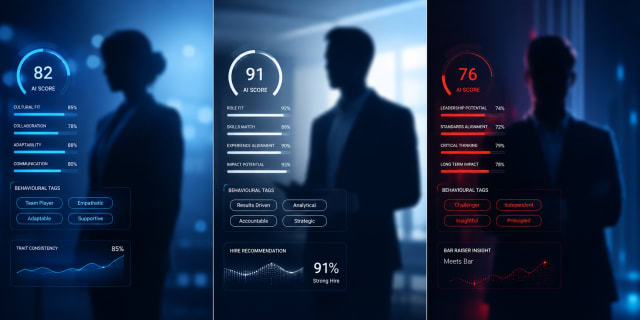
Imagine a hypothetical scenario: A senior Cloud Architect explains a complex Kubernetes migration during an AI-powered interview. The AI misinterprets the technical context, leading to an incorrect assessment of the candidate's backend infrastructure expertise.
What Is an AI Hallucination?
An AI hallucination occurs when a large language model generates information that appears credible but is factually incorrect, unsupported by evidence, or misinterprets the available context. In enterprise hiring, those errors can directly affect candidate evaluations, recruiter decisions, and organizational trust.
This isn't just an administrative glitch; it creates a massive credibility gap. When an AI makes a massive logical conversational jump, it causes cognitive discomfort that devastates a candidate's trust and willingness to work for your organization. Current research shows that 66% of U.S. adults would refuse to apply to an employer that relies blindly on automated AI screening hiring decisions.
In the era of AI-assisted recruitment, enterprises cannot rely on unconstrained AI for high-stakes hiring decisions. It's time to secure our pipelines against AI that fabricates its own reality.
Why AI Evaluation Errors Are Expensive
For enterprise hiring teams, unconstrained LLMs introduce significant risk into objective hiring decisions. AI hallucinations are an inherent risk of probabilistic language generation, particularly when models operate without sufficient grounding, constraints, or domain context.
A 2025 study from the Massachusetts Institute of Technology (MIT) revealed a deeply concerning paradox: LLMs use 34% more confident language when generating incorrect information than when delivering factual data. Because an LLM acts as a powerful autocomplete engine, it optimizes for syntactical plausibility rather than empirical truth.
- Elite models exhibit AI hallucinations as high as 88% on complex benchmarks.
- In specialized technical reasoning, elite models still exhibit unsupported outputs of up to 33%.
When enterprises deploy unconstrained AI to evaluate complex human careers, they incur a structural "Tax" on productivity. This contributes to an estimated $67.4 billion global drain on businesses in 2024 due to evaluation errors and the manual labor required to fix them.
How Grounded AI Architecture Reduces Unsupported Outputs
Reliable AI interviewing is not about better prompt engineering. It is about building a grounded AI architecture.
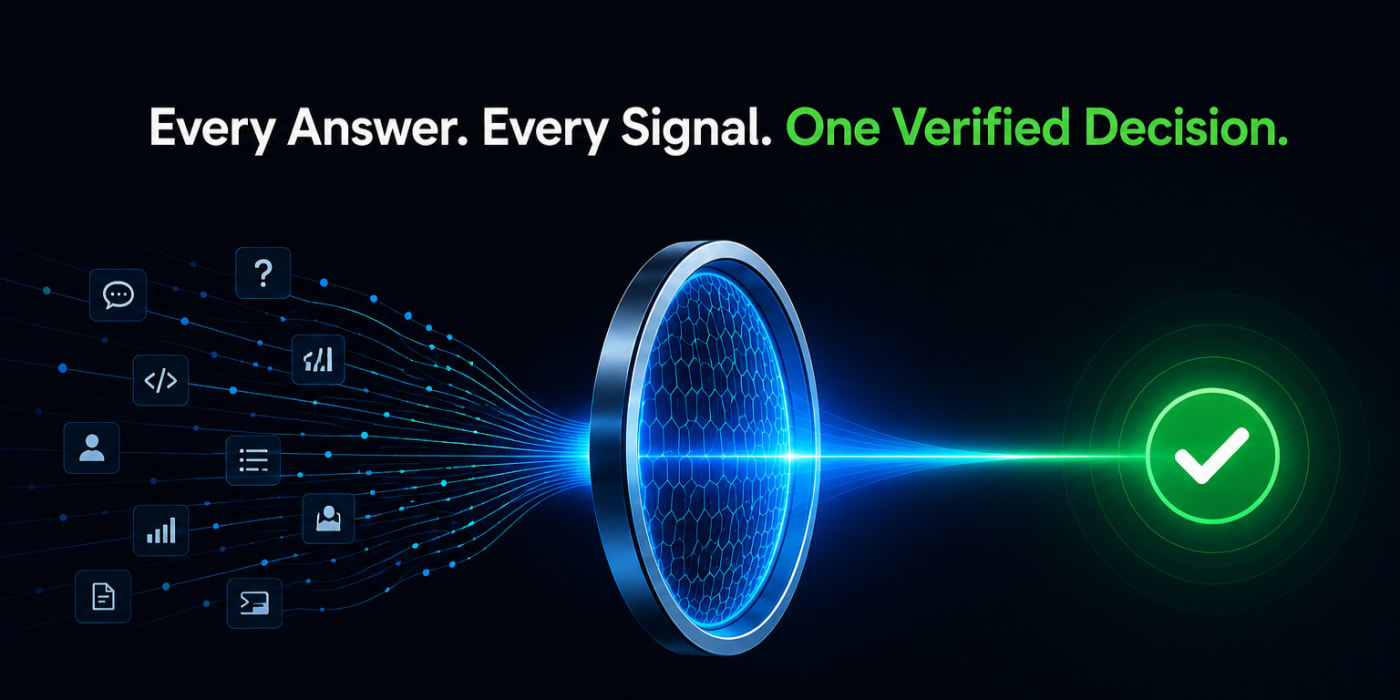
MockWin.ai implements this architecture through a Context Engine that applies structured constraints throughout the interview and evaluation workflow. Rather than allowing the model to generate responses from unconstrained context, the architecture narrows the decision space using structured inputs, domain-specific constraints, and rule-based evaluation criteria before scoring begins. Here is how MockWin constrains AI reasoning to produce more reliable evaluations:
The "Spinal Cord" (Smart Resume Parser & JD Matcher)
Before the generative AI even speaks to a candidate, MockWin intercepts the data. The Smart Parser extracts structured skills, while the JD Matcher forces the candidate's profile into a strict three-category alignment map against the job description. This heavily constrains the AI's reasoning space, significantly reducing the risk of incorrectly inferring or attributing skills that are not supported by the candidate's profile or the job requirements.
The "Brain" (Domain Classifier)
To prevent the AI from misinterpreting technical context, MockWin utilizes a Domain Classifier. It anchors the AI to domain-specific terminology and evaluation criteria, ensuring that technical realities not probabilistic guesswork govern the AI's grading rubric.
The Bar Raiser (Behavioral Filter)
Unsupported outputs compound over time, especially when fed chaotic data. MockWin’s Bar Raiser persona utilizes a controlled interrupt trigger: if a candidate rambles for more than 45 seconds, the AI politely cuts in, forcing the candidate to structure their speech and resetting the context window to halt cascading failures.
Proof from Enterprise Deployments
Theoretical elegance is meaningless unless it translates into measurable financial and operational outcomes. Does a grounded AI architecture actually work in production?
- 94% Evaluation Accuracy: By replacing probabilistic guesswork with strict grading rubrics, MockWin achieves 94% accuracy, vastly outperforming the 61% baseline typical of unstructured human interviews.
- Compressing the "45-Day Slog": Relying on safe, automated AI screening significantly reduces scheduling bottlenecks. In live enterprise deployments, MockWin reduced time-to-hire by 57%, accelerating the delivery of a ranked shortlist from an average of 14 days down to just 48 hours.
- 4.8x ROI & Immediate Cost Savings: Eliminating evaluation errors yields immediate financial relief. Internal models show MockWin saves enterprises an average of $440 per hire (or $535,000 annually for every 500 hires), delivering a 4.8x Return on Investment within the first quarter.
Methodology NoteUnless otherwise stated, independent industry statistics cited in this article are derived from publicly available research and are linked to their original sources. Product performance metrics (including evaluation accuracy, time-to-hire improvements, ROI estimates, and operational outcomes) are based on MockWin's aggregated enterprise deployment data and internal analyses. Actual results may vary depending on hiring workflows, implementation, and organizational context.
Why Human Oversight Still Matters
Deploying AI in hiring is heavily scrutinized under strict regulatory frameworks. The EU AI Act and New York City’s AEDT law both mandate one non-negotiable standard: meaningful human oversight.
MockWin is explicitly designed as a "Decision-Support Tool Only," ensuring AI execution is inexorably paired with human strategy. By utilizing Smart Clips and an automated Candidate Leaderboard, recruiters are directed via intelligent timestamps to the exact moments of a candidate's technical responses. The AI efficiently surfaces the signal, but a human recruiter always verifies the data and makes the final, legally compliant call.
Mitigate Evaluation Risk
Every week you rely on unconstrained AI, you risk losing elite technical talent to your competitors and incurring the costs of evaluation errors.
To win the war for talent, organizations must rely on empirical truth. By containing probabilistic generation within this architecture, MockWin helps evaluate candidates based on their demonstrated competence.
Organizations that treat AI as decision-support infrastructure not autonomous decision-making are better positioned to improve hiring quality while maintaining compliance, transparency, and candidate trust.
Frequently Asked Questions
What is an AI hallucination in hiring?
An AI hallucination in hiring occurs when an AI system generates or relies on incorrect or unsupported information while evaluating a candidate, potentially affecting interview outcomes or recruiter decisions.
Can Retrieval-Augmented Generation (RAG) eliminate AI hallucinations?
No. RAG can reduce AI hallucinations by supplying relevant context, but retrieval alone does not guarantee factual accuracy. Additional constraints, domain-specific validation, structured workflows, and human oversight remain important.
What is Grounded AI Architecture?
Grounded AI Architecture is MockWin's approach to reducing unsupported outputs by combining structured candidate data, domain-aware evaluation, predefined scoring criteria, and human review into a controlled interview workflow.
Why is human oversight still necessary?
Enterprise hiring decisions affect people's careers and are subject to legal and regulatory requirements. Human oversight helps validate AI recommendations, improve accountability, and support compliance.
Learn how MockWin's Grounded AI Architecture supports more reliable enterprise hiring.
Request a personalized demo.