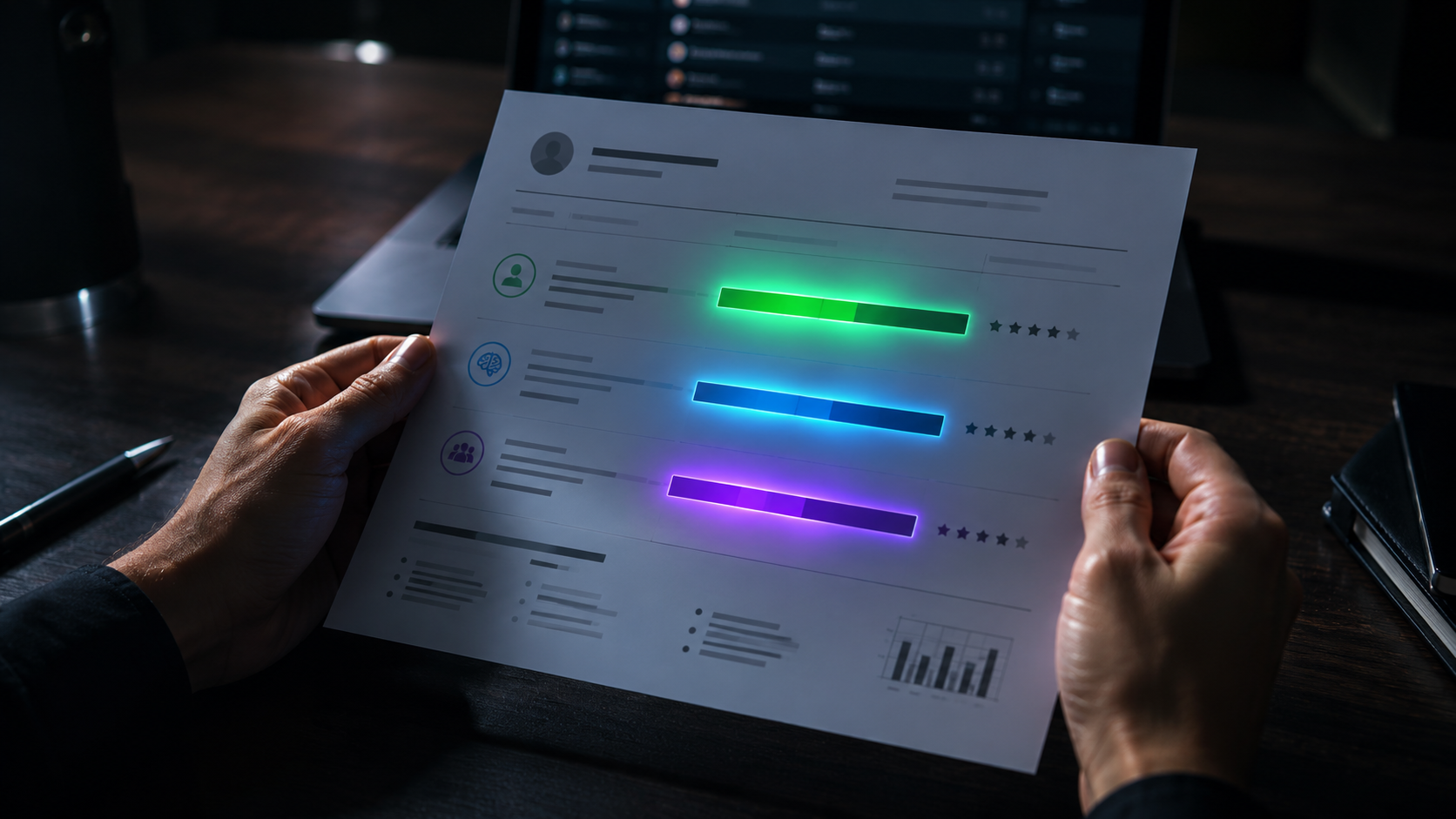
AI Interview Personas: Friendly HR vs Hiring Manager vs Bar Raiser
How to configure AI interview evaluation intensity for every role type and what goes wrong when you do not.
“A fresher applying for a support role and a principal engineer interviewing for a distributed systems position should not receive the same interview. Yet most AI screening tools give them one. Persona selection is what changes that - and getting it wrong at scale corrupts the entire shortlist.”
What This Article Covers
The concept: Mockwin AI interview personas control evaluation intensity - how deeply the engine probes answers, how precisely it scores responses, and how it sets benchmark thresholds. Three exist: Friendly HR, Hiring Manager, Bar Raiser.
The honest caveat: No screening system perfectly predicts hiring outcomes. Persona calibration improves consistency and reduces obvious mismatch patterns - but human evaluation remains essential at every stage beyond initial screening.
What we cover: What each persona does · how calibration works · what the research shows · a real deployment pattern · the decision framework · what goes wrong · fairness and accessibility · operational FAQ.
| If you are hiring for… | Use this persona | Why |
|---|---|---|
| Campus / BPO / support / freshers | 🙂 Friendly HR | Low probing pressure, high completion rate, communication-first |
| Mid-level professionals (2-5 years) | 💼 Hiring Manager | Balanced probing depth, widest role coverage, safe default |
| Senior engineers / architects / leadership | 🏋 Bar Raiser | Deep follow-up, narrow thresholds, surfaces genuine expertise |
What is an AI Interview Persona? 🔗
An AI interview persona is a configuration setting that controls evaluation intensity - how deeply the interview engine follows up on candidate answers, how precisely it scores responses against expected content, and how it adjusts benchmark thresholds. In Mockwin, three personas map to three seniority levels: Friendly HR (entry-level), Hiring Manager (mid-level), and Bar Raiser (senior/leadership).
Most AI screening tools treat every candidate identically - the same questions, the same scoring, the same thresholds regardless of role. The result is predictable: your shortlist is either too permissive or too restrictive depending on which direction the generic calibration tilts. Personas solve this by making the evaluation appropriate to the role.
AI Interview Persona Selection is a core configuration feature within Mockwin’s AI-Powered Interviews platform. It calibrates evaluation intensity to match role seniority - selecting from Friendly HR, Hiring Manager, or Bar Raiser, each with distinct drill-down depth settings, semantic strictness levels, and benchmark score thresholds. Persona Selection operates within Mockwin’s Persona Matrix - the configuration framework mapping seniority levels to appropriate evaluation depth. Used across mass hiring, tech hiring, and campus hiring campaigns.
Why Static AI Interviewers Fall Short 🔗
A static interview tool asks every candidate the same questions in the same order and evaluates every answer against the same standard. That sounds fair - but the same answer means something completely different depending on the role.
“I have worked with microservices in production” is acceptable from a mid-level developer. From a principal architect, it is a red flag - it describes what they did without explaining how, why, or what trade-offs they navigated. A static tool cannot make that distinction. An adaptive one configured with the right persona can, because the evaluation engine triggers deeper probing when an answer is vague or incomplete.
That said, structured interviews also have real limitations. They can over-normalise candidates - rewarding people who have learned to give structured answers over those who think differently but produce excellent work. Adaptive persona-based screening is a meaningful improvement over generic static tools, but it is not a substitute for human judgment on unconventional candidates.
The Three Personas - Quick Reference 🔗
- Friendly HR - entry-level and mass hiring · low evaluation pressure · communication and culture signals
- Hiring Manager - mid-level roles (2-5 years) · moderate probing · applied skill and experience verification
- Bar Raiser - senior and leadership roles · high evaluation depth · architectural reasoning and trade-off precision
Warm and low-pressure. The evaluation engine applies minimal follow-up probing, accepts directionally correct answers, and weights communication clarity over technical precision. Designed for high-volume roles where candidate comfort affects completion rates.
Professional and targeted. The engine triggers follow-up probing on vague or incomplete answers, requires demonstrated experience rather than claimed familiarity, and applies standard role-calibrated scoring. The safe default for most professional roles.
High evaluation depth. Three consecutive follow-up questions escalate from concept to application to architectural trade-off. The engine challenges surface claims in real time. For roles where shallow competence is a meaningful hiring risk.
“Bar Raiser” is used here as industry shorthand for high-rigor senior evaluation, implemented through Mockwin’s own adaptive interview framework - not derived from any single company’s process.
📊 Which persona do most enterprise teams use first?
In Mockwin deployments, Hiring Manager is the most common first configuration — used by teams hiring at mid-level professional volume who want reliable signal without the setup complexity of Bar Raiser. See how enterprise teams configure personas →
How Calibration Works - and Its Limits 🔗
Enterprise buyers reasonably ask: who decided what counts as a deep enough answer for a senior engineer? If thresholds are arbitrary, the whole system is arbitrary.
Mockwin’s personas are calibrated against aggregated benchmark data from interview sessions across role types and seniority levels. The platform identifies - across comparable campaigns - what distinguishes strong from weak performers in final-round evaluations, then sets scoring thresholds to improve consistency with those outcomes. Calibration is reviewed periodically and adjustable on enterprise plans.
| Dimension | 🙂 Friendly HR | 💼 Hiring Manager | 🏋 Bar Raiser |
|---|---|---|---|
| Drill-Down Depth | Layer 1 - 1 follow-up max | Layer 2 - up to 2 follow-ups | Layer 3 - up to 3 consecutive |
| Semantic Strictness | Low - directional answers pass | Medium - partial credit allowed | High - precision required |
| Probing Frequency | None - candidate speaks freely | Selective - on vague answers | Frequent - challenges claims live |
| Benchmark Threshold | Wider acceptance band | Standard role-calibrated | Narrow top-performer band |
| Best Seniority | 0-2 years / freshers | 2-5 years experience | 5+ years / Principal / Leadership |
⚠️ Important Limitation
No screening system - human or AI - perfectly predicts hiring outcomes. Persona calibration improves evaluation consistency and reduces obvious mismatch patterns. It does not eliminate false negatives, eliminate bias, or remove the need for human judgment at later hiring stages. Calibration improves the signal; it does not make the signal infallible.
What the Research Shows 🔗
The following findings come from external research studies and are not internal Mockwin benchmarks unless explicitly labelled. Three are directly relevant to persona calibration decisions - and the last one raises a question the industry has not fully answered.
Score distributions compress when Friendly HR is used on mid-level technical roles - candidates cluster near the top with little differentiation, making shortlisting decisions harder. Conversely, Bar Raiser on junior roles is consistently associated with lower completion rates, with the most common drop-off after the first follow-up question.
⚠️ These are directional platform observations, not controlled studies. Outcomes vary by industry, role type, and candidate pool.
A Real Deployment Pattern 🔗
A recurring failure in early enterprise deployments: a team configures Bar Raiser across all engineering roles - including junior developers alongside senior architects - under the assumption that higher evaluation depth produces better shortlists across the board.
What follows: completion rates for junior roles drop sharply. Candidates abandon after the first or second follow-up - not because they cannot do the job, but because sustained probing on architectural trade-offs communicates failure to someone who has not operated at that depth. The 2025 Stanford experiment supports this: AI interview abandonment correlates with intensity perception, not candidate ability.
After reconfiguring to Hiring Manager for sub-3-year roles and retaining Bar Raiser for senior positions, completion rates recover and senior shortlist quality is unchanged. The lesson:
The Decision Framework 🔗
| Role Type | Experience | Primary Goal | Recommended Persona |
|---|---|---|---|
| Fresher / campus drive | 0-1 year | Communication, potential, culture | 🙂 Friendly HR |
| Mass hiring - support, ops, BPO | 0-3 years | Basic competency, volume processing | 🙂 Friendly HR |
| Sales, marketing, business analyst | 2-4 years | Applied skill, domain awareness | 💼 Hiring Manager |
| Software developer (mid-level) | 2-5 years | Technical application, problem-solving | 💼 Hiring Manager |
| Senior engineer / tech lead | 5-8 years | Architectural depth, trade-off reasoning | 🏋 Bar Raiser |
| Principal engineer / architect | 8+ years | System design mastery, engineering judgment | 🏋 Bar Raiser |
| Engineering manager / CTO | Any | Strategic thinking, team leadership signals | 🏋 Bar Raiser |
✅ The Safe Default
If unsure, start with Hiring Manager. It produces reliable signal for the widest range of professional roles. Move to Bar Raiser only when the role genuinely requires demonstrated depth. Move to Friendly HR only when hiring freshers, campus candidates, or high-volume entry-level roles where completion rate and candidate comfort are evaluation-relevant.
What Goes Wrong With the Wrong Persona 🔗
Each mismatch produces a different and predictable failure mode. These are not edge cases - they are the most common outcomes when persona-role alignment is skipped:
The evaluation engine demands senior-level articulation. Completion drops. Shortlist is empty or skewed toward overqualified candidates who will not stay.
Articulate candidates who can describe work but have not done it at depth pass easily. Human interviewers waste hours on candidates who collapse at the first technical deep-dive.
Entry-level candidates encounter unexpected probing pressure and abandon mid-interview. Good potential hires are lost before evaluation is complete.
Score distribution compresses - everyone scores similarly. The leaderboard cannot differentiate genuine skill from surface familiarity. Recruiter decision-making gets harder, not easier.
Fairness, Accessibility, and Non-Native Speakers 🔗
Persona selection is itself a fairness decision - one that determines which candidates complete the process and which do not. That deserves more than a caveat at the bottom of a feature description.
- Semantic strictness evaluates substance, not grammar. The scoring engine assesses accuracy and depth of content - not grammatical precision. Non-native English speakers are not disadvantaged by language fluency alone.
- Speech recognition variance is a real concern. Strong accents or lower audio quality can affect transcription accuracy, which can affect scoring. This is a known limitation. For roles with significant non-native speaker populations, Friendly HR reduces this risk because lower semantic strictness is more tolerant of transcription imprecision.
- Neurodivergent candidates may find the sustained follow-up probing of Bar Raiser particularly challenging independent of their actual competence. For roles where neurodivergence is irrelevant to performance, consider whether that evaluation depth is genuinely necessary.
- Audit logs and override workflows matter. Any responsible deployment should include recruiter review capability for borderline scores, periodic demographic outcome audits, and a documented process for human override when the AI score conflicts with recruiter judgment.
⚠️ Persona Choice Is a Fairness Decision
AI screening does not automatically produce fair outcomes. Persona selection affects who completes the process, whose answers are scored as precise enough, and whose communication patterns are penalised. These decisions should be made deliberately, not left on defaults, and audited regularly against demographic outcome data.
Configure the Right Persona for Every Role
Start free and set up your first campaign with evaluation intensity calibrated to your role type - in hours, not weeks.
What Is AI Interview Intensity? 🔗
AI interview intensity refers to the combined level of evaluation rigor applied by an AI interview engine - encompassing drill-down depth (how many follow-up questions are triggered), semantic strictness (how precisely answers must match expected content), probing frequency (how often the engine challenges claims), and benchmark thresholds (how narrowly the top-performer band is set). In Mockwin, intensity is controlled through persona selection.
Intensity is not a quality proxy. Higher intensity is not inherently better - it is appropriate or inappropriate depending on the role. A Friendly HR session run at low intensity for a campus hiring drive and a Bar Raiser session at high intensity for a principal engineer search are both correctly calibrated for their contexts. The error is applying either configuration to the wrong audience.
FAQ - Operational Edge Cases 🔗
Should you use Bar Raiser for junior developers?
No. Bar Raiser is calibrated for senior engineering and leadership evaluation. Using it on junior roles typically increases candidate drop-off and produces false negatives - qualified candidates who can do the job fail because the evaluation demands senior-level articulation. The 2025 Stanford field experiment found that AI interview abandonment correlates with intensity perception, not candidate ability.
What causes AI interview drop-off and does it bias candidate pools?
Yes - it can. The Stanford research found candidates who declined AI interviews were slightly more experienced than those who completed, suggesting intensity-mismatched AI interviews may filter out experienced candidates who have other options. This is a real concern. It does not mean AI screening is wrong, but persona-role alignment is a candidate experience issue as much as a shortlist quality issue.
Are AI interviews harder for senior roles?
Yes, when Bar Raiser is applied. Three consecutive follow-ups, high semantic strictness, and real-time claim challenges produce a materially more demanding evaluation than mid-level personas. This is appropriate for principal engineers and architects - not for mid-level or entry-level roles where that intensity produces false negatives.
How does semantic strictness work for non-native English speakers?
Generally no - with one important caveat. The scoring engine evaluates content accuracy and depth, not grammatical precision. Non-native speakers are not disadvantaged by language fluency alone. However, strong accents can affect speech-to-text transcription accuracy, which can affect scoring. For roles with significant non-native speaker populations, Friendly HR or Hiring Manager reduces this risk.
Can recruiters override AI persona scores?
Yes. AI scoring is one input to recruiter decision-making, not a final verdict. Recruiters can review Smart Clips for any candidate - including those below threshold - and manually advance them. The system is designed to reduce volume burden, not remove recruiter judgment.
How do AI interview personas differ from static question banks?
Static banks ask every candidate the same questions in the same order regardless of their answers. Adaptive personas trigger follow-up probing based on what the candidate actually says - the evaluation engine escalates or accepts based on response depth and accuracy. Two candidates answering the same opening question differently will receive different subsequent questions, producing more diagnostic signal about genuine depth.
How long are persona-based AI interviews in Mockwin?
It depends on the persona. Friendly HR campaigns typically run 15-20 minutes. Hiring Manager sessions average 25-35 minutes. Bar Raiser sessions can run 35-50 minutes depending on how deeply the engine probes. Candidates complete interviews asynchronously on their own schedule. Retry and device-switching policies are configurable at the campaign level on enterprise plans.
Can candidates game persona-based AI interviews?
Partially - but less than most assume. Rehearsed structured answers may help candidates pass at Friendly HR or Hiring Manager level, where evaluation pressure is lower. However, adaptive follow-up probing is specifically designed to surface inconsistency - the engine escalates when answers are fluent but thin. Under Bar Raiser, a candidate who has memorised architectural talking points without genuine experience tends to collapse at the second or third follow-up. No system fully eliminates coached responses, but depth-based probing makes shallow preparation significantly less effective than it is in static question banks.
Next: Blog #16 - What Is Seniority Calibration? (Thursday May 15)
The next article covers Mockwin Seniority Calibration - how the platform automatically adjusts question difficulty and benchmark expectations based on experience signals detected in a candidate resume and early answers. It builds directly on the persona framework explained here. See all enterprise blogs →
Tags
Shaik Vahid
Content Writer and SEO Specialist crafting impactful, search-optimized content that drives visibility blending creativity with data to deliver meaningful results.
Related Articles
Why Candidate Evaluation Is Becoming the Next Competitive Layer in India’s ATS Ecosystem
India's ATS platforms have mastered workflow automation but candidate evaluation, the harder problem, remains largely unsolved. This piece examines why evaluation quality is becoming the next competitive battleground in India's recruitment technology market, what makes building it genuinely difficult, and why the companies that solve it at scale may define the next layer of hiring infrastructure.
Why Recruiters Are Replacing Phone Screens With AI Interview Software in 2026
For TA leaders and enterprise hiring teams - why the phone screen model fails at volume, what AI interview software replaces it with, when NOT to use it, and how to evaluate platforms before you commit.

Will AI Replace Recruiters? The Honest Answer from an AI Hiring Platform
MockWin runs adaptive AI interviews inside enterprise hiring funnels so we see every day where AI genuinely replaces recruiter work, and where the handoff to a human is non-negotiable. The honest answer: AI is replacing one of a recruiter's five core functions, not the role itself. Knowing which function and what to do about it is the strategic call every CHRO faces in 2026.