Why Candidate Evaluation Is Becoming the Next Competitive Layer in India’s ATS Ecosystem
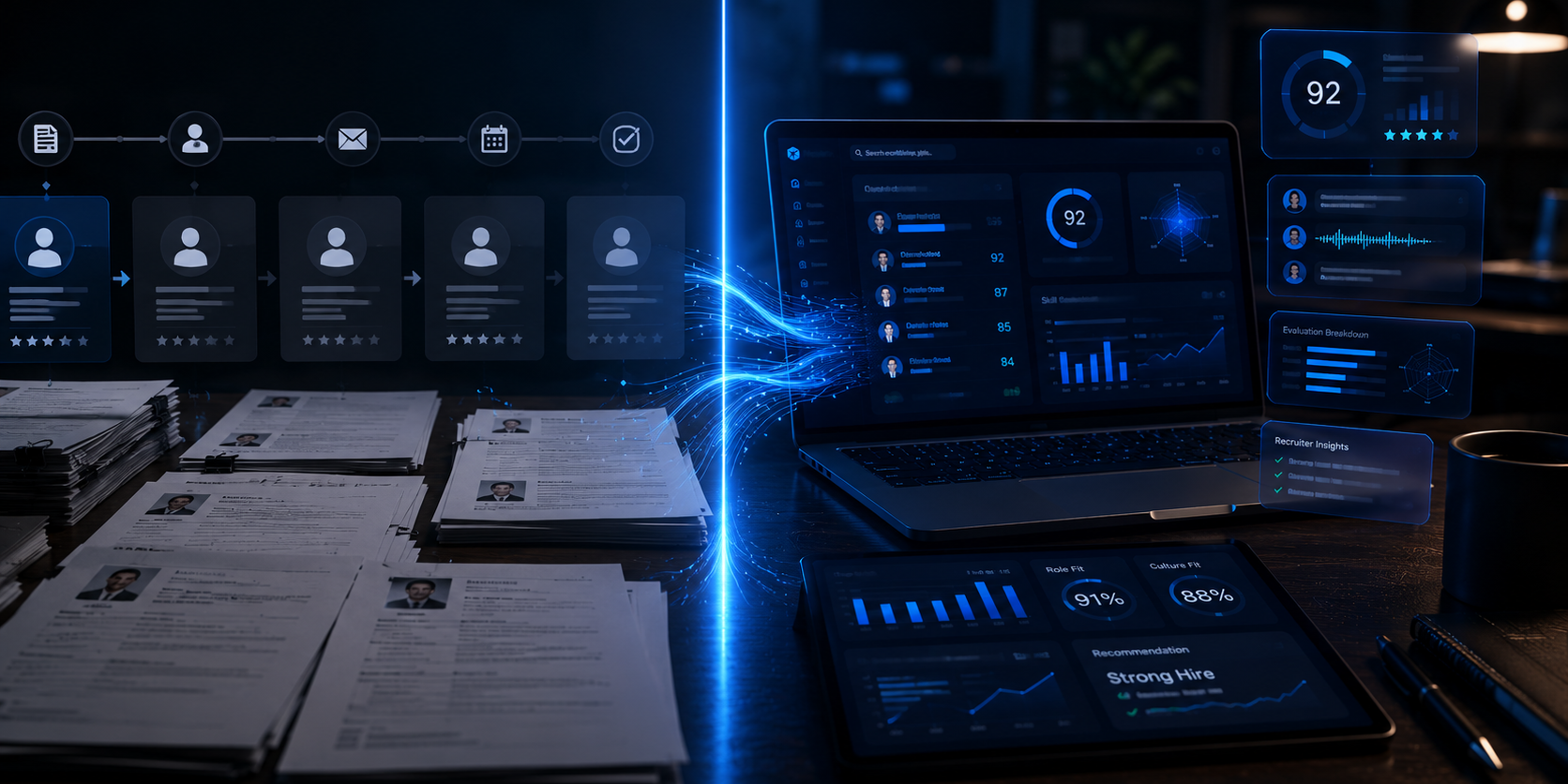
India's ATS platforms have mastered workflow automation but candidate evaluation, the harder problem, remains largely unsolved. This piece examines why evaluation quality is becoming the next competitive battleground in India's recruitment technology market, what makes building it genuinely difficult, and why the companies that solve it at scale may define the next layer of hiring infrastructure.
Why India's ATS Platforms Are Becoming Hiring Intelligence Systems
Workflow automation solved recruitment coordination. Candidate evaluation - the harder problem at the center of every AI hiring system - remains largely unsolved.
The Short Version
India's ATS ecosystem is evolving past workflow efficiency into evaluation intelligence. The next competitive moat in recruitment technology isn't scheduling automation - it's the ability to consistently, accurately, and at scale determine which candidates deserve an engineering panel's time. Building that requires a different kind of infrastructure: conversational, adaptive, contextually aware, and auditable.
📋 Table of Contents
- 1. The Workflow Era Is Over
- 2. What "Evaluation" Actually Means in Technical Hiring
- 3. Why Building This Is Harder Than It Looks
- 4. India's Hiring Environment Creates Unusual Pressure
- 5. The Build vs. Buy Decision Is Becoming Real
- 6. What Enterprises Are Actually Asking For Now
- 7. Where Interview Intelligence Companies Are Positioning
- 8. The Architectural Implication Nobody Is Saying Clearly
- 9. Conclusion
- 10. FAQ
The Workflow Era Is Over
For the past decade, the dominant logic of Applicant Tracking Systems was simple: reduce friction. Move candidates through stages faster. Help recruiters track more applicants with less email. Automate the scheduling.
That logic worked - until it didn't.
The problem isn't that ATS platforms became bad at workflow. Most of them got very good at it. The problem is that workflow efficiency is now table stakes. Every credible ATS today integrates with your calendar, syncs with your HRMS, and generates pipeline reports. The differentiation has collapsed.
What hasn't been solved - and what enterprise hiring teams are increasingly loud about - is the evaluation problem.
What "Evaluation" Actually Means in Technical Hiring
Here's a concrete example of the gap.
A fast-growing fintech startup in Bengaluru receives 600 applications for a senior backend engineering role. Their ATS parses resumes, scores them against a keyword template, and surfaces 80 candidates to the recruiter. The recruiter then has to decide which 20 get a first-round call.
That decision - the most consequential one in the entire funnel - is made with almost no structured intelligence. The recruiter reads summaries, looks for company names, and makes a judgment call.
When a mismatch inevitably surfaces during the engineering panel, it's attributed to "recruiter error." But the recruiter was never given tools capable of doing better.
This is the problem interview intelligence infrastructure is trying to solve: not faster handoffs between stages, but higher-quality signal at the point of evaluation.
🔍 See how MockWin's Candidate Evaluation Software closes this gap →Why Building This Is Harder Than It Looks
The naive version of AI interviewing is easy to prototype. Ask GPT-4 some questions, transcribe answers, generate a score. Engineering teams inside ATS companies have been building these prototypes for two years.
What they keep discovering is that the prototype is not the product.
The State Management Problem
Human interviews are fundamentally non-linear. Candidates self-correct, backtrack, and use jargon that only makes sense in context of earlier answers. A production system must maintain a live model of conversation state in real time.
The Calibration Problem
Evaluation scores are only useful if they're consistent. If the same answer scores a 7 in one session and a 4 in another, recruiters stop relying on the system entirely. Earning trust requires auditable, not just accurate, outputs.
The State Management Problem
Human interviews are fundamentally non-linear. A candidate answering a question about distributed caching might suddenly realize they should clarify something they said about their database architecture three questions ago. They self-correct. They backtrack. They use jargon that only makes sense in context of their earlier answers.
A production interview system must maintain a live model of what's been established in the conversation and decide in real time whether a new statement updates or contradicts earlier context. It also needs to generate follow-up questions that reflect what was actually said rather than a predetermined template, detect when a candidate is stalling versus genuinely uncertain, and produce evaluation output that recruiters can audit and override - all without introducing latency that breaks conversational rhythm.
This is not a prompting challenge. It's an orchestration architecture problem. And it's why most internal ATS prototypes stall after the demo phase.
The Calibration Problem
Even if you build a technically functional interview system, you face a second problem: recruiter trust.
Evaluation scores are only useful if they're consistent. If the same candidate answer scores a 7 in one session and a 4 in another - because the model's context window drifted, or a transcription error changed the semantic meaning - recruiters stop relying on the system entirely.
Enterprise hiring teams have seen enough HR tech promises. They are calibration-skeptical by default. Earning their trust requires not just accurate outputs, but auditable ones - where a recruiter can trace why a candidate received a given score and override it when context warrants.
This is why recruiter override systems and scoring transparency aren't optional features. They're prerequisites for enterprise adoption. Learn more about how MockWin approaches AI interview feedback and scoring transparency.
India's Hiring Environment Creates Unusual Pressure
India's technical hiring market has structural characteristics that make these problems more acute than in most other markets.
Scale alone makes manual screening unsustainable. India produces roughly 1.5 million engineering graduates annually - yet according to the Unstop Talent Report 2025, 83% of 2024 engineering graduates remained unemployed or without internships, while the India Skills Report 2025 found that 52% of graduates fail interviews not due to technical incompetence but communication gaps. The screening problem isn't supply. It's the gap between what resumes signal and what candidates can actually do - a gap that keyword-matching ATS tools were never designed to close.
-
01
Distributed operations compound the problem. Engineering teams are increasingly spread across Bengaluru, Hyderabad, Pune, Delhi NCR, and Chennai - with some remote. Interview coordination across time zones and engineering panels strains recruiter capacity in ways that purely scheduling-focused ATS tools weren't designed to handle.
-
02
Mixed-language communication creates an additional layer of complexity that most AI evaluation systems underestimate. Indian candidates frequently move fluidly between English and their regional language mid-sentence, or use Indian English idioms that diverge significantly from the training distribution of most models. Multilingual accuracy in transcription and evaluation isn't a feature request in this market - it's a table-stakes requirement that most current AI interview systems underdeliver on.
-
03
Engineering interview fatigue is the pressure point that tends to break the system. In high-growth startups and mid-size tech companies, senior engineers are asked to conduct first-round screening interviews at a rate that directly competes with their ability to do actual engineering work. This creates pressure from engineering leadership - not just HR - to push technical hiring automation into earlier stages of the funnel.
These pressures combine to make India an unusually important testing ground for interview intelligence infrastructure. The use cases here aren't edge cases. They're the baseline.
🌐 Explore MockWin's Remote Interviewing Solutions for Distributed Teams →The Build vs. Buy Decision Is Becoming Real
Until recently, most ATS platforms defaulted to "we'll build it eventually." Interview intelligence felt like a natural extension of their existing product surface.
That calculus is shifting - for a specific reason.
The engineering teams required to build production-grade interview infrastructure are not the same engineering teams that build great ATS products. Workflow systems require strong product intuition about recruiter behavior, solid integration engineering, and reliable data pipelines. Interview intelligence systems require something entirely different:
These are fundamentally different disciplines with different operational requirements - and maintaining them internally is not a one-time development cost. It's a permanent organizational commitment.
This is why partnership-based interview infrastructure is becoming an economically rational choice for ATS vendors who want to offer evaluation capabilities without restructuring their engineering organizations.
⚠️ The Real Trade-offs
Vendor dependency, integration complexity, and customization limits are genuine risks. But so is the opportunity cost of redirecting two to three senior engineering teams toward an infrastructure layer that specialized providers have been building for longer.
What Enterprises Are Actually Asking For Now
The evaluation criteria enterprises apply to interview infrastructure providers have matured significantly. Eighteen months ago, the primary question was "does it work?" Today, the questions are more specific:
On Reliability
How does the system handle dropped connections, audio quality degradation, and candidate session recovery? What's the documented failure rate at scale?
On Auditability
Can a recruiter see the transcript, the context state, and the scoring rationale side by side? Can they flag a specific exchange as incorrectly weighted? See MockWin's AI interview feedback tools for how this works in practice.
On Bias Mitigation
What testing has been done on evaluation consistency across gender, regional accent, and communication style? What remediation mechanisms exist when bias is detected?
On Integration Depth
Does the system support bidirectional ATS sync, or only one-way data export? Can recruiter overrides propagate back to the model's calibration layer? Explore the MockWin Hiring Operations Platform for integration details.
On Multilingual Accuracy
What's the word error rate on Indian English, Hindi, Tamil, and Telugu transcription specifically? Has the evaluation model been fine-tuned on domain-specific technical vocabulary?
✅ What This Means for Procurement
The organizations asking these questions are not early adopters. They're enterprise procurement and HR leadership at companies that have been burned by first-generation HR tech promises before. Vendors who can answer these questions concretely - with data, not promises - are the ones getting into procurement reviews.
Where Interview Intelligence Companies Are Positioning
A growing number of companies are now building around interview intelligence infrastructure rather than workflow automation - betting that evaluation quality, not pipeline management, will be the defensible layer of the next recruitment technology cycle.
MockWin.ai is one of them, focused specifically on adaptive conversational interviewing and technical assessment orchestration for the Indian hiring market.
Its positioning reflects a deliberate bet: that the defensible layer in next-generation recruitment technology isn't workflow management, but evaluation quality. The platform's architecture is oriented around replicating the behavior of an experienced technical interviewer - probing deeper based on response content, maintaining conversational context across non-linear exchanges, and producing recruiter-legible evaluation output rather than opaque scores.
🔮 The Bet MockWin Is Making
Whether that bet pays off depends on execution against the hard problems outlined above: calibration consistency, multilingual accuracy, and recruiter trust. The market it's operating in is real, the demand is validated, and the timing - as ATS platforms actively reconsider their build-vs-partner decisions - is favorable.
The category is still early - and increasingly competitive. Proving evaluation quality at scale, with the auditability enterprise buyers now demand, is the work ahead.
The Architectural Implication Nobody Is Saying Clearly
Here is the uncomfortable conclusion that follows from everything above:
Workflow coordination and intelligence orchestration are different enough problems - requiring different engineering disciplines, different data models, and different trust relationships with end users - that bundling them in a single platform may actually produce worse outcomes than separating them.
The analogy is Salesforce CRM versus revenue intelligence platforms like Gong. Salesforce is excellent at tracking deal stages. It is not excellent at telling you why a deal is stalling. That required a separate infrastructure layer, deeply integrated with CRM but architecturally distinct from it.
Recruitment technology may be approaching a similar separation. The ATS tracks candidates. Interview intelligence evaluates them. The two integrate tightly, but the companies building them best may not be the same company.
| Capability | Traditional ATS | Interview Intelligence Layer |
|---|---|---|
| Pipeline tracking | ✅ Core strength | Integration only |
| Scheduling automation | ✅ Table stakes | Out of scope |
| Candidate evaluation | ❌ Keyword matching only | ✅ Core capability |
| Adaptive questioning | ❌ Not applicable | ✅ Real-time orchestration |
| Multilingual accuracy | ❌ Underdelivers | ✅ Fine-tuned models |
| Scoring auditability | ❌ Opaque | ✅ Recruiter-legible rationale |
If that architectural separation holds, the competitive moat in the next generation of HR technology shifts. Workflow efficiency - already commoditized - becomes less valuable. Evaluation quality - still largely unsolved - becomes the defensible layer.
That's a significant strategic realignment for an industry that has spent a decade competing on pipeline management features.
Conclusion
India's ATS ecosystem isn't evolving because vendors woke up one morning and decided to add AI features. It's evolving because the fundamental limitation of workflow-first recruitment technology has become impossible to ignore.
The evaluation problem - how to consistently, accurately, and at scale determine which candidates deserve an engineering panel's time - has not been solved by scheduling automation or keyword screening. It requires a different kind of infrastructure: conversational, adaptive, contextually aware, and auditable.
Building that infrastructure is genuinely hard. The organizations that figure it out - whether as standalone platforms or as deeply integrated partners inside existing ATS ecosystems - will occupy the most defensible position in recruitment technology over the next decade.
The companies that define that decade may not be the ones that move candidates through pipelines fastest. They may be the ones that most accurately replicate the judgment, adaptability, and contextual reasoning of the best human interviewers - at the scale that human interviewers never could.
See MockWin's Evaluation Intelligence in Action
Built for India's scale, complexity, and multilingual hiring reality. Adaptive AI interviews, recruiter-auditable scoring, and enterprise-grade integration.
FAQ
What separates adaptive AI interviewing from traditional assessments?
Static assessments produce consistent inputs but can't respond to what a candidate actually says. Adaptive systems generate follow-ups based on the specific answer just given - the way experienced interviewers naturally probe, not a predetermined script.
Why don't ATS companies just build this internally?
Because production-grade interview infrastructure requires capabilities - real-time ML inference, multilingual speech processing, calibration research, and safety engineering - that sit outside most ATS teams' historical strengths. The ongoing maintenance cost is also routinely underestimated until teams are already deep into development.
What does "recruiter-augmented" AI actually mean in practice?
Recruiters remain the decision-makers, but with richer inputs. The AI surfaces transcripts, scores, and reasoning. The recruiter reviews, overrides where warranted, and makes the final call. The system learns from those overrides. Neither party operates autonomously. See MockWin's AI interview feedback for how this works in practice.
What are the biggest unsolved problems in AI interviewing today?
Multilingual accuracy at scale, evaluation consistency across demographic groups, hallucination risk in technical assessment, and enterprise-grade auditability - the primary reasons adoption has been slower than vendor hype predicted. These are exactly the problems MockWin's candidate evaluation software is built to address.
Is this trend specific to India?
The pressures are global, but India's combination of high hiring volume, multilingual communication patterns, and engineering-panel fatigue makes the pain points more acute here than in most other markets. That's why the serious experimentation is happening here first. Explore MockWin's mass hiring solutions and campus hiring tools designed for India's scale.
Does MockWin support RPO and staffing firms in addition to direct enterprise hiring?
Yes. MockWin's infrastructure is designed to serve RPO and staffing workflows as well as direct enterprise hiring teams. Both benefit from the same evaluation intelligence layer, with role-specific configuration for different hiring volumes and workflows.
Tags
Shaik Vahid
Content Writer and SEO Specialist crafting impactful, search-optimized content that drives visibility blending creativity with data to deliver meaningful results.
Related Articles

AI Interview Personas: Friendly HR vs Hiring Manager vs Bar Raiser
How to configure AI interview evaluation intensity for every role type and what goes wrong when you do not.

Why Recruiters Are Replacing Phone Screens With AI Interview Software in 2026
For TA leaders and enterprise hiring teams - why the phone screen model fails at volume, what AI interview software replaces it with, when NOT to use it, and how to evaluate platforms before you commit.

Will AI Replace Recruiters? The Honest Answer from an AI Hiring Platform
MockWin runs adaptive AI interviews inside enterprise hiring funnels so we see every day where AI genuinely replaces recruiter work, and where the handoff to a human is non-negotiable. The honest answer: AI is replacing one of a recruiter's five core functions, not the role itself. Knowing which function and what to do about it is the strategic call every CHRO faces in 2026.