
System Design Interview Prep with AI
System design interview preparation with AI is the fastest way to close the gap between knowing distributed systems and actually performing under a 45-minute clock. This guide breaks down a proven 5-step framework widely used by candidates preparing for top tech companies, the core architecture concepts - load balancing, caching, database design, message queues, and back-of-the-envelope estimation - that appear in every round, and a structured 8-week study plan combining AI-powered mock interviews with human calibration. Whether you're a junior engineer facing your first design round or a senior targeting staff roles at Google, Amazon, Meta, or Netflix, this is the actionable roadmap that turns "I don't know where to start" into confident whiteboarding. All content is for educational purposes only; company names, frameworks, and tools referenced are trademarks of their respective owners and are used solely for identification and context.
TL;DR: You've solved hundreds of LeetCode problems, but that gap between coding skill and architectural confidence is exactly what AI-powered preparation closes. Preparing for a system design interview? Traditional methods aren't enough for today's hyper-competitive FAANG landscape. By integrating artificial intelligence - specifically Large Language Models (LLMs) alongside dedicated AI mock interview copilots - you can generate custom, high-fidelity mock scenarios, receive instant architectural feedback, and rapidly grok complex distributed systems.
System design interview preparation with AI is the fastest path from "I don't know where to start" to confidently whiteboarding distributed systems. Whether you're a junior engineer facing your first design round or a senior targeting staff roles at Google, Amazon, or Meta, this guide gives you an actionable roadmap.
You'll learn the 5-step framework interviewers use to score you, the core concepts you must master, how to use AI tools like MockWin.ai at each stage, and the 8-week study plan that balances AI practice with human calibration.
What Is a System Design Interview?
A system design interview is a 45–60 minute technical evaluation where candidates architect a large-scale distributed system - like a URL shortener, chat app, or video platform - while explaining decisions aloud. It tests architectural reasoning, trade-off analysis, and communication clarity.
Unlike coding interviews that test algorithm correctness, design rounds test systems-level thinking. Google, Amazon, Meta, and Netflix weight this round heavily for senior roles. Alex Xu's bestselling System Design Interview series calls it "the most open-ended and challenging interview format in tech."
What Are the 5 Steps of a System Design Interview?
The 5-step framework is the repeatable structure top-scoring candidates follow. The five steps are: Clarify Requirements, High-Level Design, Deep Dive, Bottlenecks, and Trade-offs - in that exact order.
Step 1: Clarify Requirements
Separate functional from non-functional requirements. Ask: "How many DAUs? What latency is acceptable? Strong or eventual consistency?" Skipping this is the top reason candidates fail, according to engineering hiring managers.
Step 2: High-Level Design
Sketch your APIs, core components, and data flow. Show load balancers, app servers, databases, caches, and message queues working as a coherent system. Interviewers assess whether you see the forest before the trees.
Step 3: Deep Dive Into Critical Components
Pick the most critical component and go deep. Discuss schema design, sharding strategy, and caching policies (write-through vs. write-back, LRU vs. LFU). Senior candidates name specific technologies and justify each choice.
Step 4: Identify Bottlenecks
Flag single points of failure and latency hotspots proactively. Mention circuit breakers, retry with exponential backoff, and graceful degradation before the interviewer asks.
Step 5: Discuss Trade-offs
Articulate every choice: SQL vs. NoSQL, consistency vs. availability, Kafka vs. RabbitMQ. Strong candidates explain the constraints that drove each decision - not just what they picked, but why.
RESHADED vs. 5-Step Framework
| Dimension | 5-Step Framework | RESHADED |
|---|---|---|
| Steps | 5 (Clarify → Design → Deep Dive → Bottlenecks → Trade-offs) | 8 (R-E-S-H-A-D-E-D) |
| Best For | 45-minute interviews, quick structured answers | 60-minute interviews needing deeper coverage |
| Estimation | Covered informally during clarification | Dedicated step with explicit calculations |
| API Design | Implied within high-level design | Separate dedicated step |
| Complexity | Easier to memorize under pressure | More thorough but harder to time-manage |
| Verdict | Start here if new to design rounds | Level up once comfortable with 5-step |
What Core Concepts Must You Master?
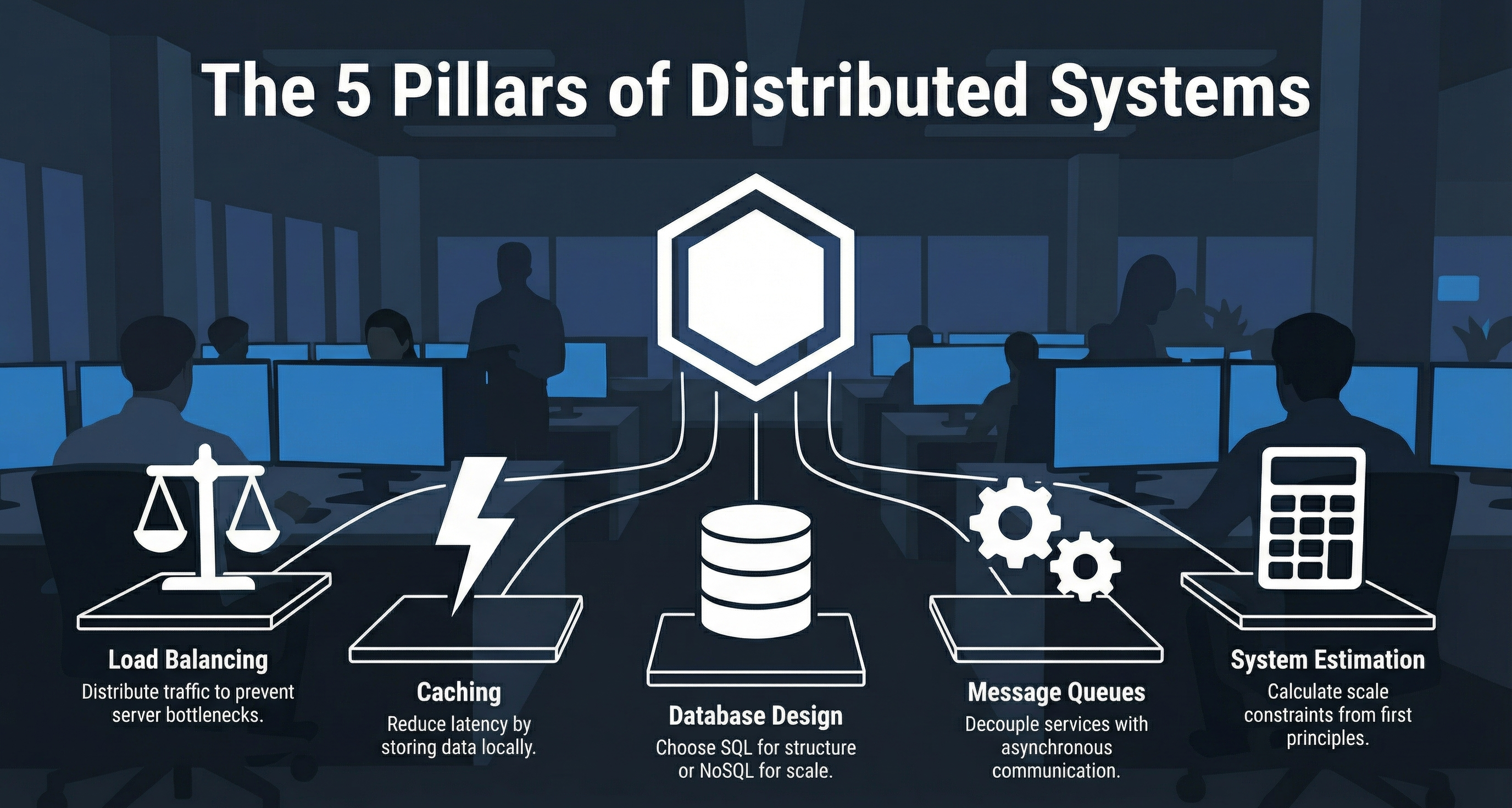
Five foundational distributed systems concepts appear in virtually every design round: load balancing, caching, database design, message queues, and estimation. Skipping them and jumping straight to mocks is a common mistake.
Load balancing is distributing incoming traffic across servers to prevent bottlenecks. Key algorithms include round-robin, weighted round-robin, and consistent hashing. Martin Kleppmann's Designing Data-Intensive Applications covers consistent hashing in depth - it's essential for cache and sharding questions.
Caching stores frequently accessed data closer to users to reduce latency via CDNs. Redis is the most commonly referenced in-memory cache in design interviews. Three invalidation strategies matter: write-through, write-back, and cache-aside - each with distinct trade-offs.
Database design requires knowing when to choose SQL (PostgreSQL, MySQL) vs. NoSQL (DynamoDB, Cassandra). SQL excels for structured data with ACID transactions. NoSQL wins for high-volume, low-latency workloads with flexible schemas.
Message queues like Apache Kafka and RabbitMQ decouple services via asynchronous communication. Kafka handles millions of events per second. RabbitMQ suits complex routing and acknowledgment patterns.
Back-of-the-envelope estimation means calculating QPS, storage, and bandwidth from first principles during the interview. Amazon CTO Werner Vogels has emphasized that understanding scale constraints separates architects from coders.
For quick definitions, the MockWin glossary covers all major concepts in plain language.
How Should You Use AI for Design Interview Prep?
AI serves four distinct roles in preparation. Using the right role at the right stage separates efficient practice from wasted time.
Role 1: Socratic Tutor (Weeks 1–2). Master concepts through dialogue, not passive reading. Prompt: "Act as a Socratic tutor. Ask me fundamental questions about distributed transactions." This builds deeper understanding because it forces you to articulate reasoning at every step.
Role 2: Mock Interviewer (Weeks 3–6). AI platforms simulate real interview pressure - follow-up questions, mid-design constraints, structured time limits. MockWin's adaptive interviewer uses drill-down architecture: it listens to your answer and generates follow-ups based on what you actually said. Three AI personas adjust difficulty - Friendly HR for juniors, Hiring Manager for mid-level, Bar Raiser for senior stress testing.
Role 3: Feedback Engine (Ongoing). After each mock, review structured feedback. MockWin's reporting suite includes a relevance score (0–100%), gap analysis of missed keywords, and a communication report tracking confidence and filler words.
Role 4: Diagram Generator. Create architecture diagrams in Mermaid or PlantUML. Iterate by adding CDN layers, notification services, and presence tracking.
Personalize your sessions by uploading your resume - the AI adapts questions to your experience and target role.
How Does AI Compare to Traditional Prep?
AI-powered preparation offers three advantages over traditional methods - while traditional prep retains one edge AI can't replicate.
| Dimension | Traditional Prep | AI-Powered Prep |
|---|---|---|
| Practice Frequency | 1–2 sessions/week (scheduling friction) | 3–5 sessions/day, on demand |
| Feedback Quality | Varies by partner's experience | Consistent rubric-based scoring |
| Cost | $100+ per session on premium platforms | Unlimited practice at a fraction |
| Social Dynamics | Real interview pressure and body language | Cannot replicate social cues |
| Best Used For | Final calibration (weeks 7–8) | High-volume practice (weeks 1–6) |
| Bottom Line | Essential for final prep - book 2–3 sessions | Use for ~80% of total practice volume |
The optimal approach combines both: AI for rapid iteration during weeks 1–6, then 2–3 human mocks during weeks 7–8 for behavioral calibration. For a deeper look at why AI platforms outperform traditional methods, the data on frequency and consistency is compelling.
What Does an 8-Week Study Plan Look Like?
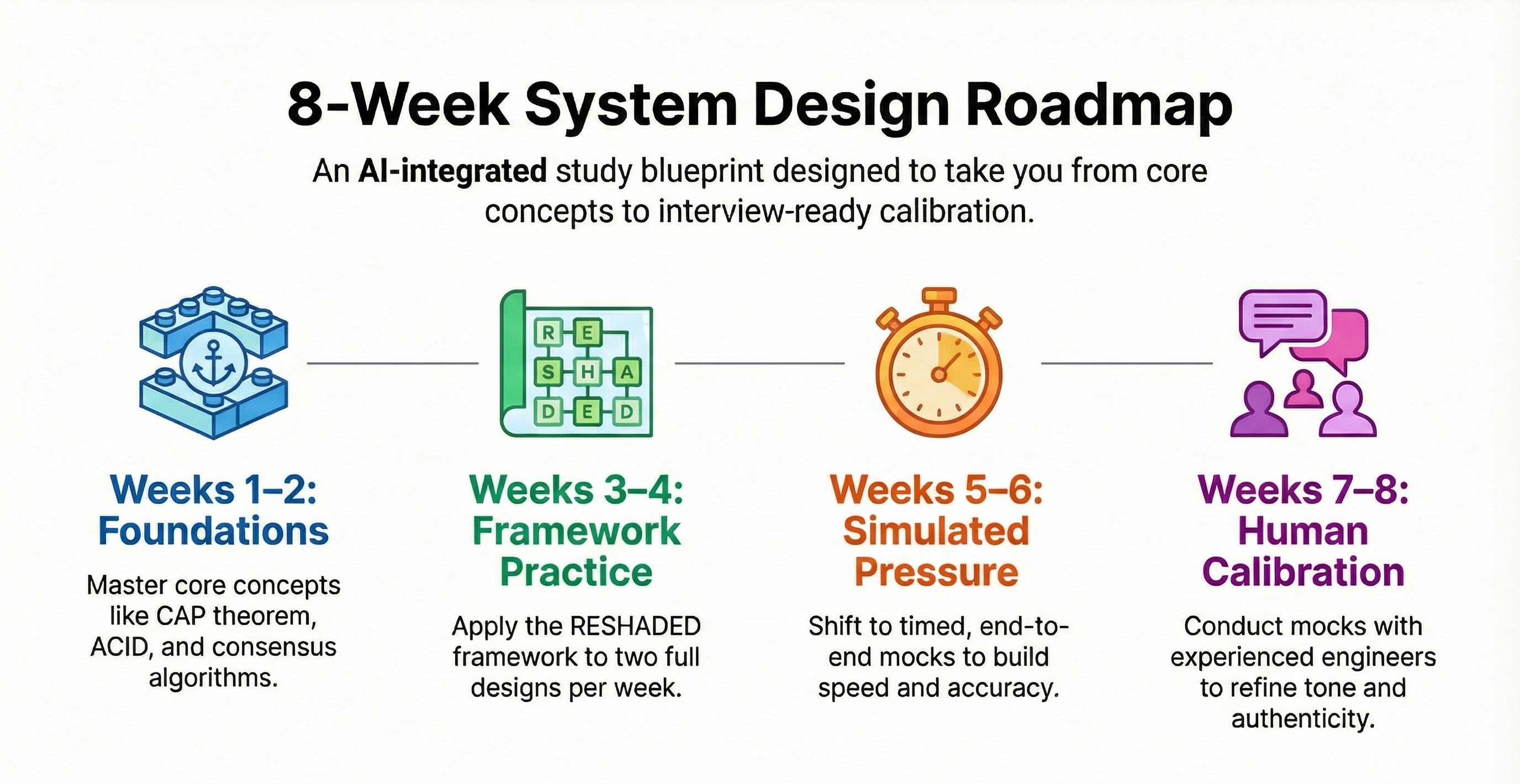
Eight weeks is the standard preparation timeline. This plan integrates AI at every stage while preventing over-reliance on any single tool.
Weeks 1–2: Foundations. Master core concepts using AI as a tutor. Cover the CAP theorem, ACID vs. BASE, and consensus algorithms (Raft, Paxos). Target: all five foundational concepts.
Weeks 3–4: Framework Practice. Adopt the 5-step or RESHADED framework and practice each component in isolation. Use whiteboarding tools like Excalidraw or Miro. Validate estimation math with AI. Target: 2 full designs per week.
Weeks 5–6: Simulated Pressure. Shift to timed end-to-end mocks. MockWin's real-time mode delivers sub-1.5-second latency that feels like a real conversation. Try Challenge Mode to compete with friends on the same design problem. Target: 3–5 mocks per week.
Mid-study checkpoint: By week 4, you should complete a URL shortener design in under 40 minutes. If that feels rushed, spend an extra week on foundations. Start free on MockWin to benchmark where you stand.
Weeks 7–8: Human Calibration. Pivot to human mocks. Book 2–3 sessions with experienced engineers to calibrate tone, pacing, and conversational authenticity.
What Are the 7 Must-Practice Design Problems?
These seven problems cover the architectural patterns tested at major tech companies, based on publicly shared interview experiences:
- URL Shortener (TinyURL) - Hashing, read-heavy DB design, horizontal scaling
- Chat System (WhatsApp) - WebSockets, message persistence, delivery guarantees
- Social Media Feed (Instagram) - Fan-out strategies, ranking algorithms, cache invalidation
- Video Streaming (YouTube) - CDN architecture, transcoding pipelines, storage optimization
- Ride-Sharing (Uber) - Geospatial indexing, real-time matching, surge pricing
- Rate Limiter - Token bucket vs. sliding window, distributed limiting, API gateway design
- Notification System - Priority queues, multi-channel delivery, retry mechanisms
Practice one per day in 30–45 minutes. Review with AI, then improve. For deep-dive walkthroughs, explore the MockWin blog.
What Mistakes Cost Engineers the Most Offers?
Five mistakes cost offers more frequently than any knowledge gap:
- Jumping in without clarifying requirements. Always spend 3–5 minutes asking questions first. Building before understanding the problem is a red flag at every level.
- Overengineering early. Adding Kafka and Kubernetes for 1,000 users shows poor judgment about when complexity adds value.
- Skipping trade-off reasoning. Picking PostgreSQL without explaining why signals pattern-following, not constraint-driven thinking.
- Poor communication. Interview coaches consistently report that communication accounts for 40–50% of evaluation scores. The architecture in your head must reach the whiteboard.
- Ignoring scale. Build for 10x–100x growth, not current traffic. Forward-looking capacity planning is the core skill this round tests.
Quick Tips for Interview Day
- Master one framework (5-step or RESHADED) before practicing specific problems
- Use AI for concept-building (weeks 1–2) and mock interviews (weeks 3–6) - don't mix the roles
- Practice all 7 problems until you finish each in under 40 minutes
- Verbalize every decision - communication weighs as heavily as technical accuracy
- Track weak spots across sessions and focus on recurring gaps, not problems you've mastered
Conclusion
Start tonight: pick one problem from the list above, set a 45-minute timer, and design end-to-end using the 5-step framework. Review your answer with AI feedback, then iterate. That single loop - design, review, improve - repeated across 8 weeks transforms "I don't know where to start" into confident whiteboarding.
As AI interviewing tools evolve through 2026, candidates who combine AI-powered volume with human calibration will hold the strongest preparation edge. Run your first mock on MockWin and see where you stand.
Frequently Asked Questions
What is a system design interview?
A 45–60 minute evaluation where candidates architect large-scale distributed systems while explaining decisions aloud. It tests architectural reasoning, trade-off analysis, and communication - required for senior roles at Google, Amazon, Meta, and Netflix.
How long does it take to prepare?
Typically 4–8 weeks with 3–5 mock sessions per week. Juniors should plan 8 weeks. Seniors with production experience may need 4–5 weeks focused on framework practice and calibration.
Can AI fully replace human mock partners?
Not entirely. AI handles high-volume practice, concept drilling, and consistent scoring effectively. Human mocks remain essential for calibrating tone, reading social cues, and practicing dynamic conversation - schedule 2–3 in your final weeks.
Is the system design interview hard?
Yes - it's consistently rated the most challenging round by senior engineers. Unlike coding interviews with clear right/wrong answers, design rounds are open-ended with multiple valid approaches. The difficulty comes from structuring ambiguity under time pressure.
What topics should beginners learn first?
Five concepts: load balancing, caching (Redis, CDNs), SQL vs. NoSQL databases, message queues (Kafka), and back-of-the-envelope estimation. Then move to the 7 must-practice problems listed above.
How do I prepare for system design in 2 weeks?
Two weeks is tight but possible for experienced engineers. Focus on the 5-step framework and the 3 most-asked problems (URL shortener, chat system, social feed). Run 2 AI mocks daily and 1 human mock in week 2.
What's the best book for system design prep?
Alex Xu's System Design Interview – An Insider's Guide (Volumes 1 & 2) is the most widely recommended. Pair it with Martin Kleppmann's Designing Data-Intensive Applications for deeper distributed systems foundations.
Tags
Shaik Vahid
Content Writer and Jr. SEO Specialist delivering high-impact, SEO-focused content where creativity meets data to drive real results.
Related Articles

AI Interview Practice by Role: The Complete Guide to Nailing Any Job Interview
AI interview practice by role simulates the exact technical and cognitive demands of a specific profession. Because 75% of enterprises use AI screening, generic preparation creates robotic responses that trigger algorithmic rejections. By mastering role-specific metrics such as system design constraints or sales empathy candidates utilizing adaptive AI secure offers 3.2x faster and achieve an 89% success rate.