
AI Interview Practice by Role: The Complete Guide to Nailing Any Job Interview
AI interview practice by role simulates the exact technical and cognitive demands of a specific profession. Because 75% of enterprises use AI screening, generic preparation creates robotic responses that trigger algorithmic rejections. By mastering role-specific metrics such as system design constraints or sales empathy candidates utilizing adaptive AI secure offers 3.2x faster and achieve an 89% success rate.
Why is AI Interview Practice by Role Essential?
AI interview practice by role transforms generic preparation into targeted, industry-specific rehearsal. When you rely on generalized mock interviews, you risk sounding robotic and missing the critical competencies hiring managers actually evaluate. This guide reveals how specialized artificial intelligence platforms analyze your resume, match you against precise job descriptions, and simulate the exact pressure you will face in an algorithmic screening. By tailoring questions and real-time feedback to your specific profession, you build the required cognitive muscle memory to excel. You will learn the specific metrics systems evaluate across nine major career tracks, discover step-by-step implementation strategies, and see exactly how role-specific preparation outperforms traditional coaching methods.
TL;DR: Key Takeaways
Targeted Preparation AI interview practice by role abandons generic scripts, using your resume and exact job descriptions to simulate highly specific interview scenarios.
Role-Specific Evaluation Systems test exact domain competencies, assessing system design for engineers, objection handling for sales, and clinical accuracy for healthcare roles.
Objective Analytics Receive instant, data-driven feedback on your STAR method adherence, vocal pacing, and technical vocabulary.
Competitive Advantage High-fidelity, industry-specific rehearsal desensitizes candidates to cognitive pressure, significantly outperforming traditional, subjective coaching.
What Is AI Interview Practice by Role?
AI interview practice by role is a specialized preparation methodology that leverages artificial intelligence to simulate realistic, job-specific assessment scenarios. Unlike generic chatbots, this approach focuses exclusively on evaluating the unique technical competencies, industry terminology, and cognitive challenges required for your targeted professional function.
This targeted method eliminates the "one-size-fits-all" trap by generating questions based on the exact requirements of your target position. You experience AI interview practice by role through platforms that utilize smart resume parsing and job description matching to build an adaptive simulation. These systems measure your problem-solving approach, technical vocabulary, and communication style against rigid industry benchmarks. By mirroring the algorithms used in enterprise applicant tracking systems, you prepare for the precise behavioral and technical signals that secure job offers.

Why Role-Specific AI Practice Outperforms Generic Prep
Role-specific AI practice outperforms generic preparation because it tests you on the exact technical skills, operational metrics, and situational judgment scenarios relevant to your industry. Generic tools train you to recite memorized, robotic answers, whereas role-specific AI evaluates your substantive domain expertise and structural logic.
When you use a generic AI tool, the algorithm optimizes for broad, probable linguistic patterns, systematically stripping away the unique analytical perspectives required for highly competitive roles. This phenomenon, known as regression toward the mean, causes candidates to sound identical to everyone else, resulting in high algorithmic rejection rates. A study highlighted by Harvard Business Review noted that keyword-stuffing and generic approaches lead to severe rejection rates for otherwise qualified candidates.
Role-specific tools conduct a diagnostic comparison between your resume and the target job description, identifying critical skill gaps. If you lack a required technical skill, the AI proactively challenges you on how you will overcome that deficit, ensuring you are never blindsided during the actual evaluation. Furthermore, custom platforms provide deep, multi-modal analysis. They track vocal pacing, facial sentiment, and structural adherence to frameworks like the STAR method. This level of high-fidelity simulation conditions candidates to withstand aggressive follow-up questioning and intense cognitive load.
AI Interview Practice by Role - Complete Breakdown
AI interview practice by role adapts its evaluation criteria, question types, and scoring rubrics entirely based on the chosen profession. The system tests developers on system architecture, sales representatives on objection handling, and product managers on strategic prioritization.
Software Engineer
Focus Area: Algorithmic problem-solving, scalable system design, and clean code explanation.
Example Questions: "Design a rate limiter for a distributed API," or "Explain the concept of polymorphism and provide a real-world example in your preferred programming language.".
Skills Evaluated: The AI evaluates your clarity in explaining complex technical concepts, your ability to defend architectural trade-offs against simulated latency constraints, and your precision with industry-specific terminology. The system tracks whether you structure your solutions logically and address obscure edge cases rather than just reciting algorithmic syntax.
Product Manager
Focus Area: Product vision, feature prioritization, stakeholder management, and deep user empathy.
Example Questions: "How would you prioritize a new feature for a social media app among competing internal requests?" or "Walk me through your strategy for launching a digital product in a saturated market.".
Skills Evaluated: AI measures your ability to bridge technical constraints with overarching business goals, articulate a clear product roadmap, and justify strategic decisions using data. The assessment focuses heavily on how you handle trade-offs and communicate your decision-making framework.
Data Scientist
Focus Area: Statistical principles, machine learning model selection, and communicating complex quantitative findings to non-technical stakeholders.
Example Questions: "Describe your approach to building a recommendation engine, including your selected data sources, algorithms, and evaluation metrics.".
Skills Evaluated: The system assesses your analytical rigor, depth of statistical knowledge, and your structural logic in outlining an evidence-based methodology. Evaluators look for logical structure, precise terminology, and the ability to clearly articulate complex analytical processes.
Marketing Manager
Focus Area: Campaign strategy, ROI measurement, brand positioning, and competitive market analysis.
Example Questions: "Outline a comprehensive six-month marketing strategy for a new product launch in a highly competitive market.".
Skills Evaluated: AI tracks your use of quantifiable metrics, such as Customer Acquisition Cost (CAC) or Lifetime Value (LTV), your creativity in strategic thinking, and your results-driven narrative structure. The system rewards data-driven storytelling that connects marketing tactics directly to measurable business outcomes.
Finance & Analyst
Focus Area: Financial modeling, risk assessment, data interpretation, and absolute quantitative accuracy.
Example Questions: "How do you project revenue growth and assess risk for a subscription-based software company?".
Skills Evaluated: The system evaluates your numerical reasoning, attention to detail, and ability to structure concise qualitative responses to complex market data. Evaluators grade your command of financial concepts and your ability to defend your market analysis under direct scrutiny.
UX Designer
Focus Area: User-centric problem solving, the design thinking process, and cross-functional collaboration.
Example Questions: "Explain how you would redesign a mobile checkout flow to drastically reduce shopping cart abandonment.".
Skills Evaluated: AI looks for evidence of user empathy, structured design methodologies, and clear articulation of design trade-offs. You must demonstrate your ability to utilize wireframing, user testing data, and cross-functional feedback to drive design improvements.
Sales & BizDev
Focus Area: Empathic discovery, aggressive objection handling, closing techniques, and pipeline management.
Example Questions: "A potential enterprise client expresses hesitation about your product's pricing model. How do you address their concern and move the sale forward?".
Skills Evaluated: The platform analyzes your active listening cues, persuasion score, enthusiasm, and adherence to sales frameworks when facing adversarial buyer personas. The system rewards responses that emphasize customer benefits over raw product features and demonstrate immense resilience.
Healthcare
Focus Area: Clinical knowledge, patient empathy, regulatory compliance, and high-stress decision making.
Example Questions: "Describe a time you had to deliver difficult news to a patient's family while strictly adhering to hospital clinical protocols.".
Skills Evaluated: The AI rigorously verifies your understanding of specialized regional regulatory standards, your clinical credentials, and your emotional intelligence in simulated patient scenarios. The evaluation prioritizes precision in clinical terminology and empathy in high-stakes environments.
How It Works - Step by Step
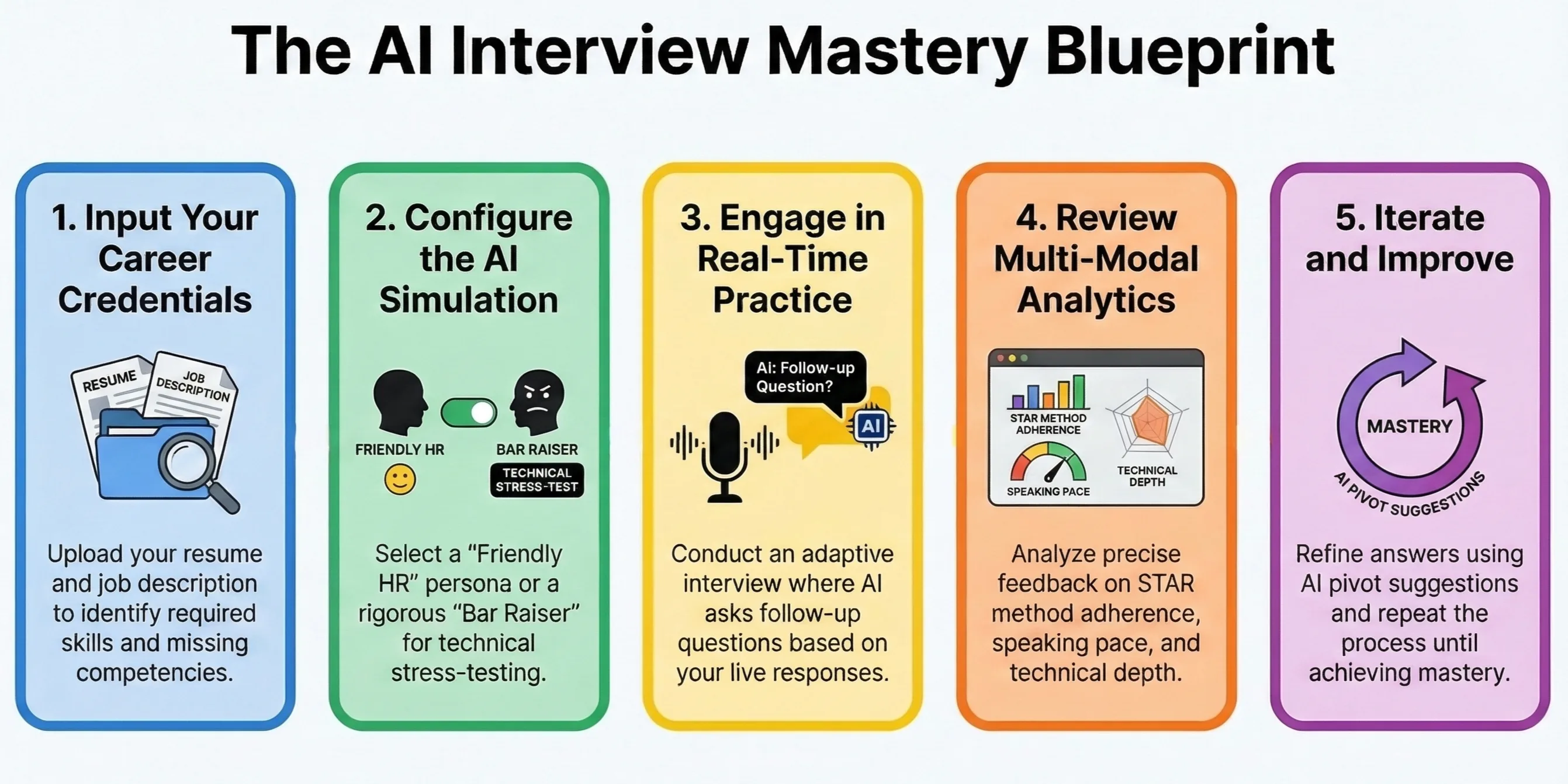
Implementing AI interview practice by role requires a structured approach that moves from initial assessment to high-fidelity simulation. You must input your target data, engage with an adaptive AI, and analyze the resulting metrics to continuously refine your delivery.
- Input Your Credentials: Upload your resume and paste the exact job description into the platform. The AI's context engine performs a diagnostic scan to identify your required tech stack, soft skills, and crucial missing competencies to build your resume-based interview practice.
- Configure the Simulation: Select the AI persona that matches your current interview stage. You can choose a "Friendly HR" layer for an initial behavioral screening or a rigorous "Bar Raiser" setting for deep technical stress-testing.
- Engage in Real-Time Practice: Conduct the interview using a real-time AI interview interface. The system utilizes an adaptive drill-down logic to ask consecutive follow-up questions based entirely on the content you speak, perfectly mimicking a live, curious hiring manager.
- Review Multi-Modal Analytics: Immediately after the session, the reporting engine generates your comprehensive AI interview feedback. You receive precise scores on your STAR method adherence, exact skill depth, speaking pace, and filler word frequency.
- Iterate and Improve: Use the AI's pivot suggestions to identify missed opportunities where you could have directed the conversation. Refine your answers to include verifiable industry metrics and practice repeatedly until you reach absolute mastery.
AI Practice vs. Traditional Coaching
AI interview practice provides immediate, scalable, and data-driven feedback at a fraction of the cost of traditional coaching. While human coaches offer high-level networking and relationship advice, specialized AI platforms deliver unlimited, objective repetitions to build rapid cognitive muscle memory.
| Feature | AI Practice by Role | Traditional Coaching |
|---|---|---|
| Cost Structure | $125 - $250 total investment | $2,000 - $16,000 per engagement |
| Availability | 24/7 on-demand, unlimited repetitions | Subject to scheduling bottlenecks |
| Feedback Quality | Objective, multi-modal data analytics | Highly personalized, but subjective |
| Scenario Customization | Hyper-specific parsing of exact job descriptions | Relies on the coach's specific industry background |
| Bias | Standardized algorithmic evaluation mitigates heuristic bias | Susceptible to human cognitive biases |
Try role-specific questions now to experience the difference objective data makes in your preparation.
How to Get Maximum Results
To maximize your results with an AI interview coach, you must treat the simulation with the exact seriousness of a live evaluation. Provide accurate job descriptions, enable strict scoring parameters, and actively implement the data-driven feedback after every session.
Treat the AI as a sparring partner, not an answer generator. Do not ask the AI to write a perfect script for you to memorize, as this completely bypasses the cognitive learning process. Instead, attempt to solve the problem independently and use an adaptive AI mock interviewer to critique your logic and expose structural flaws. Customize your STAR examples using domain-specific terminology, ensuring you replace vague narratives with quantifiable, role-focused evidence. Track your progress continuously; the high-velocity repetition actively desensitizes you to the cognitive pressure of the real event.
Common Mistakes to Avoid
The most frequent mistake candidates make is relying on generic, foundational language models that lack the vertical specialization required for advanced roles. You must avoid generic platforms, unstructured prompts, and passive consumption to succeed in algorithmic assessments.
Never memorize AI-generated text. This produces a wooden, artificial performance that fails immediately under real-time human scrutiny. Avoid skipping fundamental patterns; ensure you recognize the core competencies behind the questions rather than just memorizing static answers. Never practice without simulating real constraints. Use a strict timer, speak your reasoning out loud, and force the AI to adopt an adversarial or highly rigorous persona to propose obscure edge cases.
Practice with AI feedback to identify your weaknesses before a hiring manager does.
Conclusion
The transition to algorithmic candidate screening requires an equally sophisticated preparation strategy. Embracing AI interview practice by role ensures you build genuine, verifiable competence rather than relying on generic, easily detectable scripts. By repeatedly testing your skills against an adaptive, role-specific intelligence, you transform interview anxiety into authoritative confidence.
Stop leaving your career progression to chance and hoping generic advice will secure a specialized position. Practice with the exact metrics, constraints, and operational frameworks that modern hiring managers demand. Start your targeted preparation today, master your specific domain competencies, and secure the job offer you deserve.
FAQs
What is AI interview practice?
AI interview practice is a methodology where candidates use artificial intelligence to simulate realistic job interviews. The system asks targeted questions, records the candidate's audio and visual responses, and provides detailed data analytics on communication skills, technical accuracy, and structural logic.
How does it work by role?
The AI ingests your specific resume and target job description to create a customized evaluation. It adjusts its terminology, question difficulty, and grading rubrics to match the exact competencies required for your specific profession, whether in software engineering, sales, or healthcare.
Is it effective?
Yes. Candidates utilizing structured, specialized AI practice environments secure job offers up to 3.2 times faster than their peers. MIT Sloan research confirms that combining AI evaluations with human judgment drastically improves hiring accuracy and candidate performance under pressure.
Which roles benefit most?
Highly specialized and competitive fields see the most dramatic improvements. Software engineers facing system design challenges, data scientists managing algorithmic logic, enterprise sales professionals handling complex objections, and clinical healthcare workers verifying strict medical credentials benefit massively from targeted simulations.
How is it different from traditional coaching?
Unlike human coaches who rely on subjective feedback and limited availability, AI platforms provide 24/7 access to objective, multi-modal analytics. You receive immediate, data-driven scores on your exact speaking pace, keyword alignment, and framework adherence for a fraction of the cost.
Can AI give real feedback?
Absolutely. Advanced platforms analyze your vocal pacing, filler word frequency, facial sentiment, and the substantive depth of your technical answers. They highlight circular reasoning, identify missed opportunities from your resume, and provide actionable pivot suggestions to improve your delivery.
Is it free?
While basic, generic AI chatbots are free, they lack the multi-modal analysis and role-specific rigor required for serious preparation. Premium platforms built specifically for interview coaching offer high-fidelity simulations and deep analytics, typically operating on an affordable subscription model.
How do I choose the right tool?
Select a platform that offers role-specific question banks, adaptive follow-up logic, and detailed performance analytics. Ensure the tool supports resume-based generation and allows you to calibrate the AI's strictness to match the seniority and pressure of your target role.
Tags
Shaik Vahid
Content Writer and Jr. SEO Specialist delivering high-impact, SEO-focused content where creativity meets data to drive real results.
Related Articles

System Design Interview Prep with AI
System design interview preparation with AI is the fastest way to close the gap between knowing distributed systems and actually performing under a 45-minute clock. This guide breaks down a proven 5-step framework widely used by candidates preparing for top tech companies, the core architecture concepts - load balancing, caching, database design, message queues, and back-of-the-envelope estimation - that appear in every round, and a structured 8-week study plan combining AI-powered mock interviews with human calibration. Whether you're a junior engineer facing your first design round or a senior targeting staff roles at Google, Amazon, Meta, or Netflix, this is the actionable roadmap that turns "I don't know where to start" into confident whiteboarding. All content is for educational purposes only; company names, frameworks, and tools referenced are trademarks of their respective owners and are used solely for identification and context.