
Real Interview Simulation vs Practice Mode
This blog breaks down the critical differences between real interview simulation and practice mode, explains when and why to use each, and shows how MockWin’s AI-powered platform delivers both with adaptive questions, voice interviews, STAR analysis, readiness scores, and role-specific prep.
Introduction: The Question Every Job Seeker Asks
You have a big interview coming up. You open your prep platform and face two options: jump into a real-time AI interview simulation that mimics an actual interview under pressure, or use practice mode to rehearse answers at your own pace. Which do you pick?
This is one of the most common and most important decisions in interview preparation. Get it wrong and you either over-prepare in a low-pressure bubble or burn out on high-intensity drills before your actual interview. Get it right and you walk into that room with a confidence score of 98 out of 100.
In this guide, we break down everything: what real interview simulation and practice mode actually mean, how they differ, when each works best, and how MockWinthe #1 AI interview platform gives you the best of both worlds through its adaptive, role-specific, resume-powered interview engine.
75%
of candidates feel underprepared going into interviews
60%
of hiring managers say communication skills matter as much as qualifications
3x
more likely to succeed with structured interview practice
What Is Practice Mode?
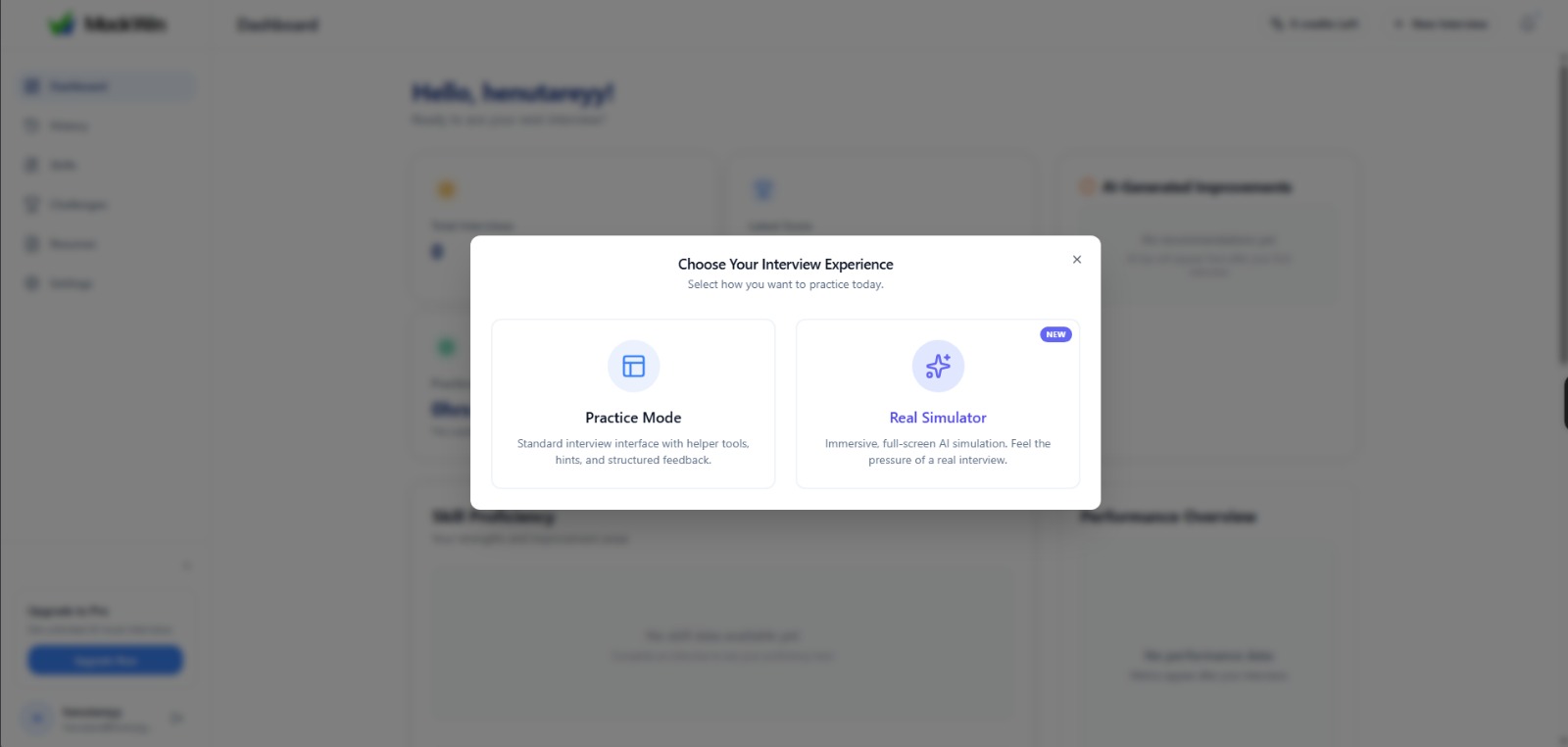
Practice mode is a low-stakes, self-paced environment where you work through interview questions without the pressure of real-time constraints. Think of it as your personal rehearsal space a place to explore, stumble, rewind, and refine.
In a typical practice mode, you:
- Read or hear a question at your own pace
- Draft, revise, or record your answer without time pressure
- Review model answers or frameworks like STAR (Situation, Task, Action, Result)
- Focus on specific skills, question types, or industries
- Revisit difficult topics as many times as needed
Practice mode is ideal for building your foundation. It is where you internalize frameworks, expand your vocabulary for technical topics, and rehearse your professional story. However, it has a critical limitation: it does not replicate the real emotional and cognitive pressure of an actual interview.
💡 MockWin Practice Mode Insight
MockWin’s role-specific practice library gives you access to 500+ Software Engineer questions, 400+ Data Science questions, 350+ Product Manager questions, and hundreds more across Marketing, Sales, Cybersecurity, Healthcare, and other roles all calibrated to your experience level.
What Is Real Interview Simulation?
Real interview simulation is a high-fidelity replication of an actual job interview. It happens in real time, under realistic conditions, with adaptive questions that respond to your answers just like a human interviewer would.
In a real interview simulation, you:
- Answer questions in real time with no pause or rewind
- Experience AI voice interaction that mimics a live interviewer
- Face follow-up questions based on what you said
- Receive a readiness score and detailed performance report after completion
- Practice under genuine cognitive and emotional pressure
The science behind this matters: research in cognitive psychology shows that skills practiced under stress conditions are far more accessible during actual stress events. In other words, if you only practice in a calm environment, you may find your mind going blank the moment a real interviewer asks an unexpected follow-up.
🎤 MockWin Real-Time AI Voice Interview
MockWin’s adaptive AI mock interviewer uses low-latency voice technology to simulate a live conversation. Questions dynamically adapt based on your responses, experience level, and target role so every session feels like a real interview, not a scripted quiz.
Real Interview Simulation vs Practice Mode: Head-to-Head Comparison
| Feature | Practice Mode | Real Interview Simulation |
|---|---|---|
| Pressure Level | Low (self-paced) | High (real-time, adaptive) |
| Question Adaptability | Static or role-based | Dynamic, adjusts to your answers |
| Voice Interaction | Optional / text-based | Live AI voice conversation |
| Time Constraints | None | Mimics real interview timing |
| Feedback Type | General tips & frameworks | Detailed STAR analysis, readiness score |
| Ideal Stage | Early prep (weeks before) | Final prep (days before interview) |
| Skill Built | Knowledge & frameworks | Confidence, fluency, stress resilience |
| Resume Integration | Partial | Full resume + JD alignment |
| Coding Rounds | Practice problems | Live adaptive coding interviews |

When Should You Use Practice Mode?
Practice mode is your best friend during the early and middle stages of interview preparation. Here is when to lean into it:
- You Are New to a Role or Industry: Build domain vocabulary and explore expected question types without anxiety.
- You Are Learning a New Framework: Internalize the STAR method or system design fundamentals until they become second nature.
- You Have More Than Two Weeks Before Your Interview: Build the knowledge base first; simulate the pressure later.
- You Want to Target Specific Skill Gaps: Use MockWin’s skill gap identification to drill precisely what you're missing.
📊Structured practice vs. improvisation
A study by the Journal of Applied Psychology found that candidates who practiced with structured feedback improved their interview performance scores by 26% compared to those who simply reviewed notes.
When Should You Use Real Interview Simulation?
Real interview simulation is your most powerful preparation tool in the final stretch. Here is when it becomes essential:
- You Have an Interview in the Next 1-7 Days: Move from learning to performing. MockWin’s simulation replicates exact conditions.
- You Know Your Content But Freeze Under Pressure: Build the stress inoculation your nervous system needs to avoid "blanking out."
- You Are Targeting Competitive Roles: Train to maintain quality across 45–60 minutes of sustained questioning.
- You Want a Measurable Readiness Score: Get an objective report on technical depth, communication, and problem-solving.
🏆 MockWin Readiness Score - Real Data
MockWin candidates who score above 85 in their simulation readiness score report a significantly higher callback rate. Top candidates score in the 92–98 range.
How MockWin Combines Both: The Smart Prep Framework
The best preparation uses both intelligently. Follow this five-step framework:
- Step 1 → Upload Your Resume + Job Description: Use resume-based generation to identify gaps.
- Step 2 → Explore Role-Specific Practice Mode: Dive into libraries for Software Engineering, Product Management, and more.
- Step 3 → Target Your Skill Gaps: Use the skill gap report to focus your sessions.
- Step 4 → Run Full Real-Time Simulations: Switch to AI voice mode for maximum realism.
- Step 5 → Review, Score, Repeat: Iterate until you hit a readiness score of 85+.
Why MockWin Is the #1 AI Interview Platform
🤖 Adaptive AI Mock Interviewer
MockWin’s AI listens and dynamically adjusts follow-up questions based on your answers. It's a genuine conversation, not a scripted quiz.
🎤 Real-Time AI Voice Interviews
Uses low-latency voice AI to train your verbal fluency and composure. Learn more about the assistant.
📝 Resume-Based Interview Generation
Extracts your actual experience and maps it against role requirements. No generic questions.
★ STAR Analysis & Behavioral Scoring
Every answer is evaluated for Situation, Action, and quantified Results. Check your feedback.
📊 Skill Gap Identification
Compares job descriptions against your answers to tell you exactly what to focus on.
📱 More Features
- Chrome Extension: Convert LinkedIn listings into mock interviews with the MockWin extension.
- Challenge Mode: Benchmark yourself against peers in Challenge Mode.
- Mobile App: Practice on the go with our Early Access app.
The Data Behind Effective Interview Preparation
| Insight | Data Point |
|---|---|
| AI Mock Interview Usage | 40% higher confidence vs. self-prep |
| STAR-structured answers | 35% more favorable rating (SHRM) |
| Voice interview practice | Reduces filler words by 50% in 5 sessions |
| Resume-aligned preparation | Increases interview-to-offer conversion by 28% |

5 Common Interview Prep Mistakes (And How MockWin Fixes Them)
Mistake 1: Only practicing in comfort zones
MockWin’s adaptive simulation adds real-time pressure to close the gap between practice and performance.
Mistake 2: Using generic question lists
MockWin uses role-specific libraries and resume-based generation to ensure hyper-relevance.
Mistake 3: Ignoring the STAR framework
Our AI scores every behavioral answer and gives actionable guidance to tighten your story.
Mistake 4: Not practicing voice out loud
Voice mode forces you to articulate and pace yourself, just like the real thing.
Mistake 5: No feedback loop
Post-interview reports provide a readiness score and specific improvement suggestions.
The Verdict: Which Should You Use?
The answer is both in the right order. Use Practice Mode when you are 2+ weeks out or learning frameworks. Use Real Simulation when the interview is in 1–7 days or you need to practice under pressure.
Ready to Master Your Interview Strategy?
Practice with MockWin’s adaptive AI interviewer
Start Free AI Mock InterviewFrequently Asked Questions
What is the difference between a mock interview and an interview simulation?
A mock interview is a broad term, while simulation refers to high-fidelity, real-time replication with adaptive questions and scoring.
How many mock interview sessions should I do?
Aim for 3-5 structured practice sessions and at least 2 full simulations. Aim for a score of 85+.
Does MockWin’s AI adapt to my specific resume?
Yes, it analyzes your background and the JD to generate specific questions and identify gaps.
Is MockWin suitable for both freshers and experienced professionals?
Absolutely. It calibrates difficulty and focus based on your specific experience level.
Can I use MockWin to practice for coding interviews?
Yes, we have a dedicated coding mode covering data structures to system design.
Tags
Neelekhana
Content Writer and SEO Specialist crafting impactful, search-optimized content that drives visibility blending creativity with data to deliver meaningful results.