

Why Mock Interviews Are Crucial for Job Seekers
A comprehensive guide on why mock interviews are crucial for job seekers, covering benefits, use cases, challenges, solutions, and how interview practice improves hiring success.
Why Mock Interviews Are Crucial for Job Seekers in Today’s Competitive Market
In today’s job market, landing interviews is no longer the hardest part converting interviews into offers is. Thousands of qualified candidates get rejected every week, not because they lack skills, but because they fail to communicate those skills effectively under pressure.
This is where mock interviews move from being “optional practice” to a career-defining strategy.
Mock interviews bridge the gap between knowing your job and convincing someone to hire you. They prepare candidates for real interview conditions, sharpen communication, and dramatically improve confidence and performance.
TL;DR/At-a-Glance Summary
What Are Mock Interviews?
Mock interviews are simulated interview sessions designed to mirror real hiring scenarios. They replicate:
- Actual interview questions
- Time pressure
- Behavioral and technical evaluations
- Follow-up probing from interviewers
Unlike passive preparation (reading articles or memorizing answers), Mock interviews force candidates to perform, receive feedback, and improve iteratively.

Why Mock Interviews Matter More Than Ever
1. Interviews Are Performance-Based Evaluations
Hiring managers don’t just assess experience they assess:
- How clearly you think
- How confidently you speak
- How well you align with business goals
- How you respond under uncertainty
Mock interviews train candidates to perform on demand, not just recall information.
2. Confidence Is Built, Not Assumed
According to multiple hiring studies, over 65% of interview rejections are linked to communication and confidence gaps, not lack of qualifications.
Mock interviews:
- Reduce anxiety through repetition
- Improve body language and tone
- Eliminate rambling and filler words
- Create calm, structured responses
Confidence becomes predictable, not accidental.
3. Preparation Now Beats Experience
Well-prepared candidates frequently outperform more experienced ones. Why?
Because preparation enables:
- Clear storytelling
- Role-specific positioning
- Strong first impressions
- Persuasive closing answers
Mock interviews level the playing field for:
- Fresh graduates
- Career switchers
- Professionals re-entering the workforce
How Mock Interviews Work
Step 1: Role & Company Simulation
Questions are tailored to the job role, industry, and seniority level.
Step 2: Real-Time Interview Practice
Candidates answer behavioral, situational, and technical questions in a timed, realistic environment.
Step 3: Structured Feedback
Feedback highlights:
- Weak answers
- Communication gaps
- Missed opportunities to showcase impact
Step 4: Iterative Improvement
Candidates repeat sessions, refining answers until clarity and confidence become natural.
Platforms like Mockwin.ai allow candidates to practice on-demand, simulate real interviews, and receive actionable feedback making preparation continuous rather than one-time.
Key Features of Effective Mock Interviews
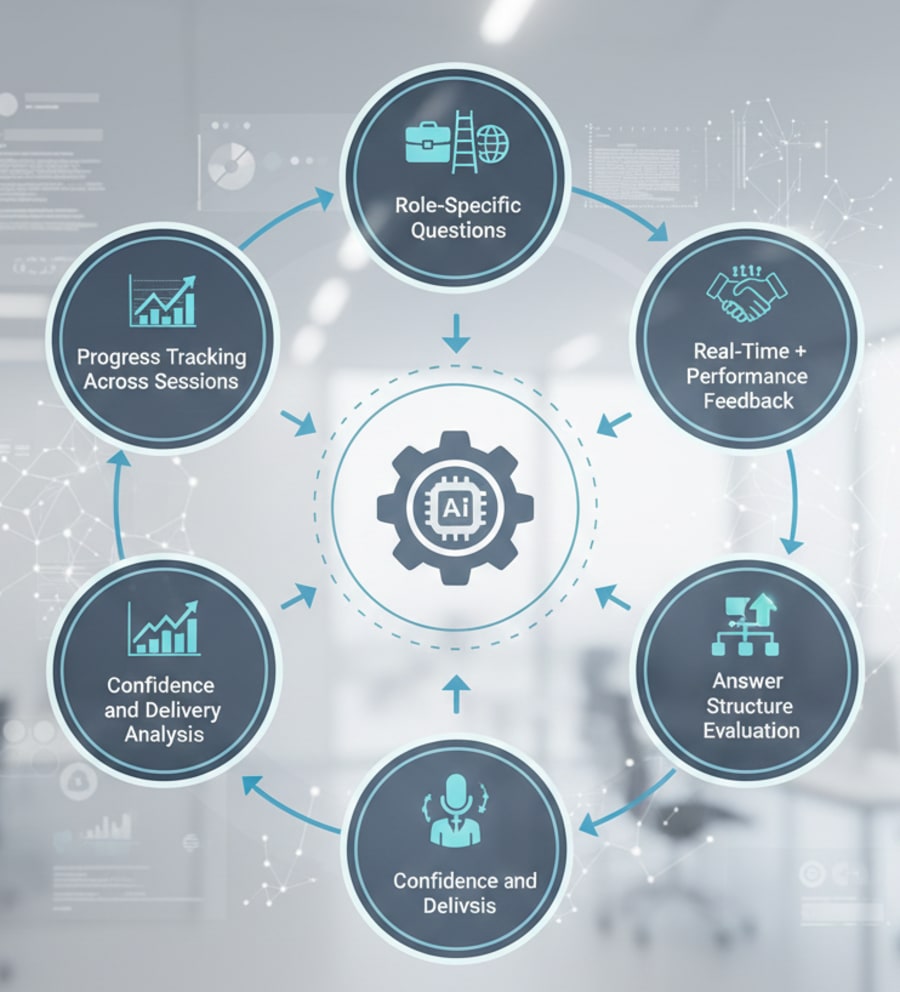
Role-specific question sets
Interview questions tailored to your exact job role, seniority, and industry to ensure relevant, focused preparation.
Behavioral + technical coverage
Balanced practice across behavioral, situational, and technical questions to mirror real interview formats.
Real-time performance feedback
Instant insights on your answers, highlighting strengths, gaps, and areas for immediate improvement.
Answer structure evaluation (STAR, clarity, impact)
Analysis of how well your responses are structured, clear, and results-driven using proven frameworks.
Confidence and delivery analysis
Feedback on tone, pacing, body language, and presence to help you sound confident and composed.
Progress tracking across sessions
Continuous performance tracking to measure improvement and refine weak areas over time.
These features turn preparation into a repeatable system, not guesswork.
Mock Interviews vs Traditional Interview Preparation
| Factor | Traditional Prep | Mock Interviews |
|---|---|---|
| Learning Style | Passive (reading, watching) | Active (speaking, performing) |
| Confidence Building | Limited | High |
| Feedback | None or delayed | Immediate |
| Realism | Low | High |
| Offer Conversion | Inconsistent | Significantly higher |
Mock interviews convert knowledge into execution the exact skill interviews demand.

Common Challenges Job Seekers Face (And How Mock Interviews Solve Them)
1: “I Know the Answer but Freeze”
Repeated mock sessions reduce cognitive overload and improve recall under pressure.
2: Weak or Unclear Stories
Feedback refines examples into structured, outcome-driven narratives.
3: Nervous Body Language
Practice builds awareness and control over tone, posture, and pacing.
4: Poor Follow-Up Responses
Simulated probing questions improve adaptability and quick thinking.
Real-World Use Cases of Mock Interviews
- Fresh Graduates: Learn how to translate academic projects into business value.
- Career Switchers: Position transferable skills clearly and confidently.
- Experienced Professionals: Eliminate complacency and sharpen executive-level communication.
- Technical Candidates: Practice explaining complex ideas in simple, interviewer-friendly language.
- Repeated Interview Rejections: Identify hidden performance gaps causing offer drop-offs.
Benefits of Mock Interviews for Job Seekers
- Higher interview-to-offer conversion rate
- Clear, confident communication
- Stronger first impressions
- Reduced interview anxiety
- Better salary and role negotiations
- Faster job search outcomes
Candidates who practice mock interviews consistently stop guessing and start controlling outcomes.
Why Mock Interviews Are a Long-Term Career Skill
Mock interviews don’t just help you land one job they build:
- Executive communication
- Persuasive storytelling
- Strategic thinking
- Professional presence
These skills compound across promotions, leadership roles, and career transitions.
Conclusion: Interviews Don’t Reward Potential They Reward Preparation
Experience may open doors, but mock interviews decide who walks through them.
In a market where every interview matters, practicing how you speak, think, and present yourself is no longer optional. Mock interviews transform preparation into performance and performance into offers.
If you’re serious about your job search, practice like the job depends on it because it does.
(FAQs)
1. Are mock interviews really effective for experienced professionals?
Yes. Experience without preparation often leads to overconfidence and weak delivery. Mock interviews refine how experience is communicated.
2. How many mock interviews should I do?
Most candidates see noticeable improvement after 3–5 sessions, with continued gains afterward.
3. Can mock interviews help with technical roles?
Absolutely. They improve how technical concepts are explained, not just what you know.
4. Are AI-based mock interviews reliable?
Modern AI mock interview platforms provide structured, unbiased feedback and allow unlimited practice, making them highly effective.
5. When should I start mock interview practice?
Ideally before applying or immediately after securing interviews not the night before.
Tags
Neelekhana
Content Writer and SEO Specialist crafting impactful, search-optimized content that drives visibility blending creativity with data to deliver meaningful results.
Related Articles

Traditional Interview Prep vs AI Interview Prep
A detailed comparison of traditional interview preparation vs AI interview preparation with real hiring stats and why MockWin’s AI mock interviews deliver faster, smarter results for job seekers.

AI-Powered Mock Interview
Learn what AI-powered mock interviews are, how they work, benefits, features, use cases, and why platforms like Mockwin.ai are transforming interview preparation

Common Interview Mistakes That Cost Candidates the Job (And How to Fix Them)
Drawing on recruitment industry benchmarks and AI-driven analysis, this guide identifies the specific patterns that frequently lead to rejection. We analyze not just what goes wrong, but the psychology behind common interview mistakes, providing you with actionable strategies and tools to help turn potential red flags into green lights.