

Common Interview Mistakes That Cost Candidates the Job (And How to Fix Them)
Drawing on recruitment industry benchmarks and AI-driven analysis, this guide identifies the specific patterns that frequently lead to rejection. We analyze not just what goes wrong, but the psychology behind common interview mistakes, providing you with actionable strategies and tools to help turn potential red flags into green lights.
Why Even Smart Candidates Make Common Interview Mistakes
You have the perfect resume. You have the right degree. You might even be the smartest person in the room. Yet, the job offer never comes. Why? Because hiring decisions are rarely made solely on technical competence. They are often decided by "gut feeling" , a metric heavily influenced by subconscious errors candidates make in the first few minutes. These are not obvious blunders; they are subtle, silent killers of credibility. In this guide, we dissect the most common interview mistakes that sabotage success and provide a clear roadmap to eliminating them.
Methodology (How This Guide Was Built)
This guide is based on recurring rejection patterns observed in high-volume recruitment workflows, combined with structured mock interview analysis (speech pace, filler words, answer structure, and virtual presence signals). The goal is to highlight preventable interview behaviors that are commonly associated with lower conversion rates in screening and hiring loops.
Note: This guide provides general interview preparation guidance and does not guarantee hiring outcomes. Hiring decisions vary by company, role, and interviewer.
TL;DR / Quick Overview
The Core Problem: Most rejections stem from lack of preparation and poor "digital" body language, not lack of skill.
The Reality: Many hiring managers rely heavily on intuition, making non-verbal cues critical.
The Solution: Structured answers (STAR method) and objective feedback via tools like Mockwin.ai.
The Result: Identifying these blind spots early positions you to move from ‘maybe’ to a stronger shortlist candidate.
What Are Common Interview Mistakes?
Common interview mistakes are recurring behavioral, strategic, or etiquette errors that signal to a recruiter that a candidate is unprepared, disinterested, or a poor cultural fit. Unlike technical errors (such as getting a coding question wrong), these mistakes are entirely preventable. They range from "Process Errors" (arriving late, ghosting) to "Communication Errors" (rambling, badmouthing ex-bosses) and "Preparation Errors" (knowing nothing about the company). They represent the gap between having the skills and successfully selling those skills.

Types of Interview Mistakes (Quick Map)
Most interview mistakes fall into four categories:
- Preparation mistakes: weak research, unclear role fit, resume gaps
- Communication mistakes: rambling, vague answers, filler words
- Professionalism mistakes: late joining, poor etiquette, negative language
- Virtual interview mistakes: weak lighting, off-camera gaze, noisy setup
Why Do These Common Interview Mistakes Happen?
Understanding the "Why" is the first step to fixing the problem. Most candidates fall into these traps due to:
- Anxiety Overload: Nervousness hijacks the brain's executive function, leading to rambling or "going blank."
- The Dunning-Kruger Effect: Candidates often overestimate their interviewing skills because they rarely receive honest feedback from recruiters.
- Lack of Structure: Without a framework (like STAR), answers tend to wander without a point.
- Passivity: Many candidates view interviews as an interrogation where they must defend themselves, rather than a collaborative business conversation.
Difference: Normal Nervousness vs. Common Interview Mistakes
It is crucial to distinguish between human anxiety and professional incompetence. Recruiters generally forgive nerves; they do not forgive red flags.
| Normal Nervousness (Forgivable) | Critical Common Interview Mistakes (Dealbreakers) |
|---|---|
| Voice shaking slightly at the start. | Arriving late without a valid notice. |
| Asking for a moment to think. | Making up an answer (Lying). |
| Fumbling a specific date/detail. | Knowing nothing about the company's mission. |
| Stuttering occasionally. | Interrupting the interviewer repeatedly. |
What Hiring Managers Are Actually Evaluating
Even in technical interviews, many decisions are influenced by signals such as:
- clarity of thinking (structured answers)
- ownership mindset (impact + accountability)
- coachability (ability to take feedback)
- professionalism (preparedness and tone)
- role motivation (why this company + role)
These patterns are especially visible in structured interview rounds and candidate screening calls where communication clarity matters as much as capability.
The Most Common Interview Mistakes (Detailed List)
Here are the most important interview mistakes you must avoid to secure your next role.
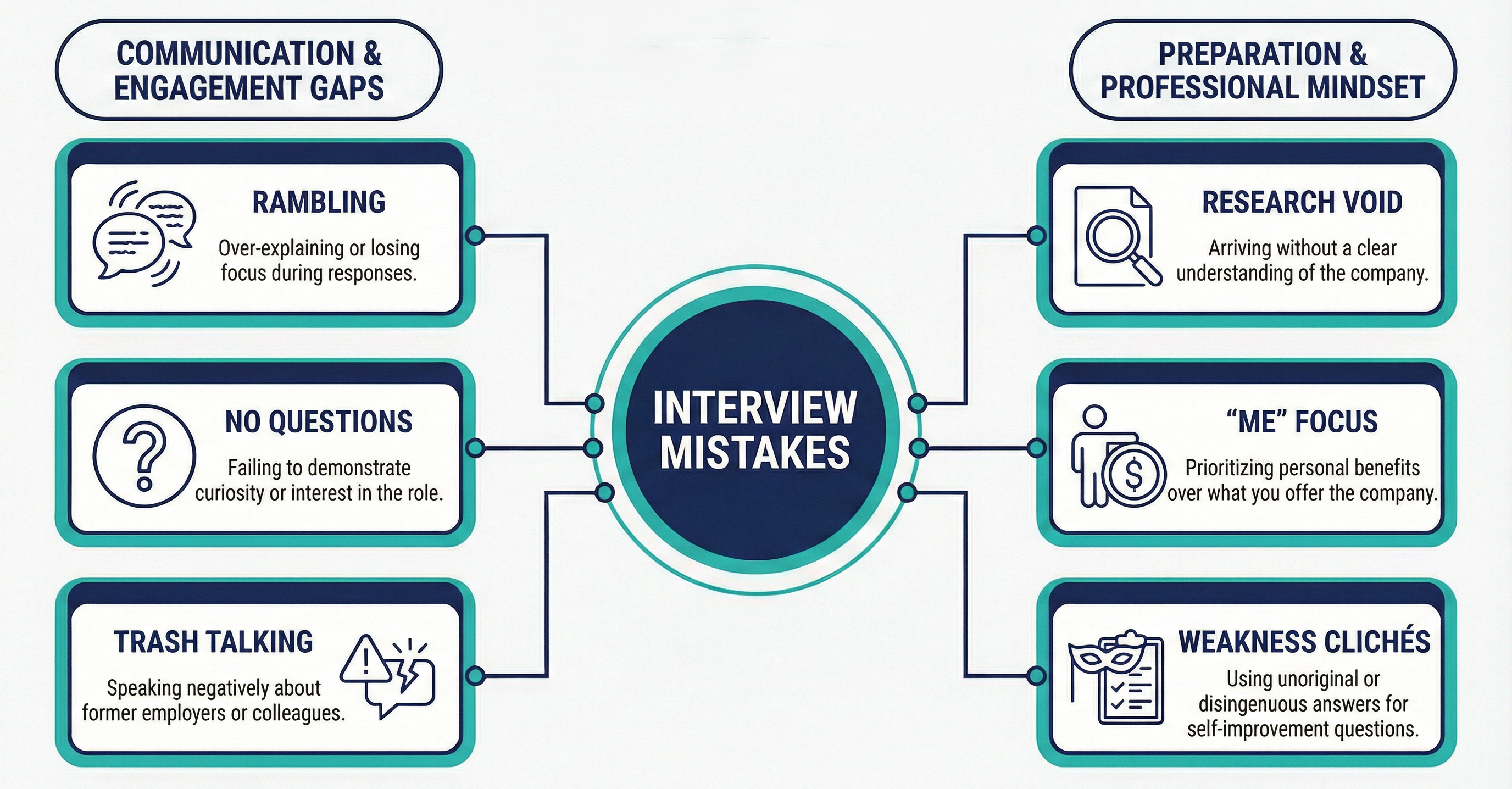
1. The Research Void
Walking in blindly is one of the highest-impact common interview mistakes. Candidates who cannot answer "What do you know about us?" may appear unprepared. You must know their products, their competitors, and their recent news.
2. The Rambler (Waffling)
Taking 5 minutes to answer a 60-second question suggests an inability to synthesize information. If you cannot get to the point, managers assume you will waste time in meetings.
The Mockwin Challenge
Think you can answer "Tell me about yourself" in under 60 seconds without saying "Um" more than twice?
Many candidates struggle with this on their first try.
3. The "Me" Focus
Asking about salary, benefits, or vacation time in the first screening call is a strategic error. It frames you as a "taker" rather than a value creator.
4. Digital Disconnect (Virtual Interviews)
In the era of remote work, poor digital presence is now a top entry in common interview mistakes. Looking at the screen instead of the camera, or having a cluttered, dark background, shows a lack of professional awareness. Mockwin.ai's eye-contact analysis can detect if you are connecting with the lens or drifting away.
5. The Generic "Perfect" Candidate
Answering "What is your weakness?" with clichés like "I work too hard" or "I'm a perfectionist." This is seen as dishonest and lacking in self-awareness.
6. The "No Questions" Silence
Saying "I don't have any questions" at the end implies a lack of curiosity or critical thinking. It is often the final nail in the coffin for an otherwise good interview.
7. The Trash Talker
Speaking negatively about past employers or colleagues. This immediately makes the interviewer worry that you will speak poorly of them in the future.
Benefits of Avoiding Common Interview Mistakes
- Higher Conversion Rate: You stop leaving interviews wondering "what went wrong" and start getting invites to second rounds.
- Salary Leverage: A flawless, confident interview positions you as a premium candidate, giving you more power to negotiate higher pay.
- Reduced Anxiety: When you know you aren't making the "obvious" mistakes, you can focus your mental energy on complex technical questions.
- Lasting Impressions: Managers remember candidates who respect their time (brevity) and know their business (research).
Challenges in Spotting Your Own Common Interview Mistakes
Why is it so hard to fix these issues on your own?
- The Blind Spot: You cannot see your own facial expressions or hear your own tone while you are speaking.
- Subjective Memory: We tend to remember our performance more favorably than it actually was.
- Lack of Feedback: Recruiters rarely tell you why you were rejected (due to legal liability), leaving you to repeat the same common interview mistakes forever.
- Simulation Gap: Practicing in a mirror is not the same as the pressure of a real interview environment.
Solutions: How to Fix Common Interview Mistakes
To truly fix these errors, you need better tools than just a mirror.
- The "Matrix" Research Method: Don't just browse the website. Create a table mapping the Company's Goals to Your Skills.
- The STAR Method: Force your brain to structure every behavioral answer into Situation, Task, Action, and Result to avoid rambling.
- The Mockwin Advantage: Practicing with a friend feels productive, but it doesn't give you data. Here is why top candidates are switching to AI simulation:
| Practicing with a Friend/Mirror | Practicing with Mockwin.ai |
|---|---|
| Biased Feedback: Friends say "You did great!" to be nice. | Objective Data: AI gives you a raw score based on tone, pacing, and keywords. |
| No Metrics: You can't count your own filler words. | Precision: "You used 'Um' 12 times in 1 minute." |
| Awkward: Hard to roleplay seriously. | Realistic: Simulates the pressure of a real interview environment. |
Process: Step-by-Step Guide to Avoiding Common Interview Mistakes
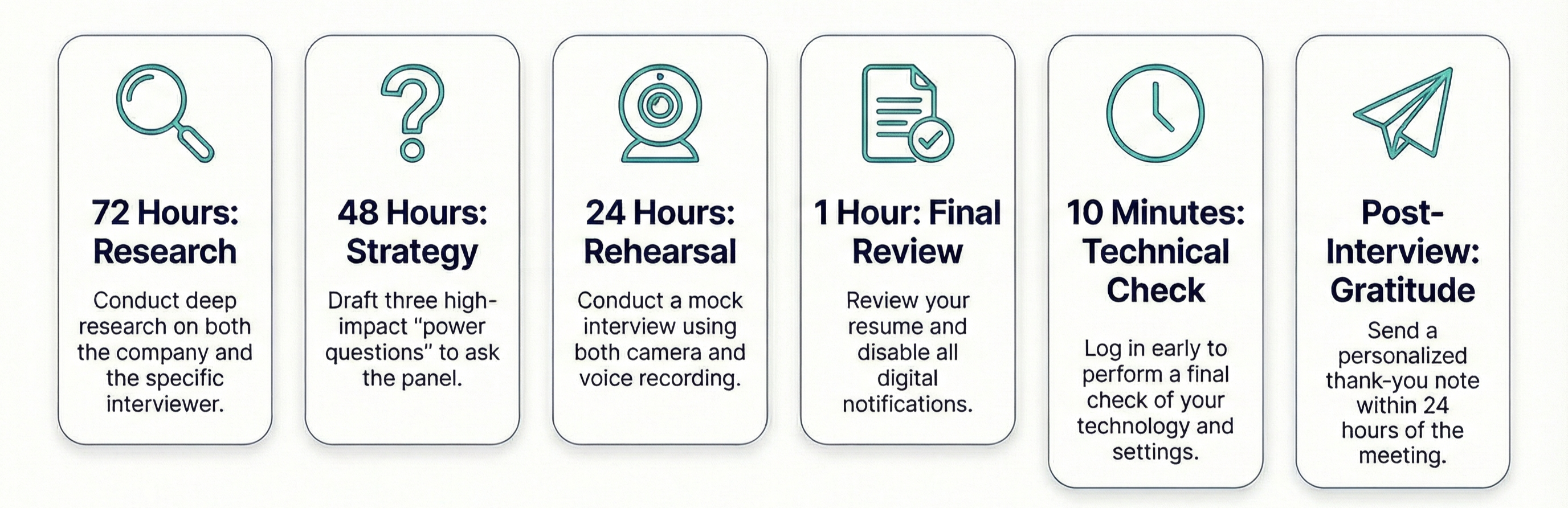
Follow this timeline to ensure you remain mistake-free.
- 72 Hours Before: Deep dive into company news, competitors, and the interviewer's LinkedIn profile.
- 48 Hours Before: Write down 3 "Power Questions" to ask at the end of the interview.
- 24 Hours Before: Run a full mock interview simulation on Mockwin.ai to check your lighting, audio, and pacing.
- 1 Hour Before: Review your resume (know every date) and turn off all phone notifications.
- 10 Minutes Before: Log in or arrive. Test your camera one last time to avoid technical common interview mistakes.
- Post-Interview: Send a personalized thank-you note within 24 hours referencing a specific topic discussed.
Conclusion
The tragedy of the job market is not that candidates lack talent, but that they fail to communicate it. Common interview mistakes act as static on the line, preventing the hiring manager from hearing your true value. By recognizing these pitfalls from poor research to weak body language and actively practicing to avoid them, you do more than just "pass" the interview. You significantly increase your chances of moving to the next round.
FAQ:
1. What is the single biggest red flag in an interview?
Lying or fabricating experience is the ultimate dealbreaker. Unlike other common interview mistakes, this destroys trust instantly and is easily verified.
2. Is it a mistake to bring notes to an interview?
No! Bringing a notebook with prepared questions and taking notes shows you are organized and engaged. Just don't read your answers from a script.
3. How do I recover if I make a mistake during the interview?
Don't panic. Pause, smile, and say, "Let me rephrase that." Acknowledging a slip-up shows maturity and composure, effectively neutralizing the mistake.
4. Is asking about salary always a mistake?
It is a mistake to ask too early (e.g., in the first 10 minutes). It is best to wait until the interviewer raises it or until the later stages of the process.
5. How can I tell if I am rambling?
Watch the interviewer's eyes. If they stop taking notes or look away, you've likely fallen into one of the most common interview mistakes: waffling. Wrap up your point immediately.
6. Do interviewers reject candidates for nervousness?
Nervousness alone is rarely a dealbreaker. Interviewers typically look for clarity, honesty, and structure. If you acknowledge nerves briefly and then deliver concise, organized answers, it often becomes a neutral factor rather than a negative one.
7. What is the best way to practice before an important interview?
The fastest method is a realistic mock interview with objective feedback. Use a structured approach (STAR), record responses, review filler words and speaking pace, and repeat until your answers consistently fit 60 - 90 seconds with clear results.
Tags
Shaik Vahid
Content Writer and Jr. SEO Specialist delivering high-impact, SEO-focused content where creativity meets data to drive real results.
Related Articles
Traditional Interview Prep vs AI Interview Prep
A detailed comparison of traditional interview preparation vs AI interview preparation with real hiring stats and why MockWin’s AI mock interviews deliver faster, smarter results for job seekers.

Why Mock Interviews Are Crucial for Job Seekers
A comprehensive guide on why mock interviews are crucial for job seekers, covering benefits, use cases, challenges, solutions, and how interview practice improves hiring success.

AI-Powered Mock Interview
Learn what AI-powered mock interviews are, how they work, benefits, features, use cases, and why platforms like Mockwin.ai are transforming interview preparation