The Ultimate Guide to Mock Interviews: Meaning, Preparation, and AI Practice
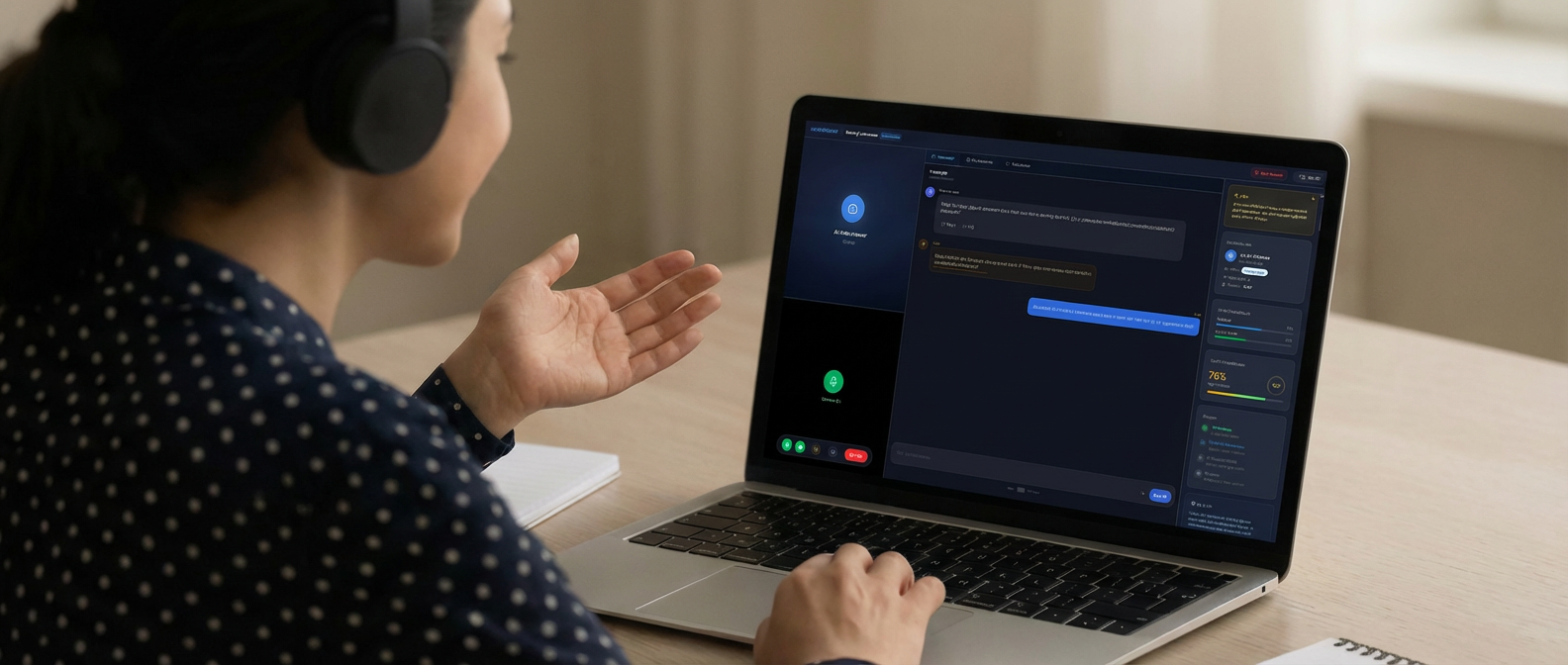
A mock interview is a simulated practice session that mirrors real job interview conditions. It helps candidates reduce anxiety, structure behavioral answers using the STAR method, and refine communication skills. By practicing with human peers or advanced AI platforms, job seekers receive highly actionable feedback to dramatically increase their chances of securing a job offer.
TL;DR Summary
The Definition: A mock interview is a practice simulation that mirrors a real job interview environment.
The Purpose: It helps candidates refine communication skills, reduce anxiety, and master behavioral frameworks like the STAR method.
The Method: Candidates practice with human peers or advanced AI platforms to receive objective feedback on performance and pacing.
The Outcome: This structured preparation significantly increases a job seeker's chances of securing a formal job offer.
What is a mock interview?
A mock interview is a simulated job interview designed to closely mimic the conditions, pressure, and question formats of a real hiring round. It involves an interviewer asking industry-specific questions, followed by constructive, actionable feedback on the interviewee's performance to improve clarity and confidence.
The primary purpose of this exercise is to provide a safe, low-stakes environment where candidates can practice their responses, eliminate filler words, improve their body language, and identify critical areas for improvement before stepping into a high-stakes professional assessment. Rather than simply reading common questions from a list, this exercise forces candidates to vocalize their thoughts in real-time, building the cognitive muscle memory required to articulate complex professional narratives under pressure. The ultimate goal is improvement, not selection.

Why are mock interviews important for job seekers?
Mock interviews are a critical differentiator for candidates in today's highly competitive talent acquisition landscape. Real interviews evaluate performance under pressure, not just raw qualifications, meaning capable candidates frequently underperform simply because they struggle to articulate their thoughts clearly in real-time.
Reduces Anxiety and Builds Confidence
Facing unknown questions in a high-pressure situation naturally induces stress. Practicing beforehand normalizes the experience, making candidates feel significantly more comfortable. Career development surveys indicate that over 85% of job seekers report feeling significantly more confident after undergoing mock interview practice. As familiarity with the process increases, debilitating interview anxiety naturally decreases.
Refines Communication and Delivery
A successful interview relies heavily on how you deliver your message. Mock interviews help candidates practice pacing, vocal tone, and concise articulation. For instance, advanced platforms analyze speech telemetry, helping candidates maintain an optimal speaking pace of 120 to 170 words per minute while minimizing disfluencies (such as "um" and "like") to project maximum competence.
Identifies Hidden Weaknesses
An objective observer or an AI tool can pinpoint structural flaws in your narratives that you might overlook, such as rambling, weak examples, or a lack of measurable impact. Reviewing detailed AI interview feedback with scoring and actionable insights allows for hyper-targeted improvement between practice sessions.
Increases Job Offer Likelihood
The ultimate benefit of rigorous practice is commercial efficiency. Studies and anecdotal evidence demonstrate that candidates who utilize comprehensive interview preparation tools are up to 40% more likely to succeed in their job applications and receive formal offers.
What are the different types of mock interviews?
To prepare effectively, candidates must practice the specific type of mock interview that aligns with their target role, industry, and seniority level.
1. HR and Behavioral Mock Interviews
An HR mock interview focuses on personality, cultural alignment, and emotional intelligence. It assesses how a candidate handles stress, conflict resolution, and teamwork. These interviews heavily feature "Tell me about a time..." prompts that require structured storytelling frameworks. They are universally applicable across all industries and roles.
2. Technical Mock Interviews
Essential for engineering, IT, and data science roles, technical mock interviews evaluate problem decomposition, code clarity, and edge-case awareness. These simulations often involve live coding environments where candidates must write compiling code while simultaneously vocalizing their algorithmic reasoning and evaluating time and space complexity.
3. System Design Mock Interviews
Targeted at mid-level to senior software engineers, system design interviews test architectural thinking and scalability planning. Candidates practice answering broad, high-level prompts (e.g., "Design a scalable chat application") and are evaluated on their ability to manage trade-offs, database choices, and performance optimization.
4. Case Study and Guesstimate Interviews
Primarily utilized in management consulting, these mock interviews test structured thinking, commercial awareness, and quantitative fluency under immense pressure. Candidates practice deducing highly specific numbers using logical proxies and structured assumptions (Fermi problems), focusing on the structural integrity of their analytical framework rather than the exact mathematical answer.
5. High Finance and Investment Banking Interviews
For investment banking, mock interviews transition rapidly from extreme behavioral fit to granular technical accounting. Candidates utilize mock sessions to practice rapid-fire, structured responses to highly specific financial modeling questions, such as projecting unlevered free cash flows to build a Discounted Cash Flow (DCF) model entirely through mental math.
How do you structure behavioral mock interview answers?
A behavioral mock interview is fundamentally an exercise in structured, high-impact storytelling. Hiring managers deploy behavioral questions based on the psychological premise that past behavior is the most reliable predictor of future performance.
The STAR Framework (For Junior to Mid-Level Roles)
The STAR method is the dominant paradigm for structuring behavioral responses. A highly calibrated STAR response should be concise, targeting a total duration of 60 to 90 seconds to prevent interviewer fatigue.
- Situation (10-15 seconds): Establish the context, timeframe, and macro-level significance of the event. Avoid overly vague exposition.
- Task (5-10 seconds): Define the specific constraints (budget, time, technical debt) and your explicit mandate or accountability.
- Action (40-50 seconds): This is the core of the answer. Detail the exact, chronological steps you took to resolve the issue using active, ownership-driven verbs.
- Result (10-15 seconds): Conclude with the measurable business impact. Quantify the outcome using hard numbers, percentages, or revenue generated.
The CARL Evolution (For Senior and Leadership Roles)
For leadership and executive positions, the CARL framework (Context, Action, Result, Learning) is often preferred. By replacing "Task" with "Context" and ending with "Learning," this method introduces a vital dimension of metacognition. The "Learning" component requires the candidate to articulate what they would optimize or change if faced with the exact same scenario again, signaling high learning agility and resilience to the interviewer.
The Present-Past-Future Framework (For "Tell Me About Yourself")
When faced with the ubiquitous "Tell me about yourself" prompt, avoid reciting your resume chronologically. Instead, use this structure:
- Present: Begin with your current impact, defining your existing title, core responsibilities, and a major recent achievement.
- Past: Highlight key foundational points along your professional journey that directly relate to the target role's requirements, supported by quantifiable outcomes.
- Future: Synthesize these experiences into a logical justification for why you are pursuing this specific role at this specific company.
How do you prepare for a mock interview?
Preparation determines the effectiveness of your practice. Treat your mock session as if it were the actual hiring round to maximize the psychological benefits and ensure accurate feedback.
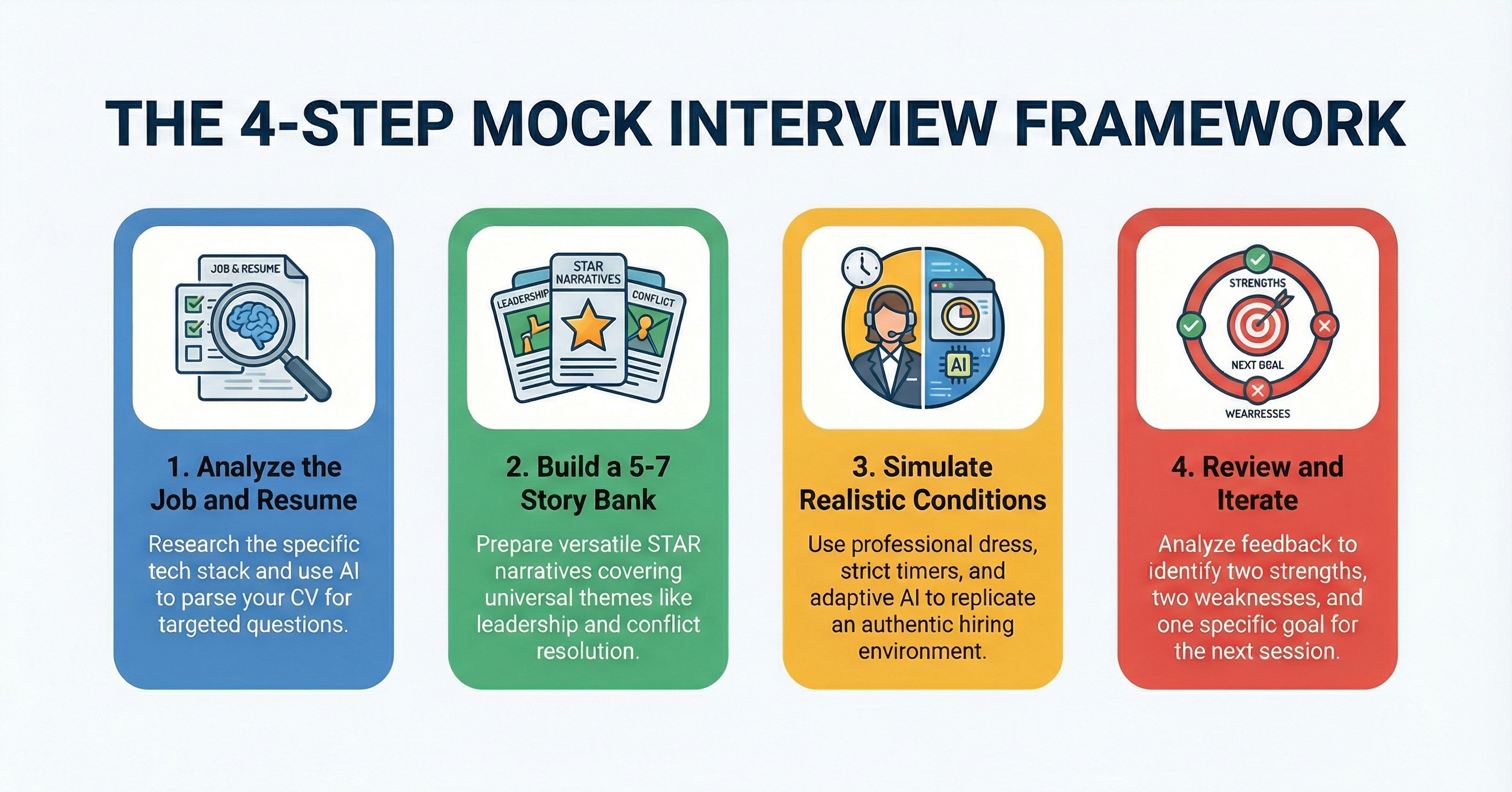
Step 1: Analyze the Job Description and Resume
Thoroughly research the company, the role, and the required tech stack or soft skills. Modern preparation involves resume-based interview practice, where AI tools parse your specific CV to generate targeted, hyper-relevant questions about your past projects and achievements.
Step 2: Build a Story Bank
Do not memorize scripted answers. Instead, prepare 5 to 7 versatile STAR stories that cover universal themes: teamwork, conflict resolution, failure, leadership, and solving a critical issue. These core narratives can be adapted to answer dozens of different behavioral prompts.
Step 3: Simulate Realistic Conditions
Create a quiet, professional setting and dress exactly as you would for the real interview. If you are practicing online, keep your camera on, maintain strict time limits, and do not pause the timer if you stumble. For the most authentic experience, utilize an adaptive AI mock interviewer that dynamically adjusts question difficulty based on how well you answer, forcing you to think on your feet.
Step 4: Review and Iterate
After the session, analyze the feedback thoroughly. Identify two strengths, two weaknesses, and one specific focus area for your next attempt (e.g., "reduce filler words" or "shorten the 'Situation' phase"). Continuous iteration is the key to building interview muscle.
What are the most common mock interview questions?
While questions vary by industry, certain prompts appear consistently across almost all screening processes. Candidates should be highly proficient at answering the following:
General & HR Questions:
- Tell me about yourself.
- Why do you want to work for this company?
- What are your greatest strengths and weaknesses?
- Where do you see yourself in five years?
- Why are you leaving your current job?
Behavioral Questions (Require STAR/CARL frameworks):
- Tell me about a time you had a conflict with a coworker.
- Describe a time you failed at a task or made a mistake, and what you learned.
- Tell me about a time you faced resistance when trying to implement a new idea.
- Describe a complex problem you solved under a tight deadline.
- Tell me about a time you showed leadership without formal authority.
How do mock interviews evaluate technical and soft skills?
Beyond the generation of contextual questions, the most significant advancement in the mock interview ecosystem is the integration of deep biometric and linguistic telemetry to quantify traditionally subjective soft skills.
Disfluencies and the "Um" Counter
Speech analysis algorithms meticulously track the frequency of vocalized pauses, commonly identified as "um," "uh," and various filler words. Research demonstrates a direct correlation between high disfluency rates and a degradation in the perceived competence of the speaker. Exceeding a threshold of three filler words per one hundred words precipitates a statistically significant negative effect.
Pacing and Words-Per-Minute (WPM)
Cognitive load and adrenaline during an interview frequently manifest as rushed, breathless speech. AI platforms analyze the WPM rate, establishing an optimal pacing benchmark between 120 and 170 WPM. Speech exceeding 180 WPM diminishes clarity and prevents the interviewer from absorbing complex points.
Lexical Density and Power Words
Advanced sentiment analysis models evaluate the vocabulary of a candidate's response to generate a "Power Word Score". This analyzes the ratio of active, confident verbs (e.g., "spearheaded," "orchestrated") against passive or minimizing phrasing (e.g., "I helped with"). This linguistic engineering ensures the candidate projects a tone of self-assurance and ownership.
Ready to eliminate interview anxiety?
Stop rehearsing in the mirror. Get objective, data-driven feedback on your pacing and filler words.
Try a Real-Time AI InterviewTraditional vs. AI Mock Interviews: A Comparison
While both human-led and AI-driven methods are valuable, the rapid advancement of conversational artificial intelligence has given AI distinct advantages for volume-based practice.
| Feature | Traditional Mock Interview (Human-Led) | AI Mock Interview |
|---|---|---|
| Availability | Limited by the interviewer's schedule and geographic location. | On-demand, 24/7 access. |
| Feedback Quality | Subjective, qualitative, and sometimes prone to unconscious human bias. | Objective, data-driven, consistent, and highly granular (measuring exact WPM, tone, and sentiment). |
| Customization | Varies heavily based on the human interviewer's personal expertise. | Highly personalized; generates questions specifically matched to the user's uploaded resume and job description. |
| Adaptability | Limited to the human's prepared question list. | Features real-time adaptive follow-ups based on semantic analysis of the user's spoken answer. |
| Cost & Scalability | Professional career coaches can be highly expensive; difficult to scale for multiple daily sessions. | Highly affordable subscription models offering unlimited, repeatable practice sessions. |
Savvy candidates often use a strategic layering approach: utilizing highly available, low-cost platforms like real-time AI interview simulators for daily, high-volume practice to build foundational confidence, and then booking a single, premium human-led session as a final "dress rehearsal" before the real event.
How many mock interviews should you practice?
The optimal number of practice sessions depends heavily on the candidate's experience level and the complexity of the target role.
- For Freshers and First-Time Job Seekers: Aim for 5 to 8 mock interviews. The primary goal here is to overcome initial anxiety, build baseline confidence, and gain exposure to standard HR and behavioral questions.
- For Experienced Professionals: Aim for 3 to 6 mock interviews. Experienced candidates usually possess the necessary knowledge but need practice refining their executive storytelling, ensuring achievements are quantified, and tailoring practice to a distinct career path using role-specific AI interview practice.
- Before Final Hiring Rounds: Conduct at least 2 full, timed interview simulations back-to-back. The goal is pressure training, managing complex adaptive follow-ups, and ensuring absolute consistency in delivery.
Master the STAR Method Today
Upload your resume and let our AI generate a customized interview matched to your exact job description.
Start Your Free Mock InterviewFrequently Asked Questions (FAQ)
What is a mock interview?
A mock interview is a structured practice session that simulates the conditions, pressure, and format of a real job interview. It allows candidates to rehearse their answers, refine their body language, and receive constructive feedback to improve their performance before meeting with an actual employer.
How do I prepare for a mock interview?
To prepare effectively, thoroughly analyze the job description to identify key skills, match your past experiences to those requirements, and prepare 5 to 7 structured stories using the STAR method. Simulate real conditions by dressing professionally, using a timer, and practicing in a quiet environment.
What is an HR mock interview?
An HR mock interview is a screening simulation that focuses on your personality, behavioral fit, and communication style. It evaluates soft skills such as emotional intelligence, conflict resolution, cultural alignment, and your overall motivations for applying to the company.
Are AI mock interviews actually effective?
Yes. AI mock interviews are highly effective because they provide scalable, on-demand practice with objective, data-driven feedback. They dynamically generate customized questions based on your resume, ask real-time follow-up questions, and track granular metrics like speaking pace and filler word usage to guarantee measurable improvement.
How do mock interviews reduce interview anxiety?
Interview anxiety stems primarily from uncertainty and fear of the unknown. Mock interviews mitigate this by building familiarity with the format, improving recall speed for your professional stories, and training you to handle unexpected follow-up questions calmly. As the process becomes normalized through repetition, stress naturally decreases.
What is the STAR method in behavioral interviews?
The STAR method is an acronym for Situation, Task, Action, and Result. It is a highly structured storytelling framework used to answer "Tell me about a time..." questions concisely. It ensures candidates provide clear context, define their specific responsibilities, detail the exact actions they took, and conclude with a quantifiable business outcome.
How long should a mock interview answer be?
For behavioral questions, you should aim to deliver a complete, structured answer within 60 to 90 seconds. This duration provides enough time to showcase your impact using the STAR method while remaining concise enough to maintain the interviewer's attention and avoid rambling.
Tags
Shaik Vahid
Content Writer and Jr. SEO Specialist delivering high-impact, SEO-focused content where creativity meets data to drive real results.
Related Articles
Traditional Interview Prep vs AI Interview Prep
A detailed comparison of traditional interview preparation vs AI interview preparation with real hiring stats and why MockWin’s AI mock interviews deliver faster, smarter results for job seekers.

Why Mock Interviews Are Crucial for Job Seekers
A comprehensive guide on why mock interviews are crucial for job seekers, covering benefits, use cases, challenges, solutions, and how interview practice improves hiring success.

AI-Powered Mock Interview
Learn what AI-powered mock interviews are, how they work, benefits, features, use cases, and why platforms like Mockwin.ai are transforming interview preparation