
Technical Interview Skill Assessment: How AI Grades You
MockWin's Stack Report grades your depth in React, SQL, AWS, and more, then flags every JD keyword you failed to mention. Here is how it works.
Introduction
Technical interview skill assessment has fundamentally changed. That rejection email with zero feedback? It probably came from an algorithm, not a human reviewer. With an estimated 93% of Fortune 500 CHROs now integrating AI into hiring decisions, according to recent enterprise workforce surveys, understanding how these systems grade you is no longer optional. It is essential for landing your next role.
In a 2025 study published by researchers at Chicago Booth's Center for Applied AI, over 70,000 job applicants were reportedly screened using AI-led interviews. The findings suggested that AI interviews led to 12% more job offers, 18% more job starters, and 16% higher retention rates after 30 days of employment. These systems are not just filtering candidates. They are predicting success.
The hiring paradox is stark: according to HackerRank's 2024 Developer Skills Report, a significant majority of developers report difficulty securing employment, while organizations spend months trying to fill technical positions. The bottleneck is AI screening systems that candidates do not understand and cannot prepare for.
This guide explains exactly how AI technical interview skill assessment works, what Mockwin's Stack Report measures, how JD keyword matching identifies your gaps, and the specific strategies that will dramatically improve your scores.
Quick Summary
- AI interview systems grade your proficiency across specific technologies (React, SQL, AWS) using code analysis, natural language processing, and behavioral telemetry
- Platforms extract every keyword from job descriptions and flag skills you failed to mention, even if you have years of experience
- "Depth scoring" distinguishes genuine expertise from name-dropping using Abstract Syntax Tree analysis and code quality metrics
- According to the 2024 Stack Overflow Developer Survey, the vast majority of developers now use AI tools regularly. Modern assessments evaluate your AI collaboration and prompt engineering skills accordingly
- Understanding how AI grades you transforms random rejections into strategic preparation with actionable improvement areas
What Is Technical Interview Skill Assessment?
Technical interview skill assessment is the structured, AI-driven process of evaluating a candidate's coding proficiency, problem-solving abilities, and technical knowledge using automated systems. These platforms analyze code correctness, efficiency, communication clarity, and job description alignment to generate objective scores that predict on-the-job performance with greater accuracy than traditional interviews.
Modern technical interview skill assessment typically includes:
- Dynamic code execution against hidden test cases, boundary conditions, and edge cases across 40+ programming languages
- Abstract Syntax Tree (AST) analysis to verify algorithmic understanding regardless of syntax errors
- Natural language processing (NLP) using transformer models like RoBERTa to evaluate explanation quality and confidence levels
- JD keyword extraction to identify skill gaps between job requirements and candidate responses
- Behavioral telemetry including keystroke dynamics, coding patterns, and problem-solving approach
- AI collaboration scoring measuring how effectively candidates use in-platform AI assistants like CodeSignal's Cosmo
💡 Industry estimates suggest that companies with robust technical skill assessment processes can experience up to 30% lower new hire turnover in tech roles and reduce time-to-hire by 25 to 40%.
Why Does Technical Interview Skill Assessment Matter?
Technical interview skill assessment matters because it determines whether a human ever sees your application. These systems process thousands of candidates at scale, applying identical criteria to every applicant while flagging skill gaps that traditional interviews miss. For candidates, understanding how these systems work is the difference between random rejections and strategic preparation.
- Reduces costly mis-hires: Industry estimates place the cost of a bad technical hire at 30% to 150% of annual salary when factoring in recruiting, onboarding, and lost productivity
- Eliminates interviewer bias: AI focuses solely on skills and performance, not background, demographics, or appearance
- Scales globally: Candidates in Bangalore, São Paulo, or Warsaw can complete assessments on their own schedule, even at 2 AM
- Provides actionable feedback: Unlike traditional rejections with zero explanation, AI assessments show exactly which skills need development
- Ensures consistent evaluation: Everyone gets the same questions, delivered the same way, scored using the same rubric
💡 In the same Chicago Booth research, when given the option to interview with an AI agent or a human recruiter, 78% of applicants reportedly opted for the AI interviewer, citing fairness and reduced bias as their primary reasons.
The best way to prepare for these AI-powered evaluations is to practice under the same conditions. Mockwin's role-specific AI interview practice lets you simulate the exact assessment format used by top employers, tailored to your target job title.
How Does AI Grade Your Technical Interview?
AI grading systems evaluate technical interviews through seven distinct layers of analysis, combining dynamic code execution, static code analysis, and natural language processing. Understanding each layer helps you prepare strategically. Here is exactly what happens when you submit a coding challenge:
Step 1: Dynamic Execution and Test Case Analysis
When you submit code, the assessment engine compiles and executes it against a comprehensive suite of hidden test cases. These include standard inputs, boundary conditions, edge cases, and error-inducing parameters specifically designed to reveal true understanding, not just pattern matching from practice problems.
Platforms routinely conceal specific test inputs, revealing only pass/fail outcomes. This prevents candidates from reverse-engineering solutions based solely on visible examples. Systems use frameworks like JUnit for Java, pytest for Python, and Jest for JavaScript to validate functionality across 40+ programming languages including C++, Go, Kotlin, Ruby, Rust, Scala, SQL, and TypeScript.
Step 2: Abstract Syntax Tree (AST) Evaluation
Beyond execution, AI generates and analyzes your code's Abstract Syntax Tree, a structural map of your solution's hierarchy. This allows verification of specific algorithms or data structures regardless of minor syntax errors that might cause compilation failures.
If an assessment requires a dynamic programming solution, AST analysis detects proper memoization table initialization and correct recursive logic, awarding partial credit even when small bugs cause test failures. This hybrid approach dramatically reduces false-negative rates from brittle auto-graders that historically penalized candidates for minor errors despite correct underlying logic.
Step 3: Time and Space Complexity Analysis
AI calculates both time complexity (how runtime scales with input size) and space complexity (memory allocation requirements). Brute-force solutions that produce correct outputs but execute inefficiently get penalized, even if all test cases pass.
The system rewards candidates who optimize for O(log n) when possible rather than settling for O(n²). Modern platforms like HackerRank deploy dedicated "AI Code Quality Grading" engines that evaluate submissions against expert benchmarks, scoring clarity, modularity, and architectural elegance, not just whether the code works.
Step 4: Code Quality and Maintainability Scoring
As AI coding assistants make generating functional code easier, platforms now heavily weight readability and maintainability. The evaluation examines variable naming conventions, code structure, error handling patterns, and documentation quality.
Research into AI agent-based code modifications reveals that automated refactoring primarily targets logic complexity and documentation enhancements. Platforms evaluate your code against curated examples of expert solutions, providing comparative scores that predict how well you would maintain a production codebase.
Step 5: JD Keyword Gap Analysis
This is where most candidates unknowingly fail. Mockwin's AI extracts every technical requirement from job descriptions (frameworks, tools, methodologies, certifications) and tracks whether you addressed each one during your interview.
If the JD mentions "GraphQL" and you never brought it up, that is flagged as a gap. You might have five years of GraphQL experience but simply forgot to mention it because the interviewer did not ask directly. Your Stack Report shows exactly which requirements you addressed and which you missed, giving hiring managers an alignment score before they ever review your code.
What gets extracted: Required programming languages and versions, specific frameworks (React, Angular, Django, Spring Boot), cloud platforms (AWS, Azure, GCP), database technologies (PostgreSQL, MongoDB, Redis), DevOps tools (Docker, Kubernetes, Terraform), methodologies (Agile, CI/CD, TDD), and soft skill indicators.
After every practice session, Mockwin's AI feedback system breaks down exactly which JD keywords you covered and which you missed, so you can close those gaps before the real interview.
Step 6: Behavioral and Communication Analysis
Advanced NLP algorithms (frequently fine-tuned versions of transformer models like RoBERTa) analyze transcribed responses for structural coherence, vocabulary complexity, and emotional tone. Industry leaders like HireVue have discontinued facial expression analysis due to bias concerns. Modern systems rely exclusively on what you say and how you say it.
The AI evaluates:
- Communication clarity: Sentence structure, grammatical precision, articulation without rambling or filler words
- Problem-solving approach: STAR framework adherence (Situation, Task, Action, Result), logical sequencing, concrete resolutions
- Confidence language: Hedging patterns ("I think," "maybe," "probably") versus authoritative phrasing
- Technical depth: Cross-referencing responses against JD requirements and industry-standard terminology
Step 7: AI Collaboration Scoring
With the vast majority of developers now using AI tools daily and many using multiple AI assistants simultaneously, platforms now explicitly evaluate AI collaboration skills. CodeSignal's "Cosmo" and HackerRank's AI-assisted IDE capture complete transcripts of your interactions with built-in AI assistants.
The system evaluates whether you move beyond basic "zero-shot prompting" and effectively use "few-shot prompting" with examples, "chain-of-thought prompting" for complex reasoning, or advanced techniques like Recursive Self-Improvement Prompting (RSIP). High scores go to candidates who demonstrate clear instruction-style communication, define output boundaries, and navigate AI away from hallucinations.
AI Interview Assessment vs Traditional Evaluation
Understanding the key differences between AI-powered and traditional interview assessment helps you prepare strategically for modern hiring processes. The table below breaks down seven critical dimensions where these approaches diverge:

| Aspect | AI-Powered Assessment | Traditional Evaluation |
|---|---|---|
| Consistency | Identical criteria applied to every candidate using predefined rubrics | Varies by interviewer mood, experience, and unconscious bias |
| Speed | Real-time scoring during or immediately after the interview | Hours to days for feedback compilation and consensus |
| Objectivity | Data-driven proficiency metrics across multiple dimensions | Subjective impressions and gut feelings |
| Scalability | Unlimited concurrent assessments, 24/7 availability | Limited by interviewer availability and bandwidth |
| Feedback Quality | Specific skill gaps, scores, and improvement recommendations | Generic rejection or vague "not a fit" feedback |
| JD Alignment | Automated keyword matching against all requirements | Manual comparison prone to oversight and inconsistency |
| Bias Mitigation | Masks personal information, applies consistent standards | Subject to unconscious bias based on demographics, accent, appearance |
For a deeper understanding of how Mockwin compares to traditional prep methods, see Why Mockwin.
What Does Mockwin's Stack Report Measure?
Mockwin's Stack Report provides hiring managers with a comprehensive technical candidate assessment across ten distinct dimensions. Here is exactly what appears when they review your evaluation:
| Assessment Dimension | What It Measures |
|---|---|
| Technology Scores | Proficiency rating (0 to 100) for each relevant skill: React, SQL, AWS, Python, Node.js, etc. |
| JD Alignment | Percentage of job description requirements you addressed during the interview |
| Keyword Gaps | Specific JD terms and technologies you failed to mention (flagged for review) |
| Code Quality | Readability, maintainability, and architectural elegance compared to expert benchmarks |
| Complexity Analysis | Time and space efficiency metrics (Big O notation) with optimization recommendations |
| AI Collaboration | Prompt engineering quality, debugging approach, hallucination mitigation effectiveness |
| Confidence Score | How authoritatively you discussed technical topics based on linguistic patterns |
| Communication Clarity | STAR framework adherence, logical sequencing, explanation quality without rambling |
| Benchmark Comparison | How your scores compare to successful candidates hired for similar roles |
| Integrity Score | Keystroke dynamics, plagiarism detection, behavioral telemetry for authenticity |
Depth vs Surface Detection: How AI Knows If You Are Faking
Modern AI assessment distinguishes between candidates who simply mention a technology and those who demonstrate genuine, hands-on understanding. The system uses multiple signals to separate real expertise from resume padding, and the difference dramatically affects your score.
Compare these two responses:
Surface-level
"I have used AWS for cloud infrastructure."
Depth indicator
"I configured S3 bucket policies for cross-account access and optimized Lambda cold starts by reducing package size from 50MB to 12MB, cutting initialization time by 60%. We also implemented CloudFront caching that reduced API response times from 800ms to 120ms."
The second response contains specific services (S3, Lambda, CloudFront), concrete actions (configured, optimized, implemented), measurable outcomes (60% reduction, 800ms to 120ms), and technical details that can only come from hands-on experience. AI systems are trained to recognize and reward this pattern consistently.
The Pass@k Metric: Rather than grading a single submission, advanced platforms use "Pass@k" measurement, evaluating the probability that you will generate at least one correct solution across multiple iterative attempts. This reflects modern development workflow: generating, reviewing, and refining AI-assisted code until a viable solution emerges.
Mockwin's adaptive AI mock interviewer dynamically adjusts question difficulty based on your responses, helping you build depth signals across your entire tech stack before the real assessment.
Common Mistakes That Tank Your AI Interview Score
Understanding what hurts your score is just as critical as knowing what helps. These are the seven most common reasons qualified candidates fail AI-graded technical interviews:
1. Vague technology references: "I have done a lot of backend work" tells the AI nothing. Name specific languages, frameworks, versions, and use cases. The system needs concrete signals to score depth.
2. Missing JD keywords: If the job posting mentions Kubernetes and you never say the word, the system flags it as a gap, even if you have deployed dozens of clusters. AI can only score what you actually say.
3. Surface-only explanations: Listing technologies without explaining how you used them signals resume padding. The AST analysis reveals whether you understand underlying concepts or just memorized keywords.
4. Excessive hedging language: Constant "I think" and "maybe" phrases lower confidence scores, even when you are just being humble. NLP models interpret hedging as uncertainty regardless of intent.
5. Failing to bridge to unasked topics: Sometimes interviewers do not ask about everything in the JD. Strong candidates proactively mention relevant skills, ensuring the AI captures their full competency profile.
6. Poor AI collaboration: In AI-enabled assessments, refusing to use the provided assistant, or using it as a crutch, counts against you. Modern roles require demonstrating AI orchestration skills, not dependence.
7. Robotic typing patterns: Platforms log keystroke dynamics including "dwell time" and "flight time." Instantaneously generating complex code blocks or exhibiting robotic uniformity can trigger plagiarism flags. Some platforms report detection accuracy rates above 90%.
If you want to practice answering questions based on your own resume, Mockwin generates custom questions from your CV so you never get caught off guard by experience-based follow-ups.
How to Score Higher on AI-Graded Technical Interviews
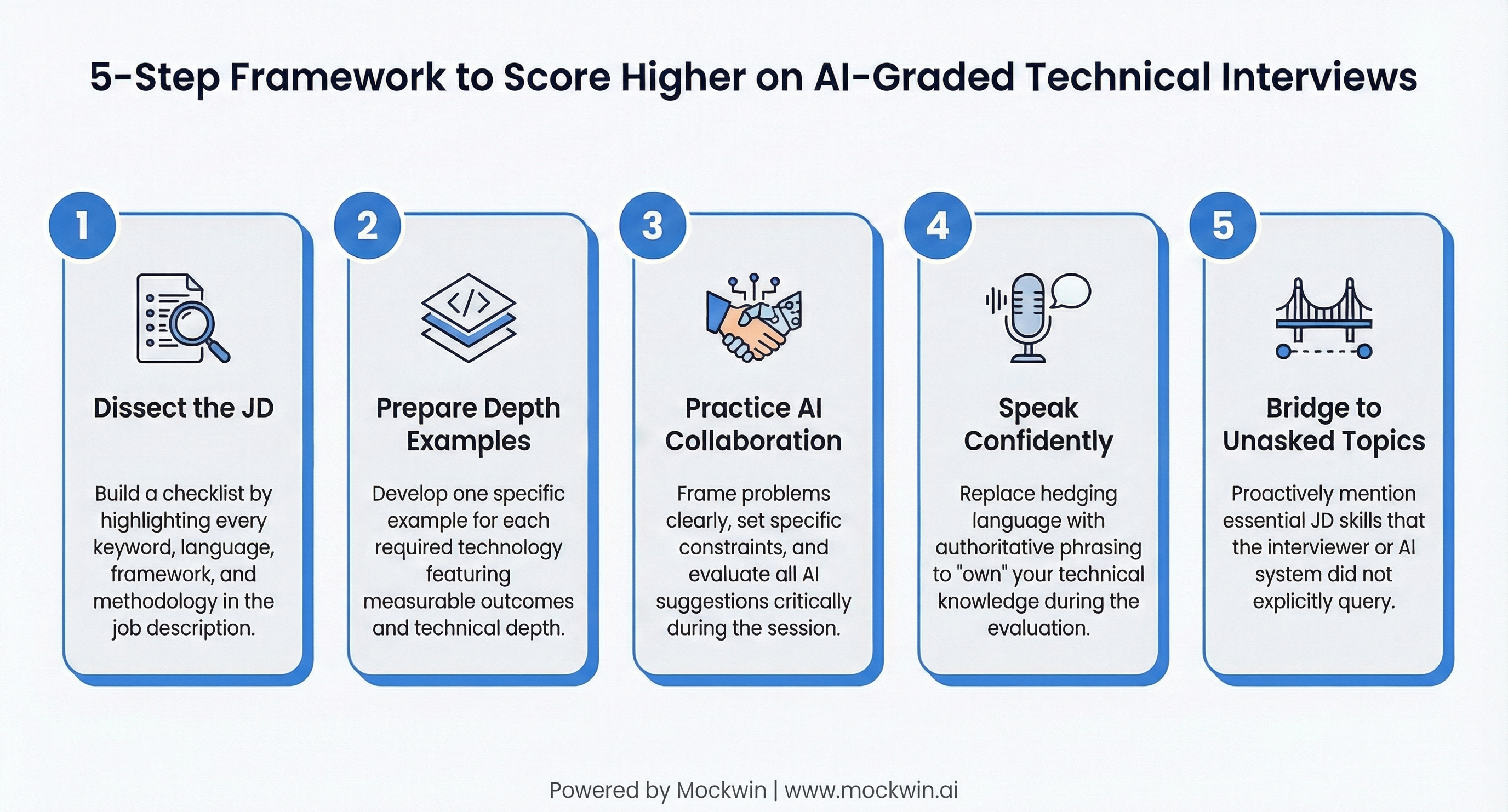
Strategic preparation dramatically improves AI assessment scores. Follow this five-step framework to demonstrate your actual competency level and maximize your results on every platform:
Step 1: Dissect the Job Description
Print out the JD and highlight every technical term: languages, frameworks, tools, methodologies, certifications, and soft skill indicators. This becomes your keyword checklist that you will systematically address during the interview.
Create explicit notes to mention each one naturally. Do not force it, but do not leave critical skills unaddressed because the interviewer did not ask directly. The AI extracts and categorizes every requirement. Your job is to address them all.
Step 2: Prepare Depth Examples for Core Technologies
For each major technology in the JD, prepare at least one specific example demonstrating genuine expertise with measurable outcomes:
Weak
"I know React pretty well."
Strong
"In my last project, I refactored a component tree causing unnecessary re-renders. I implemented React.memo strategically and used the React DevTools Profiler. We reduced render cycles by 60% and cut initial page load from 3.2 seconds to 1.1 seconds."
Specificity, measurable outcomes, and tool references signal depth. The AST analysis and NLP scoring both reward this pattern consistently across all platforms.
Step 3: Practice AI Collaboration Skills
When using in-platform assistants like CodeSignal's Cosmo or HackerRank's AI IDE, demonstrate strategic AI orchestration:
- Frame problems clearly before asking for help. Provide context and constraints
- Use explicit constraints: "Implement this search optimizing for O(log n) time complexity"
- Critically evaluate AI suggestions. Catch errors, identify hallucinations, verify edge cases
- Use AI for boilerplate generation while demonstrating strategic thinking on architecture
Evaluators see complete transcripts of your AI interactions. "Generate the solution for me" scores very differently than "Let me verify my approach. Here is my reasoning, what edge cases might I be missing?"
Step 4: Speak with Calibrated Confidence
Record yourself answering technical questions. Listen for hedging patterns and practice replacing them:
- "I think you could..." → "The approach I would take is..."
- "Maybe this would work..." → "This works because..."
- "I am not totally sure, but..." → "Based on my experience..."
Acknowledge genuine uncertainty when it exists, but do not undercut yourself when you actually know the answer. The best AI systems cross-reference confidence with accuracy, so false certainty hurts more than honest doubt.
Step 5: Bridge to Unasked Topics
If the interviewer does not ask about a JD requirement, find natural ways to bring it up:
- "That reminds me of a similar challenge I solved using [technology from JD]..."
- "We evaluated [JD keyword] for this use case. I can walk through the tradeoffs we considered..."
This ensures the AI captures your full skill set, not just what happened to come up organically. Your Stack Report reflects every skill you mentioned, not just those directly questioned.
To stress-test your bridging skills under pressure, Mockwin's Challenge Mode simulates high-stakes scenarios designed to push your limits and build composure.
Key Takeaways
- Map the JD: List every technical keyword before your interview and systematically address each one
- Go specific: Replace vague claims with concrete examples, metrics, and named tools
- Show your process: Debug iteratively, think visibly, demonstrate the messy reality of real development
- Speak confidently: Drop hedging language unless you genuinely do not know the answer
- Bridge gaps: Proactively mention relevant skills even when not directly asked
- Use precise terminology: "React Query" scores better than "that data fetching library"
- Collaborate with AI strategically: Treat in-platform assistants as tools to demonstrate judgment, not crutches for answers
Conclusion
Technical interview skill assessment has evolved beyond human judgment alone. AI systems now determine whether your application reaches human reviewers, grading your proficiency across technology stacks, flagging JD keyword gaps, and measuring the depth of your explanations with unprecedented precision.
But understanding how AI grades you transforms the black box into a strategic advantage. Address every job description keyword, demonstrate depth through specific examples with measurable outcomes, speak with calibrated confidence, bridge to topics interviewers do not ask about, and show you can collaborate with AI tools strategically rather than depend on them blindly.
Your technical skills matter. The AI just needs to actually see them.
See How AI Would Score Your Interview
Ready to understand exactly how AI evaluates your technical skills? Mockwin's Stack Report shows your proficiency scores, JD alignment percentage, keyword gaps, and specific improvement recommendations, before you apply for your next role.
Frequently Asked Questions
What is technical interview skill assessment?
Technical interview skill assessment is the AI-driven process of evaluating a candidate's coding proficiency, problem-solving abilities, and technical knowledge using automated systems. Platforms analyze code correctness, efficiency, communication clarity, and job description alignment to generate objective scores that predict on-the-job performance more accurately than traditional interviews.
How does AI know if I really understand a technology?
AI uses multiple signals: Abstract Syntax Tree analysis to verify algorithmic understanding regardless of syntax errors, code complexity metrics to evaluate efficiency, behavioral telemetry to detect natural coding patterns, NLP to assess explanation depth, and the Pass@k metric to evaluate iterative problem-solving. The combination distinguishes genuine expertise from surface-level familiarity or keyword stuffing.
What is Mockwin's Stack Report?
Mockwin's Stack Report is an AI-generated assessment showing your proficiency scores across technical skills like React, SQL, and AWS, plus which job description keywords you addressed or missed during your interview. It includes JD alignment percentage, code quality metrics, confidence scores, and specific improvement recommendations, giving both you and hiring managers objective data.
Why do qualified developers fail AI-graded technical interviews?
Common reasons include: forgetting to mention JD keywords the AI was tracking, giving vague explanations lacking specific metrics and examples, using hedging language that lowered confidence scores, or not demonstrating AI collaboration skills in platforms that evaluate them. AI can only score what you actually say. Experience you do not mention does not count.
Can candidates see their AI assessment scores after an interview?
Increasingly, yes. NYC Local Law 144 (enforced since July 2023) requires bias audits and candidate notification. The EU AI Act (enforceable August 2026) classifies recruitment AI as "high-risk" and mandates explainability rights. Many companies now proactively share detailed feedback. Always ask for your assessment data after rejection. It provides valuable preparation.
Is using an AI coding assistant during a technical assessment considered cheating?
It depends on the platform. Modern assessment tools like HackerRank and CodeSignal now explicitly include AI assistants to evaluate how well you collaborate with AI tools. Strategic usage is expected and scored. However, using external unauthorized tools can trigger integrity flags through keystroke dynamics and behavioral telemetry, with some platforms reporting detection accuracy rates above 90%. Always follow specific assessment guidelines.
Tags
Shaik Vahid
Content Writer and Jr. SEO Specialist delivering high-impact, SEO-focused content where creativity meets data to drive real results.
Related Articles

Interview Skill Gap Analysis: Find Exactly What You're Missing
A comprehensive guide to uncovering your hidden interview weaknesses, mapping corporate expectations, and using targeted analysis to turn rejections into job offers.

How to Use AI to Improve Your Communication Skills
This comprehensive guide explores the intersection of AI and professional development, focusing on actionable strategies to enhance speech clarity, confidence, and interview performance using cutting-edge tools like Mockwin.

Real-Time AI Interview feedback
This comprehensive guide explores the transformative power of real-time AI in interview preparation. It covers how instant data-driven insights help candidates eliminate anxiety, refine communication, and secure top-tier job offers using the Mockwin platform.