
Interview Copilot: What It Is, How It Works & Everything You Need to Know
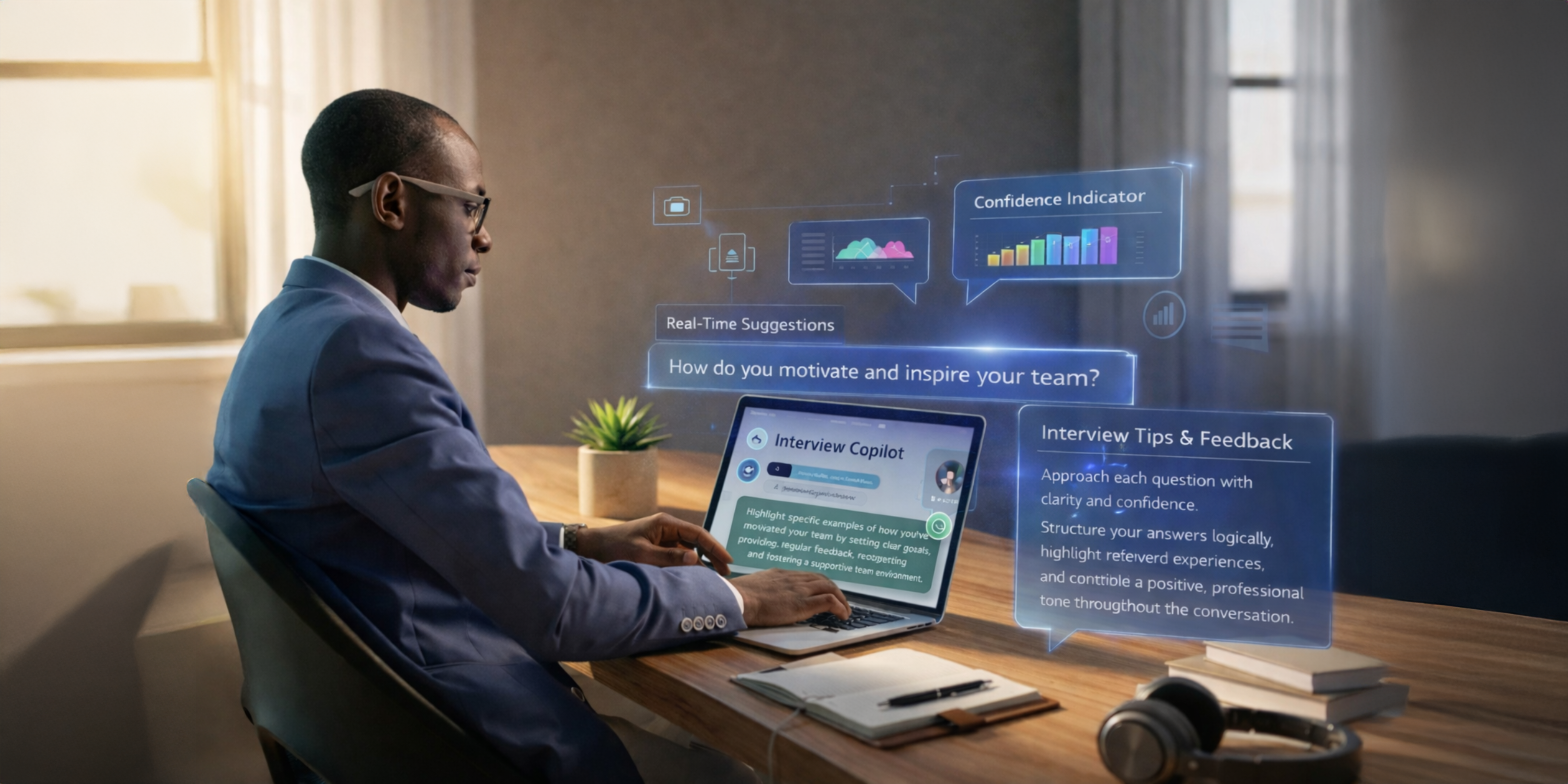
An interview copilot is an AI-powered practice assistant that listens to interview questions, generates live structured hints, scores your answers using the STAR framework, and coaches your delivery helping you build confident, structured interview responses through guided practice.
You know your experience. You know what you have achieved. But the moment an interviewer asks an unexpected question, the pressure rearranges everything and the answer that was clear in your head comes out incomplete, unfocused, or missing the one thing the interviewer most wanted to hear.
That is the gap an interview copilot closes. It works alongside you during practice sessions, giving you live structural guidance on every answer, immediate feedback on exactly what you covered and missed, and the ability to correct and retry before moving on. By the time the real interview arrives, structured and confident responses come naturally not under pressure, but through preparation.
This guide answers every question candidates ask about interview copilot tools: what they are, how they work, what research says about using them effectively, how to choose the right platform, and how to build genuine interview skill rather than surface-level familiarity with AI tools.
- 1. Quick Answers
- 2. What Is an Interview Copilot?
- 3. vs. Traditional Prep
- 4. How It Works (7 Steps)
- 5. Core Features
- 6. What Research Says
- 7. Is It Ethical?
- 8. What Employers Say
- 9. How to Choose a Platform
- 10. 7-Session Progression
- 11. By Interview Type
- 12. Common Mistakes
- 13. Quick Tips
- 14. Who It’s Best For
- 15. FAQs
- What is an interview copilot?
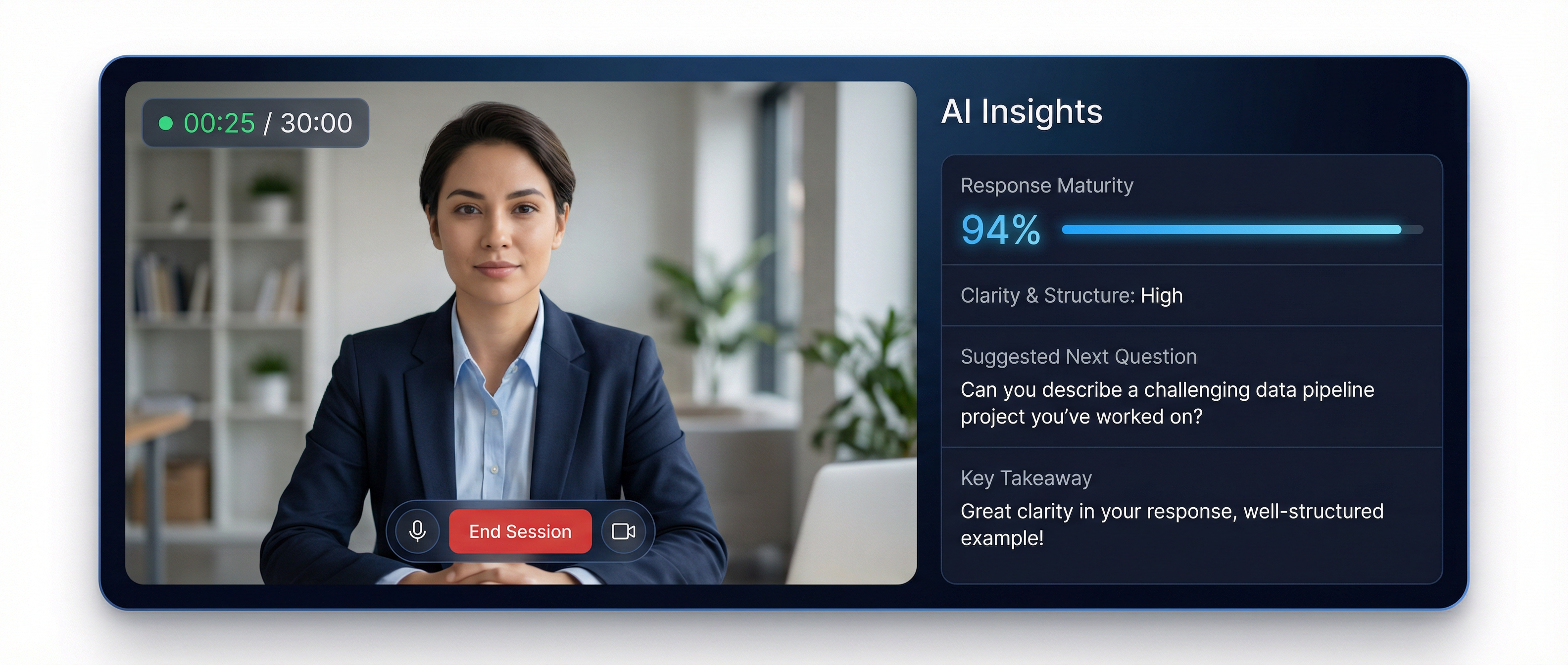
- An interview copilot is an AI-powered software tool that generates questions from your resume and target job description, displays three structured bullet-point hints while you answer, scores your response using STAR Detection, and produces a post-session Gap Analysis showing which job description keywords your answers missed.
- What is an AI interview copilot?
- An AI interview copilot is an interview copilot powered by large language models - such as GPT-4o, Claude, or Gemini Pro - combined with speech-to-text engines, computer vision, and NLP, adding non-verbal analysis, speech analytics, and adaptive questioning on top of the core hint-and-feedback loop.
- What is copilot AI for interviews?
- Copilot AI for interviews is the AI calibration engine within interview copilot platforms adjusting question difficulty, follow-up depth, and strictness based on your resume, target role, and live session performance.
- What is copilot interview?
- A copilot interview is a practice session using an AI interview copilot tool. The terms “copilot interview,” “interview copilot,” “AI interview copilot,” “copilot AI interview,” and “copilot AI” all refer to the same category of real-time AI interview assistance technology and are used interchangeably.
- What is the difference between interview copilot, copilot interview, and copilot AI interview?
- All three terms - “interview copilot,” “copilot interview,” “AI interview copilot,” “copilot AI interview,” and “copilot AI” - refer to the same category of real-time AI interview assistance technology. They are used interchangeably across the industry.
- What it is: An interview copilot is a guided AI practice tool that coaches your answers with live hints, STAR scoring, and instant retry.
- Core problem it solves: The gap between knowing your material and articulating it confidently under live interview pressure.
- How it works: Upload resume + JD → AI generates contextual questions → live hints appear → STAR Detection scores your response → instant retry available → Gap Analysis shows what you missed.
- Key insight: Traditional prep tells you what to say. A copilot interview approach teaches you how to think under pressure.
- Who it’s for: Any candidate who wants structured, confident responses that transfer into real interviews without needing AI on the day.
- Where to access it: Mockwin’s AI interview assistant delivers the complete interview copilot experience.
What Is an Interview Copilot? The Complete Definition
An interview copilot is an AI-powered software tool that operates as a real-time coaching layer during interview practice. It combines natural language processing, speech-to-text transcription, resume parsing, and job description matching to generate questions specific to your background display structured answer guidance while you respond score your answers against established frameworks and produce detailed performance reports after each session.
The name “interview copilot” accurately describes the relationship between candidate and tool. You are the pilot - the one speaking, thinking, deciding. The AI is the copilot monitoring context and surfacing the right guidance at the right moment without taking over the conversation.
An AI interview copilot is distinguished from a basic mock interview tool by four capabilities that basic tools do not offer: live hints displayed during your answer rather than after it, STAR detection with a numerical score per answer, instant retry on low-scoring responses, and adaptive follow-up questions generated from what you actually said rather than a static list.
According to a structured analysis of the interview copilot market, the most accurate description is this: these tools function as “contextual safety nets that prevent panic during high-stress memory retrieval, providing bullet points that the candidate must organically flesh out.” This defines exactly where the value lies not in scripting answers, but in scaffolding structure.
Complete Feature Set of a Copilot AI Interview Platform
- Real-time question generation from your resume and target JD not a generic question bank
- 3 live bullet-point hints per question mapped to question type and answer framework
- STAR Detection - identifies Situation, Task, Action, Result presence in every answer
- Relevance Score - 0 to 100% grade measuring how specifically your answer addressed the question
- Instant retry - real-time correction before advancing when scores fall short
- Drill-Down follow-up architecture - AI generates next question based on what you said
- Smart Resume Parser - extracts skills, experience, education, and achievements
- JD Matcher - identifies required tech stack, soft skills, and keywords from target role
- Speech analytics - tracks WPM, filler word frequency, and tone in real time
- Non-verbal analysis - computer vision tracking of eye contact, facial sentiment, and posture
- Post-session Gap Analysis - lists every JD keyword absent from your answers
- Skill Depth grading - grades proficiency per tool (“React: Advanced,” “CSS: Basic”)
- Tell Me About Yourself Generator - 45-second elevator pitch from your parsed resume
- Pivot Suggestions - flags specific moments where a stronger answer was available
- Missed Opportunities - flags resume achievements relevant to a question you never mentioned
What Is the Difference Between an Interview Copilot and Traditional Interview Prep?
The difference between a copilot interview approach and traditional interview preparation is not a difference of degree it is a difference of kind. Traditional prep works before the interview through static rehearsal. An interview copilot works during practice, in the moment answers are formed, when structural gaps actually occur.
| Dimension | Interview Copilot | Traditional Prep |
|---|---|---|
| When it helps | During practice - live, real-time | Before practice - static, advance preparation |
| How it coaches | Displays hints while you speak | Provides answers to review and memorize |
| Feedback timing | Immediate - after each answer | End of session or not at all |
| Adapts to what you say | Yes - Drill-Down follow-ups | No - static question lists |
| Identifies structural gaps | Yes - STAR Detection per answer | No - self-assessment only |
| Tracks delivery | Yes - WPM, filler words, tone | No |
| Shows what you missed | Yes - JD keyword Gap Analysis | No |
| Builds transferable skill | Yes - through corrected repetition | Partially - through memorization |
| Risk in real interview | None when used for practice | None |
The core insight research consistently supports: traditional preparation tells you what to say. A copilot interview practice approach teaches you how to think under pressure with the STAR structure internalized rather than recalled from memory under duress.
How Does an Interview Copilot Work? The Complete Step-by-Step
Understanding exactly how a copilot interview tool works helps candidates use it effectively rather than passively. The most common question how does an interview copilot work? has a clear answer: through seven structured stages that build on each other from session setup to post-interview debrief.
- Resume and Job Description UploadUpload your resume as a PDF or DOCX file. The Smart Resume Parser extracts your Skills, Years of Experience, Education, and Key Achievements. Paste the job description for the role you are targeting. The JD Matcher identifies Required Tech Stack, Soft Skills, and Nice-to-Have Keywords aligning the entire session to that specific role. This is the foundation of resume-based interview practice.
- Contextual Question GenerationThe interview copilot generates questions at the intersection of your background and the target role not from a generic bank. If your resume mentions leading a specific project, the AI asks about it directly: “Walk me through the decision-making process you used during that platform migration” - not the generic “tell me about a challenge you overcame.”
- Live Hint DisplayThe AI interview copilot reads the question and immediately displays 3 structured bullet-point hints on screen showing the architecture your answer needs. For behavioral questions: Situation context → Personal Action → Measurable Result. For technical questions: Problem Definition → Solution Approach → Trade-Off Awareness. For situational questions: Context → Decision Logic → Anticipated Outcome.
- Real-Time Speech AnalysisAs you speak, the copilot AI interview engine simultaneously tracks three delivery dimensions: Words Per Minute (optimal: 130–160 WPM), filler word count (every “um,” “like,” “basically,” “you know”), and tone whether your delivery reads as Open and confident or Defensive and closed.
- Immediate STAR FeedbackThe moment you finish, STAR Detection flags which components were present, underdeveloped, or absent. The Relevance Score - 0 to 100% - grades how specifically your answer addressed the actual question. This precision is what the AI interview feedback system is built to deliver.
- Instant RetryIf your Relevance Score falls below threshold, the interview copilot immediately offers a redo before advancing with the specific feedback still visible on screen. This is the highest-value moment in any copilot interview session. Correction happens while the question is live in working memory.
- Drill-Down Follow-UpThe AI generates follow-up questions based on what you actually said not a static list. At maximum depth: “Why did you choose SQL?” → “How did you scale it past 10 million records?” → “What would you do if the index failed?” This mimics exactly how a senior interviewer probes for genuine depth. The adaptive AI mock interviewer dynamically increases difficulty as your scores improve.
Core Features of an AI Interview Copilot
A high-quality copilot interview platform combines multiple technical systems into one unified practice experience. Here are the features that define the category:
Feature 1 - Live Answer Hints (3 Bullet Points Per Question)
The live hint system is the defining feature of an interview copilot. Three structured bullet points appear before you start answering showing the structural components your answer must include. These hints are question-type-aware: behavioral questions receive STAR mapping, technical questions receive engineering-focused scaffolding, and situational questions receive decision-logic framing. Critically, the hints do not script your answer they ensure you cover every required component in your own words.
Feature 2 - STAR Detection with Relevance Score
The STAR Detection engine scans every answer for all four framework components Situation, Task, Action, Result. Each component is evaluated individually, and a composite Relevance Score of 0–100% reflects how well the complete answer addressed the specific question. Candidates who consistently score below 70% on Results typically discover they are telling strong stories without conclusions a pattern invisible without this measurement.
Feature 3 - The AI Persona System (3 Levels, 4 Axes)
A sophisticated copilot AI interview platform uses a Persona Matrix to simulate different types of real interviewers, calibrated across four axes Drill-Down Depth, Interrupt Tolerance, Semantic Strictness, and Context Weight:
Friendly HR
Never interrupts, low strictness. Best for beginners, junior roles, culture-fit practice.
Hiring Manager
Rare interruptions, medium strictness. Right calibration for most mid-level professional practice.
Bar Raiser
Interrupts at 45s, high strictness, penalizes imprecise terminology. Best for senior roles and Challenge Mode.
Feature 4 - Speech Analytics
The speech analytics layer surfaces three delivery dimensions most candidates never objectively measure: Words Per Minute, filler word count across the full answer, and tone analysis distinguishing Open confident delivery from Defensive hedging delivery. These appear in the Communication Report with a visual confidence meter showing voice stability across the complete session.
Feature 5 - Non-Verbal Analysis via Computer Vision
During video sessions, the interview copilot tracks eye contact frequency, facial sentiment (Confidence vs. Anxiety signals), and posture stability using computer vision. Inconsistent eye contact is among the most cited recruiter concerns in post-interview feedback yet most candidates have never had objective data on their own performance in this dimension.
Feature 6 - Post-Session Gap Analysis
After every session, the Stack Report generates a Gap Analysis listing every keyword present in the target job description that never appeared in any of your answers. This output is a personalised pre-interview checklist: specific, actionable, and based entirely on the actual gap between what the employer requires and what you demonstrated.
Feature 7 - Tell Me About Yourself Generator
The interview copilot generates a polished, 45-second “Tell Me About Yourself” elevator pitch from the parsed data in your uploaded resume tailored to your actual career trajectory and the target role’s priorities rather than a generic scripted opener.
Feature 8 - Pivot Suggestions and Missed Opportunities
Post-session analysis flags specific moments where a stronger answer pivot was available: “You answered ‘Yes.’ A stronger response would have been: ‘Yes and here is how I used that to achieve a specific outcome.’” Missed Opportunities separately flags resume achievements that were directly relevant to a question but never mentioned in your answer.
Feature 9 - Chrome Extension and Mobile Access
The Mockwin Chrome extension adds a “Practice for This Job” button directly on LinkedIn and Indeed job posts scraping the JD from the active tab and launching a custom copilot interview session instantly. The Mockwin mobile app provides full AI interview copilot access across all devices.
Start Your First Interview Copilot Session Free
Upload your resume, paste your target job description, and get your first STAR-scored session with live hints and a Gap Analysis report - no setup required.
Start Your Free Copilot Interview Session →What Does Research Say About AI Interview Copilot Tools?
The research on interview copilot tools is extensive, consistent, and practically useful. Here is what the evidence actually shows:
Key Research Findings
- 55% of professionals say AI in job interviews is “the new norm,” according to survey data cited in corporate hiring policy research.
- 28% of job seekers already use AI to generate interview answers, according to internal survey data cited by major employers.
- 12% more job offers, 18% more candidate starts, 17% higher 30-day retention - outcomes from a field experiment across approximately 70,000 candidates using AI-assisted interview screening, according to independent research on AI-led hiring outcomes.
- 78% of candidates preferred the AI interviewer over a human when given the option in the same study reflecting the consistency and non-judgment of AI-powered practice.
- The cognitive overload problem is documented: Research confirms that live AI script-reading backfires because “the human brain struggles to simultaneously listen to an interviewer, read scrolling AI-generated text, synthesize technical logic, and verbally articulate a natural response without sounding robotic.”
- Expert consensus favors practice-first usage - independent review analysis, community research, and academic studies all converge on one recommendation: AI interview copilot tools deliver the most value for practice and simulation, not live real-interview use.
Is Using an Interview Copilot Ethical?
The ethical question around an AI interview copilot depends entirely on how it is used. The distinction is clear and consistently made by every expert source:
✅ Ethical Use - Practice and Preparation
Using a copilot interview tool to practice answering questions, build structural thinking, receive delivery feedback, and identify gaps in your preparation is equivalent to working with a human interview coach or using structured frameworks to reinforce key talking points. Every expert source classifies this use as fully acceptable, recommended, and increasingly standard practice.
⚠️ Problematic Use - Live Assistance During Real Interviews
Using an AI interview copilot to read AI-generated scripts during an actual employer interview raises authenticity concerns and is practically self-defeating. It produces the behavioral patterns interviewers identify: a consistent 5–7-second delay before answering, filler phrases to mask generation time, verbose textbook-style introductions, and freezing when interrupted. This is a documented detection pattern observed by experienced interviewers and automated assessment platforms alike.
The Three-Principle Ethical Framework
- A copilot interview tool should help you communicate what you genuinely know and have done not fabricate experience you do not have.
- An interview copilot should reduce performance anxiety, not replace genuine preparation.
- If a role requires skills or experience you do not have, a copilot AI interview tool is not the solution honest self-assessment is.
What Do Employers Say About AI Interview Copilot Use?
Corporate policy on AI interview copilot use is genuinely divided understanding each major employer’s position helps candidates prepare appropriately:
| Employer | Policy on AI During Interviews | Policy on AI for Preparation |
|---|---|---|
| Amazon | Zero tolerance - disqualification for AI use during real interviews | Permitted |
| Reintroduced in-person engineering interviews to reduce AI-assisted answers | Permitted | |
| Microsoft | Permits AI use during specific technical loops if it “reflects true capabilities” | Permitted |
| Anthropic | Prohibited unless recruiter explicitly authorizes for specific assessment | Actively encouraged - use Claude for prep |
The practical conclusion: Using Mockwin’s AI interview assistant for copilot interview practice is consistent with every major employer’s policy. Every employer permits preparation. What varies is whether AI tools are allowed during the live interview itself and for most employers, they are not.
What to Look For When Choosing an Interview Copilot Platform
Rather than comparing specific competitors whose features and documentation change regularly here are the criteria that separate a high-quality AI interview copilot from a basic mock interview tool:
- Live hints during your answer (not after). The core value of an interview copilot is guidance in the moment answers are formed. If a platform only provides post-answer feedback, it is a mock interview tool, not a copilot.
- STAR Detection with a numerical score. Vague feedback does not build skill. A genuine copilot AI interview platform scores each STAR component individually and gives a numeric Relevance Score per answer.
- Instant retry capability. The ability to redo an answer immediately while feedback is visible and the question is fresh is the feature most directly tied to accelerated skill development.
- Resume and JD-matched question generation. Generic question banks do not prepare you for your actual interview. An interview copilot should generate questions from your specific resume and target job description.
- Speech analytics with specific metrics. “Work on your delivery” is not useful feedback. A high-quality copilot interview platform measures WPM, filler word count, and tone specific, objective, improvable metrics.
- Post-session Gap Analysis. The most time-efficient pre-interview tool is a list of JD keywords you failed to mention. Not all interview copilot platforms generate this but it is one of the most actionable outputs the category can produce.
- Adaptive difficulty. A fixed-difficulty session does not build resilience. The adaptive AI mock interviewer increases difficulty as your scores improve.
- Role-specific calibration. Use AI interview practice by role to ensure sessions are calibrated to your actual target position.
For platform terminology and definitions, Mockwin’s interview and HR terminology glossary covers the full vocabulary of AI-assisted interview preparation.
How to Use an Interview Copilot Effectively: The 7-Session Progression
Learning how to use an interview copilot effectively is not about a single session the night before. It is a structured progression that builds, stress-tests, and verifies your skill:
Friendly HR Persona - Build the Framework
Start with Friendly HR calibration. The goal is not to score well it is to internalize the STAR structure. Take every retry. Review the Gap Analysis from both sessions and note the JD keywords your answers consistently miss.
Hiring Manager Persona - Stress the Structure
Advance to the Hiring Manager calibration. Drill-Down follow-ups will probe more deeply. Maintain STAR structure even when unexpected follow-up questions arrive. Use AI interview practice by role for role-specific calibration.
Bar Raiser Persona - Test Under Pressure
Advance to Bar Raiser calibration. You will be interrupted if you ramble. Imprecise terminology will be flagged. Three consecutive follow-up questions will probe every major claim. Verify your STAR structure holds under real pressure via Challenge Mode.
Full Simulator - No Hints, No Retry, No Safety Net
Run one complete Full Simulator session: strict timer, no hints, no retries, Bar Raiser calibration. If your Full Simulator scores are within 15 points of your best Co-Pilot scores, you are ready for the real interview.
Gap Analysis Review
Run one final Co-Pilot session the day before. Review the Gap Analysis - it gives you the specific JD keywords to surface naturally in tomorrow’s interview. Use the Tell Me About Yourself Generator to finalize your opening.
Interview Copilot for Different Interview Types and Industries
A copilot AI interview platform adapts to different formats because the JD Matcher and Resume Parser ensure every session is calibrated to your specific role:
All RolesBehavioral Interviews
STAR Detection is the primary coaching mechanism. Live hints map directly to Situation, Task, Action, Result. Pivot Suggestions identify moments where a stronger STAR structure was available but unused. Missed Opportunities flags resume achievements that were relevant but never mentioned.
Engineering · DataTechnical Interviews
Hints map to Problem Definition, Solution Approach, and Trade-Off Awareness. The Stack Report grades demonstrated depth on specific languages and frameworks against the JD’s stated requirements. The Drill-Down architecture probes three levels deep on every technical claim.
Consulting · FinanceCase Study Interviews
Hints prompt structured problem decomposition, hypothesis formation, and quantified recommendation delivery. Bar Raiser calibration flags vague analytical language and pushes for precise, structured reasoning with specific numbers and defined trade-offs.
All RolesCulture Fit & HR Interviews
The Friendly HR persona creates a supportive practice environment for motivations, values, and career narrative. The JD Matcher prioritizes the soft skills and cultural signals the employer listed ensuring culture-fit answers address exactly what the hiring team is looking for.
VP · Director · C-SuiteSenior Leadership Interviews
Bar Raiser calibration with maximum Context Weight generates hyper-specific questions about your leadership decisions, organizational impact, and strategic reasoning drawn directly from your actual resume. The Drill-Down architecture probes three levels deep on every major claim.
Common Mistakes When Using an Interview Copilot - And How to Fix Each One
The three bullet points are structural scaffolding, not sentences to recite. Reading them verbatim produces robotic, disconnected delivery that interviewers identify immediately. Use the hints to orient your thinking then speak from your genuine experience in your own voice.
Every skipped retry is the most valuable practice moment wasted. The retry enables correction while the specific feedback is visible and the question is still fresh the highest-probability environment for genuine skill improvement.
Most candidates focus entirely on STAR scores and overlook WPM, filler word count, and tone data. These delivery metrics frequently explain why technically correct answers fail to land well with interviewers.
An interview copilot is a learning tool not a permanent safety net. Candidates who practice only in Co-Pilot mode build skill with hints visible but never verify that skill holds without them.
Copilot interview question quality is directly proportional to the specificity of your resume inputs. Generic entries produce generic questions that will not match what real interviewers ask.
A single copilot interview session shows you your current gaps it does not fix them. Skill development requires repeated, corrected practice across multiple sessions.
Quick Tips for Getting the Most Out of Your Interview Copilot
Who Is an Interview Copilot Best For?
An AI interview copilot delivers the highest value to candidates who are actively building interview skill not just testing existing readiness:
| Candidate Type | Why an Interview Copilot Helps |
|---|---|
| First-time professional candidates | Friendly HR persona provides structural scaffolding before facing real interviewers |
| Mid-level professionals | STAR Detection catches the Result component consistently dropped under pressure |
| Career changers | JD Matcher identifies target-role terminology; Gap Analysis shows where translation fails |
| Non-native English speakers | WPM and filler word metrics pinpoint specific delivery patterns to address |
| Neurodivergent candidates | Explicit structural prompts and patient calibrated feedback create equitable practice environment |
| Senior professionals | Bar Raiser + resume-specific questions provide realistic senior-level rehearsal |
| Underperformers under pressure | Directly addresses the gap between capability and live verbal performance |
Conclusion
An interview copilot is not a shortcut to passing interviews you are not prepared for. It is a precision skill-development tool that closes the specific gap that costs qualified candidates job offers the gap between knowing your material and performing confidently under live pressure.
The research is consistent: 55% of professionals consider AI in interviews the new norm, AI-assisted screening processes produce 12% more offers and 17% higher retention, and 28% of candidates are already using AI to generate answers. The question for every job seeker is not whether to engage with AI interview tools it is whether to use them in a way that builds genuine skill or creates short-term dependency.
The copilot interview approach on Mockwin builds skill through a specific, research-validated mechanism. Live structural hints scaffold your thinking. STAR Detection scores your answers precisely. Speech analytics surface delivery patterns you cannot hear yourself. Non-verbal analysis shows how you appear on screen. The Gap Analysis converts every session into a personalised pre-interview checklist. And the instant retry builds the habit of getting answers right.
Start with the interview copilot. Build the structure. Test it under pressure. Walk into the real interview and perform it without assistance because the copilot interview practice has already done its work, and the skill is now yours.
Start Your Interview Copilot Practice Today
Upload your resume, paste your target job description, and run your first complete copilot interview session on Mockwin. The Gap Analysis from that single session gives you a precise pre-interview checklist before you have reviewed anything else.
Start Your Free Interview Copilot Session →To explore plan options, review Mockwin’s pricing here.
Frequently Asked Questions
What is an interview copilot?
An interview copilot is an AI-powered practice tool that coaches candidates during interview preparation by displaying live structural hints per question, detecting STAR framework usage, scoring each answer from 0 to 100%, and generating a post-session Gap Analysis showing which job description keywords your answers missed. It generates contextual questions from your uploaded resume and target job description not a generic question bank.
What is an AI interview copilot?
An AI interview copilot is an interview copilot powered by large language models such as GPT-4o, Claude, or Gemini Pro, combined with speech-to-text engines and computer vision. It adds non-verbal analysis, speech analytics, adaptive follow-up questioning, and skill depth grading on top of the core hint-and-feedback system. Mockwin’s AI interview assistant delivers the complete experience.
What is copilot AI for job interviews?
Copilot AI for job interviews is the AI calibration engine that powers an interview copilot adjusting question difficulty, follow-up depth, semantic strictness, and context specificity based on your role, resume, and live session performance. It is what makes a copilot interview experience adaptive rather than static.
What is the difference between copilot interview and interview copilot?
“Copilot interview” and “interview copilot” refer to the same category of AI-assisted interview practice technology. Both terms, along with “AI interview copilot,” “copilot AI interview,” and “copilot AI,” are used interchangeably in the job-seeking community.
How does an interview copilot work? How does interview copilot work?
An interview copilot works through seven stages: resume and JD upload, contextual question generation, live hint display (3 structured bullet points per question), real-time speech analysis, immediate STAR feedback with a Relevance Score, instant retry on low-scoring answers, and Drill-Down follow-up questions generated from what you actually said. The complete workflow is covered in the “How Does an Interview Copilot Work” section above.
What is a copilot interview?
A copilot interview is a practice session conducted using an AI interview copilot tool where the AI provides live structural hints, scores your answers using the STAR framework, and gives immediate feedback after each response. The terms “copilot interview” and “interview copilot” refer to the same category of AI-assisted interview practice technology and are used interchangeably.
Is using an interview copilot for practice ethical?
Yes. Using an interview copilot for practice and preparation is fully ethical equivalent to working with a human interview coach or using structured preparation materials. Every expert source reviewed for this guide classifies practice use as acceptable and recommended. Using a copilot AI interview tool during an actual employer interview is a separate question that depends on each employer’s policy.
What is the Gap Analysis in an interview copilot?
The Gap Analysis is a post-session list showing every keyword present in your target job description that your answers failed to mention. It functions as a personalised pre-interview checklist showing exactly which competencies, tools, and skills the employer stated as requirements that you need to consciously surface in your actual interview.
Is an interview copilot worth it? Is interview copilot worth it?
An interview copilot is worth it for candidates who want to build structural interview skill rather than memorize generic answers. The specific value comes from live hints that prevent structural gaps in real time, STAR scoring that identifies patterns across multiple sessions, and a Gap Analysis that converts every practice session into a personalised checklist for the next real interview.
How do you use an interview copilot?
To use an interview copilot effectively: upload a detailed, quantified resume and paste the actual job description of your target role, start with the Friendly HR persona to build STAR structure, always take the instant retry when offered, review speech analytics (WPM, filler words) after every session, advance through Hiring Manager then Bar Raiser personas, and use the post-session Gap Analysis as your pre-interview checklist. Follow the 7-session progression covered in this guide for best results.
How many sessions does it take to see improvement?
Most candidates report measurable improvement in answer structure within three to four copilot interview sessions when they consistently take the instant retry and review the Communication Report after each session. Full skill transfer where structured answers come naturally without hints typically requires five to seven sessions depending on starting baseline and practice frequency.
Can I use an interview copilot on my phone?
Yes. The Mockwin mobile app provides full AI interview copilot access across all devices. Sessions are fully continuous across web and mobile, meaning preparation is not limited to a desktop setup.
Tags
Shaik Vahid
Content Writer and Jr. SEO Specialist delivering high-impact, SEO-focused content where creativity meets data to drive real results.
Related Articles

Dojo Mode Interview Practice: How AI Drilling Builds 90% Mastery
You've practiced the question before. You knew the answer yesterday. But sitting across from the interviewer, your mind goes completely blank.
MockWin.ai Credits: The Complete Guide
Everything about free credits, paid credits, how to earn them, what they unlock, and how to never run out before your dream interview.

Stop Freezing in Interviews: Master Your Next Pitch with MockWin.ai
Most candidates fail interviews due to panic and pressure, not a lack of skill. MockWin.ai eliminates this anxiety by using an adaptive "Drill-Down" AI that generates dynamic follow-up questions directly from your uploaded resume and target job description. By practicing in this simulated high-pressure environment, you expose and fix your hidden weaknesses before the real interview, transforming fear into undeniable confidence.