

Interview Anxiety and AI-Based Solutions: Complete Guide to Confident Interviewing
Interview anxiety isn't just "butterflies" it's a biological "fight-or-flight" response that hijacks your cognitive function when you need it most. Fortunately, the fusion of AI and neuropsychology provides a powerful antidote. Adaptive AI mock interviews act as low-stakes exposure therapy, eliminating the fear of the unknown through repeated, bias-free practice. Combined with science-backed breathwork to instantly turn off your body's stress response, this modern approach empowers you to actively rewire your nervous system. By leveraging these tools, you can transform paralyzing fear into high-performance excitement, ensuring you walk in ready to showcase your absolute best self.
Interview Anxiety: Causes and Solutions for Confident Interviewing
Landing an interview is a major milestone, but the excitement often quickly morphs into a knot of dread. When the pressure to perform triggers debilitating interview anxiety, logical thinking suffers, and candidates stumble over words or draw a blank, costing them dream jobs and costing companies top talent. This comprehensive guide explores interview anxiety, its psychological and physiological roots, and how modern AI-based solutions can help you overcome it. Whether you are a job seeker looking to conquer your nerves or a hiring manager wanting to create a supportive environment, this guide provides actionable, science-backed strategies. Understanding the causes of interview anxiety is the first step toward finding effective solutions to present the best version of yourself.
TL;DR / At-a-Glance Summary
Interview anxiety triggers a debilitating "fight-or-flight" response that impairs cognitive function, often rooted in psychological factors like imposter syndrome and the fear of failure.
AI-based mock interviews provide a low-stakes environment for repeated practice and objective feedback, acting as an effective form of exposure therapy to reduce this fear.
In-the-moment physiological symptoms can be rapidly managed using targeted breathwork, such as the 4-7-8 method or the physiological sigh, to deactivate the body's stress response.
Candidates can improve their performance by cognitively reframing nervousness as excitement, while interviewers can drastically lower candidate anxiety by establishing a transparent, welcoming environment
What Is Interview Anxiety?
Interview anxiety is a specific form of performance anxiety characterized by intense feelings of stress, nervousness, worry, and fear experienced before or during a job interview. It goes beyond harmless butterflies, crossing a threshold where it triggers an autonomic nervous system response that severely hinders a candidate's ability to function and communicate.
Key Concepts / Terminology
- Fight-or-Flight Response: The body's automatic reaction to perceived threats, releasing adrenaline and cortisol that cause physical symptoms like racing heartbeats and sweating.
- Imposter Syndrome: A behavioral pattern where individuals doubt their accomplishments and fear being exposed as a "fraud," leading to frantic over-preparation.
- MASI (Measure of Anxiety in Selection Interviews): A framework identifying five core dimensions of interview anxiety: communication, appearance, social, performance, and behavioral anxiety.
- State vs. Trait Anxiety: State anxiety is transient apprehension in a specific moment, while trait anxiety is a stable personality characteristic predisposing someone to stress.

Why Is Overcoming Interview Anxiety Important?
- Business Impact: When candidates are overwhelmed by stress, evaluators receive distorted data, often misinterpreting behavioral anxiety as a lack of competence or confidence. This causes organizations to miss out on highly qualified talent.
- Operational Impact: Anxious candidates might resort to "Deceptive Impression Management" (stretching the truth) to protect themselves from failure, which complicates accurate candidate assessment.
- Strategic Impact: Prolonged interview stress elevates cortisol, which can suppress the immune system and cause "brain fog" that damages cognitive performance over time.
- Who Needs This: Job seekers need these solutions to showcase their true potential, while HR professionals and hiring managers must understand anxiety to refine their selection processes and eliminate subjective bias.
How AI-Based Solutions for Interview Anxiety Work
AI tools mitigate interview anxiety by providing structured, repetitive practice that acts as a form of exposure therapy.
- Inputs: The candidate engages with an adaptive AI mock interviewer, answering text, audio, or video-based questions tailored to a specific role.
- Process: The AI analyzes the candidate's speech patterns, pacing, and content delivery in a low-stakes, simulated environment.
- Outputs: The system provides immediate, objective feedback on performance, identifying areas of strength and highlighting nervous habits.
- Feedback Loop: Through repeated exposure, the candidate habituates to the interview format, reducing the novelty of the situation and the associated fear response.
Types of Interview Anxiety
According to the MASI framework, interview anxiety manifests in several distinct categories:
- Communication Anxiety: Discomfort with articulating thoughts, leading to disorganized responses despite actual knowledge.
- Appearance Anxiety: Excessive self-monitoring regarding dress or posture, which distracts from content delivery.
- Social Anxiety: Intense fear of negative evaluation and difficulty interpreting interpersonal cues.
- Performance Anxiety: Preoccupation with avoiding failure, resulting in overthinking that impairs cognitive flexibility.
- Behavioral Anxiety: Observable physical signs of distress, such as fidgeting, sweating, or voice cracking.
Normal Nervousness vs. Debilitating Anxiety
| Feature | Normal Nervousness | Debilitating Anxiety |
|---|---|---|
| Arousal Level | Mild stress (around 3–5 on a 10-point scale). | High stress (above 5/10), triggering the fight-or-flight response. |
| Impact on Focus | Increases alertness, motivation, and sharpens attention. | Brain shifts to survival mode; logical thinking collapses. |
| Physical Symptoms | Mild "butterflies" or a slight adrenaline rush. | Panic attacks, freezing, severe shaking, or nausea. |
| Best Approach | Reframe the feeling as excitement. | AI mock practice, cognitive behavioral therapy, and breathwork. |
Key Benefits of AI-Based Solutions
- Immediate Feedback → Objectivity Without Judgment: AI provides bias-free insights. This matters because candidates with social anxiety intensely fear human judgment; AI completely removes this social scrutiny.
- Repeated Exposure → Reduced Novelty: AI allows for unlimited practice runs. This has a quantifiable impact: meta-analyses show that practicing the situation through exposure is as effective as full CBT in reducing social anxiety symptoms.
- Skill Refinement → Increased Confidence: AI tools adapt to various roles, allowing targeted practice. The strategic advantage is that as competence grows through structured feedback, underlying anxiety naturally decreases.
Common Challenges / Risks
- Technical Limitations: Video and AI interviews can introduce tech glitches (e.g., poor internet, software failures) which paradoxically spike anxiety. Mitigation: Conduct tech checks 60 minutes prior, use a neutral background, and have a backup phone number ready.
- Severe Psychological Barriers: AI practice might not be enough for clinical-level distress. Mitigation: If anxiety causes panic attacks or impairs daily life, individuals should seek professional Cognitive Behavioral Therapy (CBT) to challenge deep-rooted negative beliefs.
- The Imposter Cycle: High achievers might use AI tools to frantically over-prepare out of a fear of exposure. Mitigation: Pair AI practice with mindfulness and cognitive restructuring to separate facts from feelings.
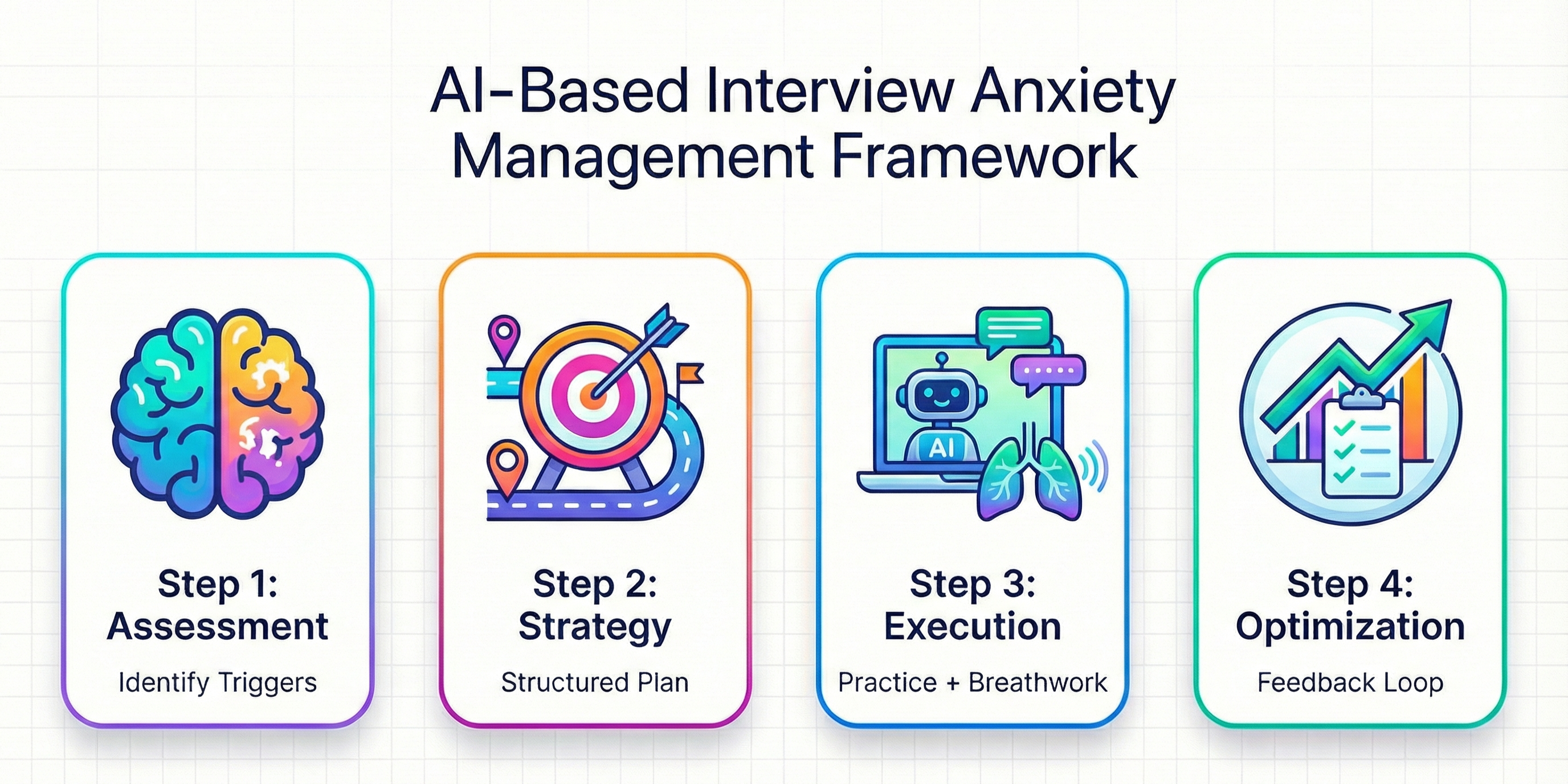
How to Implement AI-Based Solutions and Anxiety Management
Step 1: Assessment
Evaluate your current anxiety triggers. Identify whether your symptoms are primarily physiological (racing heart), cognitive (mind blanking), or situational (fear of coding tests).
Step 2: Strategy
Align your goals with specific frameworks. If you fear technical interviews, plan to use the UMPIRE method (Understand, Match, Plan, Implement, Review, Evaluate) alongside your AI practice.
Step 3: Execution
Utilize AI mock interviewers for role-specific practice. Incorporate the 4-7-8 breathing technique (inhale 4, hold 7, exhale 8) right before starting the simulation to regulate your cortisol and heart rate.
Step 4: Optimization
Review the AI feedback objectively. Use a "Rejection Journal" or debrief notes to track improvements in pacing, clarity, and confidence over time, treating every session as a valuable data point.
Real-World Use Cases / Scenarios
Scenario 1:
A candidate repeatedly freezes during technical coding interviews due to cognitive overload. → Implementation: The candidate uses AI practice to rehearse the UMPIRE method and practices "thinking aloud" to show their reasoning. → Outcome: The candidate demonstrates logical problem-solving even when unsure of the final answer, securing the job offer.
Scenario 2:
A job seeker suffers from severe video interview anxiety, constantly distracted by their own image on screen. → Implementation: They run virtual AI mock interviews, practice looking directly into the webcam lens, and use the "Physiological Sigh" (double inhale, long exhale) to lower their heart rate. → Outcome: They maintain confident virtual eye contact and present a calm, authoritative presence.
Best Practices / Expert Tips
- Anxiety Reappraisal: Never tell yourself to "calm down." Instead, say "I am excited." Shifting from high-arousal anxiety to high-arousal excitement is biologically easier and significantly improves performance.
- The Physiological Sigh: Take a deep inhale through the nose, add a second quick "pop" inhale, and follow with a long exhale through the mouth. This is the fastest neurological way to offload carbon dioxide and reduce stress in real-time.
- Power Posing: Stand in an expansive posture (hands on hips, chest open) for two minutes before the interview to boost confidence and lower cortisol levels.
- Grounding (The 5-4-3-2-1 Technique): If your mind races, silently identify 5 things you see, 4 you feel, 3 you hear, 2 you smell, and 1 you taste to anchor yourself back in reality.
Metrics That Matter
- Arousal Scale: Track your subjective stress on a 1-10 scale; aim to keep it in the optimal 3-5 range for healthy motivation.
- Heart Rate / Cortisol Recovery: Measurement of how quickly physiological symptoms (sweating, palpitations) subside using breathing techniques.
- Interview-to-Offer Conversion Rate: The ultimate KPI for candidates utilizing AI practice and cognitive methods to overcome performance barriers.
Future Trends in Interview Anxiety Solutions
- Advanced AI Integration: AI tools will increasingly offer adaptive, real-time feedback on micro-expressions, pacing, and vocal modulation to help candidates refine their delivery.
- Virtual Reality (VR) Exposure: Immersive tech will simulate high-pressure panel or group interviews to safely habituate candidates to intimidating environments without real-world consequences.
- Empathetic Hiring Automation: Screening tools will evolve to assess candidate potential while minimizing artificial "pop quiz" stress, aligning with a broader market evolution toward supportive, transparent hiring.
Who Should Invest in AI-Based Solutions?
- Individuals: Job seekers ranging from entry-level applicants to executives who suffer from imposter syndrome or general interview dread.
- Enterprises / HR Departments: Companies that want to standardize scoring, eliminate subjective bias, and ensure they don't lose top talent to situational anxiety.
- Career Coaches & Universities: Institutions providing students and clients with scalable, low-stakes exposure therapy and practice.
Conclusion
Interview anxiety is a formidable, yet highly manageable challenge. By reframing the problem understanding that a pounding heart is just the body's natural fight-or-flight response, not a sign of incompetence you can regain control. Using AI-based practice tools provides the repeated exposure necessary to turn novel, terrifying experiences into familiar routines. Overcoming interview anxiety isn't about the total absence of fear, but rather possessing the resilience and tools to perform at your peak despite it.
FAQs
How can I immediately calm my nerves before an interview?
To immediately calm your nerves, utilize deep breathing exercises like the 4-7-8 method or the physiological sigh. Practice positive self-talk, reframe your anxiety as excitement, and use power posing for a few minutes to quickly reduce cortisol and ground your nervous system.
What are the main causes of interview anxiety?
The primary causes include psychological factors like fear of failure, imposter syndrome, and perfectionism. Additionally, the body's automatic fight-or-flight response to high-stakes evaluation triggers severe physical symptoms like a racing heart and mind blanking.
When should I consider professional help for interview anxiety?
You should seek professional support if your anxiety causes panic attacks, significantly impairs your ability to apply for jobs, or disrupts your daily well-being. Therapies like Cognitive Behavioral Therapy (CBT) are highly effective for severe performance anxiety.
How does virtual interview anxiety differ, and what are the solutions?
Virtual anxiety often centers around technical failures and the discomfort of seeing oneself on camera. Solutions include thoroughly testing your tech beforehand, looking directly at the webcam lens to simulate eye contact, and ensuring a professional, distraction-free background.
What role can interviewers play in reducing a candidate's anxiety?
Interviewers can drastically reduce candidate stress by offering a warm welcome, outlining the interview structure clearly, using mindful questioning techniques, and allowing candidates time to think without rushing them. This creates a supportive, inclusive atmosphere.
Tags
Shaik Vahid
Content Writer and Jr. SEO Specialist delivering high-impact, SEO-focused content where creativity meets data to drive real results.
Related Articles

Behavioral Interview Questions: How AI Helps You Practice
From understanding the STAR method to getting real-time feedback on your delivery, eye contact, and answer structure - a complete guide to AI-powered behavioral interview preparation.

The STAR Method: Complete Guide with Real Examples for Everyone
The STAR method is the gold standard framework for answering behavioral interview questions and it has been for over 50 years. Yet 80% of candidates still answer behavioral questions poorly, rambling through vague stories without a clear structure or measurable ending. The result? The interviewer moves on, unconvinced. The problem isn't a lack of good experience. It's the lack of a proven structure to tell it. Whether you're a fresher with zero work history, a developer navigating a FAANG interview loop, an HR professional conducting structured assessments, or a senior manager competing for a leadership role this guide gives you everything, backed by 50 years of behavioral science research and real examples for every type of person.