

How to Prepare for a Job Interview Step-by-Step (2026)
Most candidates prepare for interviews by reading a list of questions the night before. That is not preparation; that is wishful thinking. This guide gives you the system that actually works.
This guide answers one question completely: how to prepare for a job interview - from the day you get the call to the moment you walk in. It covers every step in sequence, what to do at each one, and how to know when you are actually ready.
Whether you are a fresher preparing for your first interview or an experienced professional targeting a senior role, the preparation system is the same. What changes is the content of your answers - not the structure of how you build them.
At a glance
What this covers: 6-step interview preparation system from day one to interview day
Who it is for: Freshers and experienced professionals preparing for any role
Time required: 7–10 days for full prep · 1–2 days for emergency prep
The outcome: Walk in knowing exactly what to say, how to say it, and your readiness score
Contents
- 1. Why most candidates fail to prepare properly
- 2. Step 1 - Analyse your resume against the job description
- 3. Step 2 - Build your Tell Me About Yourself answer
- 4. Step 3 - Build your STAR story bank
- 5. Step 4 - Drill your weak question categories
- 6. Step 5 - Run a full mock interview under real conditions
- 7. Step 6 - Review your readiness score and close the gaps
- 9. 7-day preparation timeline
- 10. Frequently asked questions
Why Most Candidates Fail to Prepare Properly
Most candidates fail job interviews not because they lack the skills - they fail because they have never practised articulating their experience under pressure. Reading interview questions is not the same as answering them. The gap between knowing an answer and delivering it fluently in a live interview is wider than most people expect until they are sitting in the chair.
3.7× More likely to reach final rounds
Candidates who practise with structured AI interview simulations are 3.7x more likely to advance compared to those who only read question lists and think through answers in their head.
The most common preparation mistake is treating an interview like an exam you can cram for. You cannot. An interview is a performance skill; it requires repetition under conditions that simulate the real thing. The six steps below are not a checklist to read through. They are a practice system to work through in sequence.
💡 The benchmark for knowing you are ready: your answers feel fluent, not memorised. You should be able to start any STAR story from any point and still land the result. If you can only deliver an answer in the exact order you rehearsed it, you are not ready yet.
Step 1 - Analyse Your Resume Against the Job Description
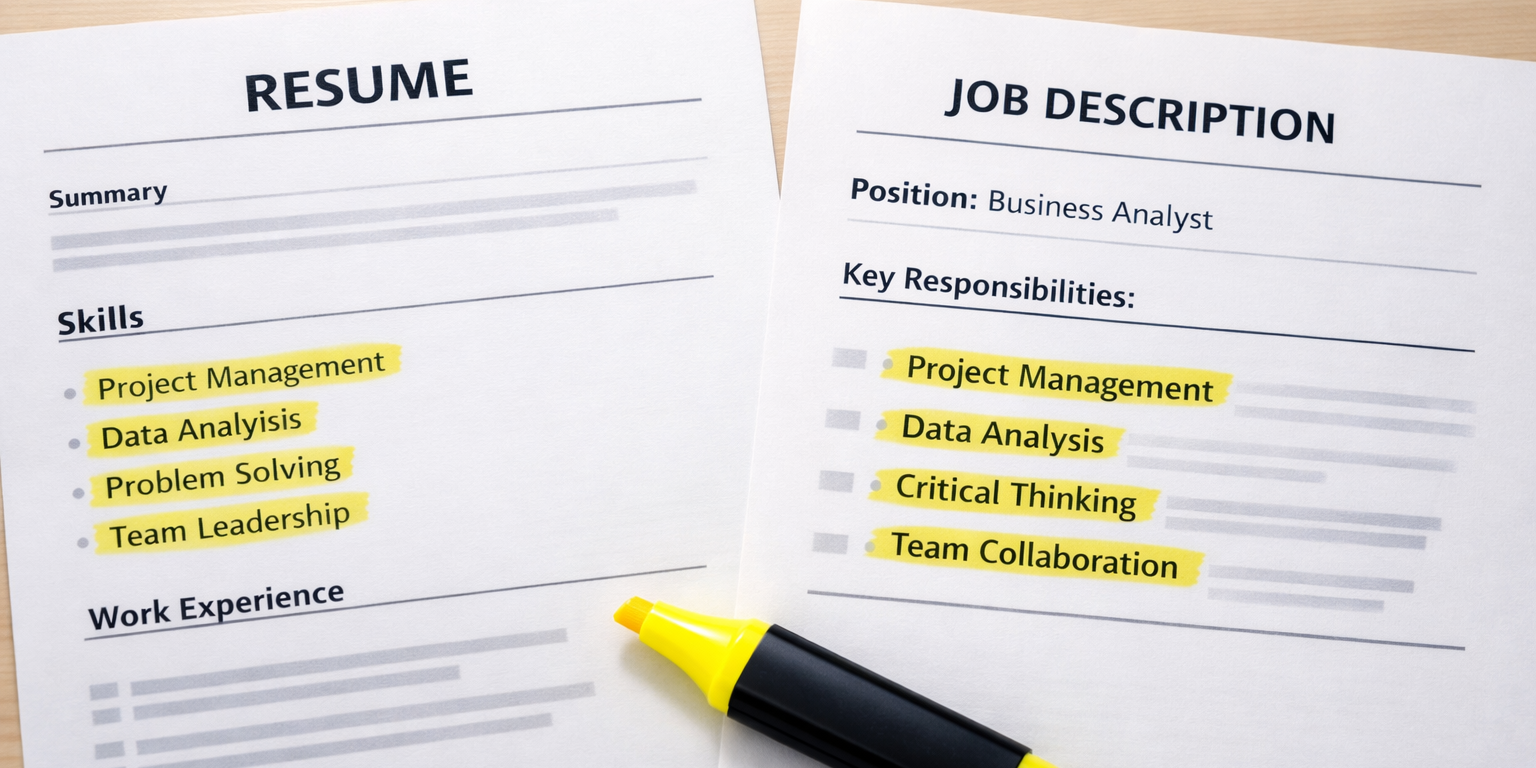
The job description tells you exactly what the interviewer will ask about. Every required skill, every listed responsibility, and every repeated keyword is a likely question. Your job in Step 1 is to map your experience to those requirements before the interviewer does it for you.
What to do
- Read the job description carefully and highlight the top 3 required skills and responsibilities - these will drive 80% of the interview questions.
- For each requirement, identify the specific experience or project from your background that best demonstrates it. This becomes your answer evidence bank.
- Identify the gaps - requirements you have limited evidence for. These need a bridging answer, not avoidance.
- Note any keywords the JD repeats. Mirror that language in your answers - it signals you understood the role, not just applied to a title.
Mockwin - Smart Resume Parser + JD Matcher
Step 2 - Build Your "Tell Me About Yourself" Answer
Tell Me About Yourself opens every interview. It is not small talk; it is the interviewer's first filter for communication clarity, career narrative, and confidence. Most candidates ramble for three minutes. The best candidates deliver a crisp, structured 60–90 second pitch that makes the interviewer want to know more.
The 15-Minute Decision Window
A comprehensive survey of hiring managers by Glassdoor revealed that most interviewers form a firm opinion of a candidate within the first 15 minutes. Nailing this opening question is the highest-leverage preparation you can do.
The Present-Past-Future formula
- Present (20–25s): Who you are now and your most relevant recent achievement. Lead with impact, not your job title.
- Past (15–20s): The 1–2 experiences that built the skills most relevant to this role. Brief and targeted - not your full history.
- Future (15–20s): Why this specific role at this specific company excites you. Mention something real about the company, product, or team.
Fresher Tip Present-Past-Future
Present = your degree, specialisation, and a specific project. Past = internships, coursework, or extracurricular leadership. Future = why this company's work connects to what you want to build.
Mockwin - Tell Me About Yourself Generator
Step 3 - Build Your STAR Story Bank
Behavioural questions make up the majority of every interview at every level. They all have the same answer structure: the STAR method. Your job in Step 3 is to prepare 8–10 strong STAR stories you can adapt to answer any behavioural question.
89% of Failures are Behavioral
A landmark study by Leadership IQ tracking 20,000 new hires found that while 46% fail within 18 months, 89% of those failures are due to behavioral mismatches rather than technical incompetence. This is why interviewers weigh STAR answers so heavily.
The STAR framework
The 8 stories every candidate needs
| A time you showed leadership or took initiative without being asked |
| A time you failed - and what you learned from it |
| A time you handled conflict with a colleague or stakeholder |
| Your proudest professional or academic achievement |
| A time you worked under significant pressure or a tight deadline |
| A time you had to learn something new quickly |
| A time you disagreed with a decision and how you handled it |
| A time you improved a process or solved a problem creatively |

Critical rule: Every STAR story must end with a specific result. "The team was happy" is not a result. "We reduced onboarding time by 30% over two months" is a result. Answers that trail off without a result are the single most common STAR failure in real interviews.
Read the complete STAR Method guide with examples →
Step 4 - Drill Your Weak Question Categories
After building your STAR bank, most candidates assume they are ready. They are not. The difference between a story that reads well on paper and one that lands confidently in a live interview is repetition under pressure. Step 4 is where you find your weak categories and drill them until the answers feel automatic - not rehearsed.
How to identify your weak categories
- Run a quick practice session covering all question types - behavioural, situational, role-specific, and standard HR questions.
- Note which answers felt uncertain, rambling, or incomplete. Those are your weak categories.
- Drill those categories in loops - answer, get feedback, improve, repeat - until answers are consistently structured.
- Do not move to the full mock simulation until you hit a clean STAR structure even on your weakest category.
Mockwin - Dojo Mode + Co-Pilot Mode
Step 5 - Run a Full Mock Interview Under Real Conditions
This is the step most candidates skip - and the most important one. A full mock under real conditions means: strict timer, no pauses, no hints, no stopping to correct yourself. The goal is to simulate the actual interview so the real thing feels familiar, not foreign.
The #1 Hiring Competency
According to the National Association of Colleges and Employers (NACE) Job Outlook report, employers consistently rank "oral communication" as the absolute most critical skill they evaluate during an interview, outranking technical proficiency and GPA.
What a proper mock interview measures
- STAR compliance: Did every behavioural answer have all four components - including the Result?
- Speaking pace: Target 120–170 words per minute. Too fast signals nerves. Too slow signals disengagement.
- Filler words: "Um," "like," and "you know" erode credibility fast. Target fewer than 3 per minute.
- Answer relevance: Did your answer address the specific question asked - or a slightly different one you rehearsed?
- Non-verbal signals: Eye contact frequency, facial confidence vs. anxiety, posture stability throughout the session.
Mockwin - Full Simulator (Real-Match Mode)
5-7 Practice sessions
Research on skill acquisition shows 5-7 deliberate sessions with structured feedback produce measurable improvement in interview performance. One session with real-time feedback is worth more than ten unguided repetitions.

Step 6 - Review Your Readiness Score and Close the Gaps
After your mock session, you get a performance report that tells you exactly where you are strong and exactly where you will lose points in a real interview. Step 6 is about using that report to close the remaining gaps before the real thing.
What your readiness report covers
- STAR Detection: Highlights which answers used the full framework and which were missing components - usually the Result.
- Relevance Score: A 0-100% grade on how well each answer addressed the specific question asked.
- Communication Report: Visual confidence meter, WPM graph, and filler word frequency across the full session.
- Gap Analysis: Keywords from the JD that you failed to mention - skills you have but did not demonstrate.
- Pivot Suggestions: Specific moments where a better bridge would have showcased your strongest experience.
Mockwin - Challenge Mode + LinkedIn Verified Badge
Your 7-Day Interview Preparation Timeline
The most effective 7-day preparation plan: Day 1 - resume and JD analysis. Days 2-3 - STAR story building and out-loud practice. Days 4-5 - weak category drilling. Days 6-7 - full mock simulations and readiness score review. If you have more than 7 days, use extra time for additional mock sessions and deeper company research.
7-day preparation plan
- Day 1: Upload resume and JD to Mockwin. Review your personalised question set. Identify your 3 strongest skill matches and 2 biggest gaps.
- Day 2: Generate your Tell Me About Yourself pitch. Write all 8 STAR stories in a document - draft only, do not practise out loud yet.
- Day 3: Practise every STAR story out loud. Time each one - target 90-120 seconds. Fix any that trail off without a result.
- Day 4: Run Dojo Mode on your two weakest question categories. Do not stop until you consistently hit structured answers.
- Day 5: Run Dojo Mode on 2-3 more categories. Research the company thoroughly - recent news, products, mission, team structure.
- Day 6: First full mock simulation - no pauses, no hints. Review the full performance report. Note the top 3 gaps.
- Day 7: Fix the specific gaps from Day 6. Run a second full simulation. Aim for 90%+ STAR compliance before the real interview.
Emergency prep (1-2 days): Prioritise in this order - Tell Me About Yourself, top 5 STAR stories, company research, one full mock simulation.
Start Your Interview Preparation on Mockwin
Upload your resume, paste the JD, and get a personalised practice plan - resume parsing, STAR drilling, full mock simulation, and a readiness score - all in one place.
5 Things That Separate Prepared Candidates from Everyone Else
The signals interviewers notice in the first 60 seconds
- They always land the result. Unprepared candidates tell great stories and trail off. Prepared candidates always end with a specific number or observable outcome.
- They use "I" not "we." Interviewers cannot evaluate a team. Every STAR answer must make your specific contribution unmistakably clear.
- They mirror the JD language. Using the exact phrases from the job description signals you read and understood the role - not just applied to it.
- They have real weakness answers. Unprepared candidates say "I work too hard." Prepared candidates name a real weakness and describe the specific steps they took to address it.
- They have questions ready. "Do you have any questions for us?" answered with silence signals low interest. Always have 3 prepared questions that show you thought about the role and the team.
Conclusion
Knowing how to prepare for a job interview is not complicated - but it requires following the steps in sequence and actually doing the work, not just reading about it. The system has six steps because preparation has six distinct phases, each building on the last. Skipping any step - especially the full mock simulation - leaves a gap that will show up in the real interview.
Start with Step 1 today. Upload your resume and the job description, map the overlap, and build your personalised question set. Everything else follows from that foundation.
When you are ready to practise, Mockwin gives you every tool in this guide in one place - resume parsing, STAR drilling, full simulation, and a readiness score that tells you exactly when you are ready.
Frequently Asked Questions
How do I prepare for a job interview step by step?
To prepare for a job interview step by step: (1) Analyse your resume against the JD to find what the interviewer will focus on, (2) build a 60-90 second Tell Me About Yourself using Present-Past-Future, (3) prepare 8-10 STAR stories across key competencies, (4) drill weak question categories until answers feel natural, (5) run a full mock interview under timed conditions with no pauses or hints, (6) review your performance report - STAR compliance, WPM, filler words, gap analysis - and fix the specific issues before your real interview.
How many days before an interview should I start preparing?
Ideally 7-10 days. Day 1: resume and JD analysis. Days 2-3: STAR story building. Days 4-5: weak area drilling. Days 6-7: full mock simulations and performance report review. If you only have 1-2 days, prioritise: Tell Me About Yourself, your top 5 STAR stories, company research, and one full mock simulation.
How should a fresher prepare for a job interview with no experience?
Freshers should build STAR stories from academic projects, internships, hackathons, and extracurricular leadership. The STAR method works just as well with non-professional examples - structure and clarity matter more than the setting. Run at least 3-5 AI mock interview sessions to get feedback on STAR structure, speaking pace, and filler words before the real interview.
What is the most important step when preparing for a job interview?
The single most important step is practising your answers out loud under timed conditions - not just reading questions or thinking through answers in your head. The gap between mentally rehearsing an answer and delivering it fluently under pressure is wider than most candidates expect until they are sitting in the chair.
How do I use the STAR method to prepare for behavioral interview questions?
The STAR method structures behavioral answers into four parts: Situation (10-15 seconds of context), Task (5-10 seconds of your specific responsibility), Action (40-50 seconds of exactly what you did - use "I" not "we"), and Result (15-20 seconds of measurable outcome). A strong STAR answer runs 90-120 seconds total. Always end with a specific number or concrete observable outcome in the Result.
Tags
Shaik Vahid
Content Writer and SEO Specialist crafting impactful, search-optimized content that drives visibility blending creativity with data to deliver meaningful results.
Related Articles

How to Answer "Tell Me About Yourself" Best Answers + Examples
It opens every single interview. Most candidates ramble for three minutes and lose the interviewer in the first thirty seconds. This guide shows you exactly what to say and what not to say.

Free AI Mock Interview Practice: How to Start with Free Credits
Stop letting interview anxiety sabotage your job offers. By utilizing Free Credit Triggers, you can instantly bypass $150-per-hour coaching paywalls to access the exact adaptive AI simulators corporate recruiters use to evaluate candidates. Activate the Viral Bridge to continuously unlock free, enterprise-grade feedback on your communication skills, transforming high-pressure preparation into a zero-cost pipeline to interview mastery.

AI Mock Interviews vs Human Mock Interviews: A Complete Comparison Guide
AI mock interviews provide data-driven, scalable interview preparation with real-time feedback on structure, keywords, and communication metrics, while human mock interviews focus on emotional intelligence, nuance, and delivery. The most effective interview coaching strategy combines both for measurable improvement and polished performance.